

Dog Park Bar Industry Report: Market Size, Growth Rate, and Projections Through 2030
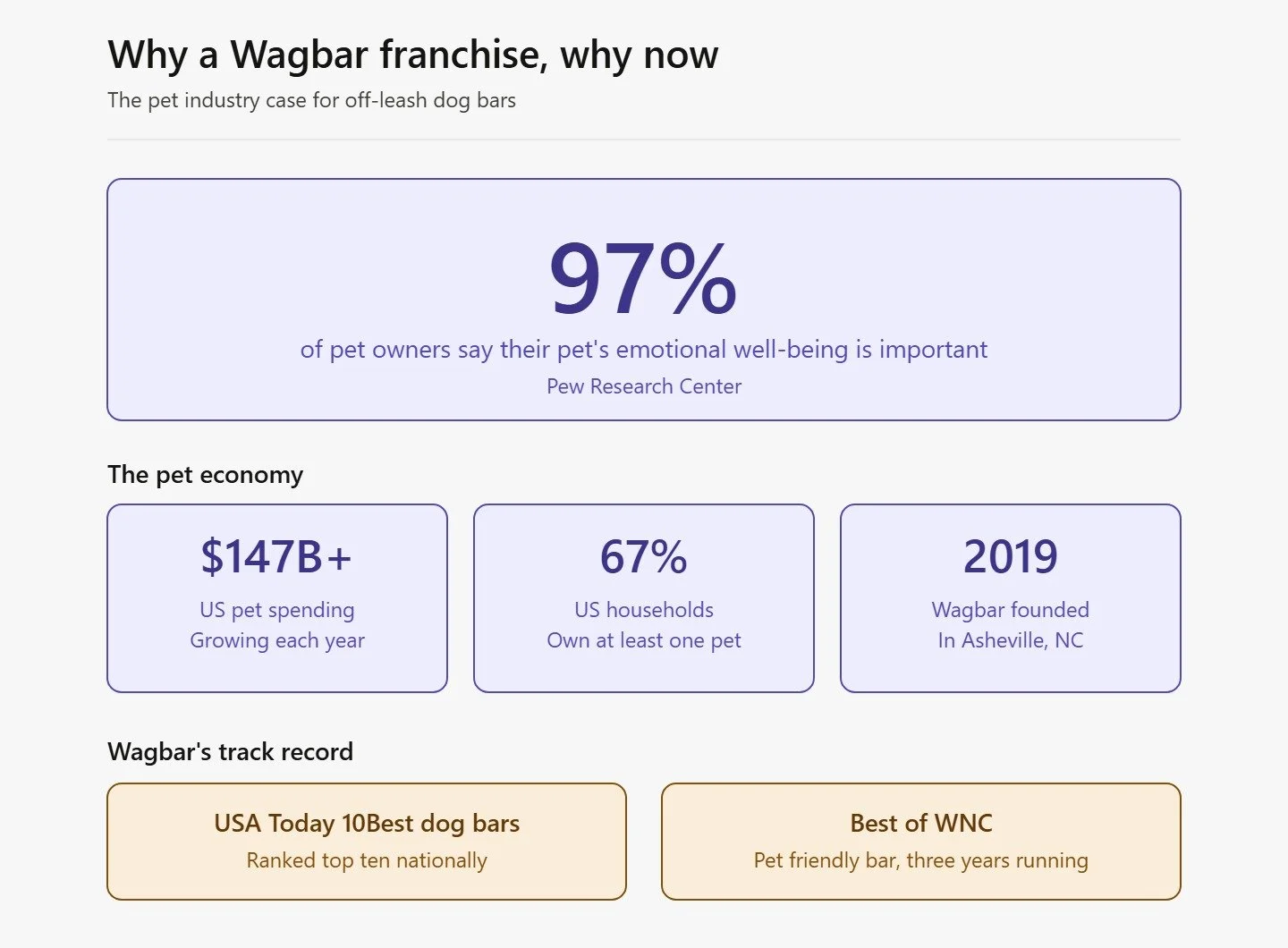
Top TLDR: The dog park bar industry operates inside a $147 billion U.S. pet market that has grown every year for three decades, with Bloomberg Intelligence projecting the global pet market reaches $500 billion by 2030. Dog park bars capture the fastest-growing segment of that market: experience-based spending by dog owners. Investors evaluating this category should request Wagbar's full financial disclosures to assess market availability.
The first time most people walk into a dog park bar, they say some version of the same thing: "Why did it take this long for someone to build this?"
That reaction isn't just good marketing fodder. It reflects something real about where the pet industry and the experience economy have been heading for years. Two massive, durable spending categories have been converging on the same idea: people want to spend time with their dogs in social settings, and they're willing to pay for it. The dog park bar didn't create that demand. It just finally answered it.
This report covers the market data behind the dog park bar industry, where it sits within broader pet and hospitality trends, what the growth trajectory looks like through 2030, and why the current moment represents an early entry point into a category that is still defining itself.
The Pet Industry Foundation: $147 Billion and Growing
Any analysis of the dog park bar market has to start with the broader pet industry, because that's the ocean this concept swims in.
American households spent $147 billion on their pets in 2023, according to the American Pet Products Association (APPA, 2023). That figure has increased every single year for more than three decades without exception. It grew through the 2001 recession. It grew through 2008. It grew through COVID. Pet spending is one of the most recession-resistant categories in consumer spending, which is a meaningful statement about the durability of this market.

Dog ownership accelerated sharply between 2019 and 2021, with the APPA reporting that the share of U.S. households owning a pet climbed to 70% by 2022, up from 67% before the pandemic. Many of those new dog owners have kept their animals. That's a lasting addition to the addressable market for dog-focused services and experiences.
The spending mix is shifting too. Historically, pet spending was dominated by food and veterinary care. That's still the bulk of the pie, but services and experiences have been the fastest-growing subcategory for several years. Pet owners aren't just buying products for their animals. They're buying experiences with them.
The Global Picture: Bloomberg Intelligence's $500B Projection
The U.S. numbers are significant, but the global trajectory is what frames the long-term investment thesis.
Bloomberg Intelligence has projected that the global pet care market will reach $500 billion by 2030 (Bloomberg Intelligence, 2023). That's roughly double the current size of the global pet market, driven by three forces: expanding pet ownership in Asia-Pacific and Latin America, increasing humanization of pets across all demographics, and the growth of premium and experience-based pet spending in mature markets like the U.S. and Western Europe.
For context, the global pet market was valued at approximately $246 billion in 2023 (Grand View Research, 2023). Getting to $500 billion by the end of the decade implies a compound annual growth rate (CAGR) of roughly 9–10%. That pace is consistent with the 6.8% CAGR the North American pet market has maintained over the prior decade, with acceleration expected as experience categories catch up to product categories in spending share.
The dog park bar concept is specifically positioned to capture the experiential portion of this growth. It's not competing for food budgets or veterinary dollars. It competes for the discretionary spending that pet owners are increasingly directing toward social, community, and lifestyle experiences with their animals.
The Experience Economy: Why This Timing Matters
The dog park bar doesn't exist in a vacuum. It emerged at the intersection of two trends that have been building simultaneously: the humanization of pets and the broader shift in consumer spending from products to experiences.
Harvard Business Review first named the "experience economy" as a distinct stage of economic development in 1998 (Pine & Gilmore, HBR, 1998). The underlying idea is that consumers, once their material needs are satisfied, shift spending toward experiences that create memories and social identity. That trend accelerated significantly among millennials, who are now the largest cohort of dog owners in the United States.
According to Eventbrite's research on millennial spending, 78% of millennials would choose to spend on an experience over a product given the same budget (Eventbrite, 2022). That preference directly benefits categories like dog park bars, where the value proposition is the experience itself, not a physical good you take home.
FSR Magazine and other hospitality industry publications have covered the rise of what they call "eatertainment" and "petertainment" venues as a distinct segment of the hospitality market. These are spaces designed around an activity or experience rather than a traditional food-and-beverage visit. Dog park bars fit squarely in this category. The beverage revenue supports the experience, but the experience is why people come and why they come back.
Where Dog Park Bars Fit: A Category Still Being Defined
One of the things that makes the dog park bar market both exciting and difficult to size precisely is that it's genuinely new. There's no decades-long established industry to benchmark against. The concept didn't exist as a franchise category five years ago.
What we can do is look at comparable categories to understand the growth pattern of a concept that solves a clear, unmet need at the right moment in market development.
Indoor trampoline parks are a useful parallel. The first large-format trampoline park opened in the U.S. in 2004. By 2014, there were approximately 400 facilities. By 2019, that had grown to more than 1,000 U.S. locations, and the global market had reached $1.6 billion (Grand View Research, 2020). The growth was rapid once the concept proved itself, because it filled a clear gap in the entertainment market.
Dog park bars are at roughly the same stage trampoline parks were in 2006 or 2007. The concept works. Early operators have proven the demand. The franchise infrastructure is being built. What comes next, in a market with 90+ million dogs in American households, is the expansion phase.
The Wagbar Data Point: Early Evidence From an Operating Concept
Most market projections for emerging categories are built on modeling and inference. With Wagbar, there's actual operating data from a real business that has run since 2019.
Wagbar's flagship location in Weaverville, North Carolina opened in November 2019, was built during COVID-19, and not only survived but built a loyal community that returns consistently. The location has been voted Best Pet Friendly Bar/Brewery at the Best of WNC Mountain Express awards multiple times and was named one of USA Today's 10 Best Dog Bars in the country. That's not a soft metric. That's consumer demand expressed through behavior and recognition.
The franchising program, which launched after several years of flagship operation, has already signed 16+ franchise agreements across markets including Charlotte, Richmond, Dallas, Los Angeles, Phoenix, Cincinnati, and more. Wagbar's expansion from a single Asheville-area location to a national franchise system happened faster than most hospitality concepts because the demand was already there. The business didn't have to educate customers on why they'd want this. They already wanted it.
Market Drivers Through 2030: What Sustains the Growth
Several forces are likely to sustain above-average growth in the dog park bar category through the end of the decade.
Dog ownership demographics skew toward high spenders. Millennials and Gen Z now represent the majority of new pet owners in the U.S. These cohorts are more likely to treat pets as family members, more likely to prioritize pet-focused social experiences, and more likely to pay premium prices for quality. According to the APPA, millennials spend more per pet annually than any prior generation.
Urban density increases the value proposition. Dog owners in cities and dense suburbs face a consistent problem: limited off-leash space, limited socialization opportunities for their dogs, and limited options for spending time with other dog owners in a social setting. A dog park bar franchise solves all three problems simultaneously. The denser the market, the stronger the unmet need.
The pet humanization trend has no natural ceiling. Pew Research found that 97% of pet owners consider their pet's emotional well-being to be important (Pew Research Center, 2023). When emotional well-being is a priority, spending on socialization, play, and experiences follows. Wagbar's membership model speaks directly to this: owners who want their dogs to have regular social engagement come back multiple times a week, not just occasionally.
Experience hospitality continues to outperform. The National Restaurant Association's 2024 State of the Industry report identified experience-driven venues as one of the strongest-performing segments of the bar and restaurant industry. After several years of inflationary pressure on consumer spending, people have become more selective but haven't stopped spending on experiences they value. Dog park bars combine two things that people consistently prioritize: time with their dogs and social connection with other people.
The Competitive Landscape: Wide Open at the Top
Unlike mature hospitality categories with dominant national chains, the dog park bar space has no incumbent that owns more than a handful of locations. That's both an opportunity and a signal about how early we are in the category's development.
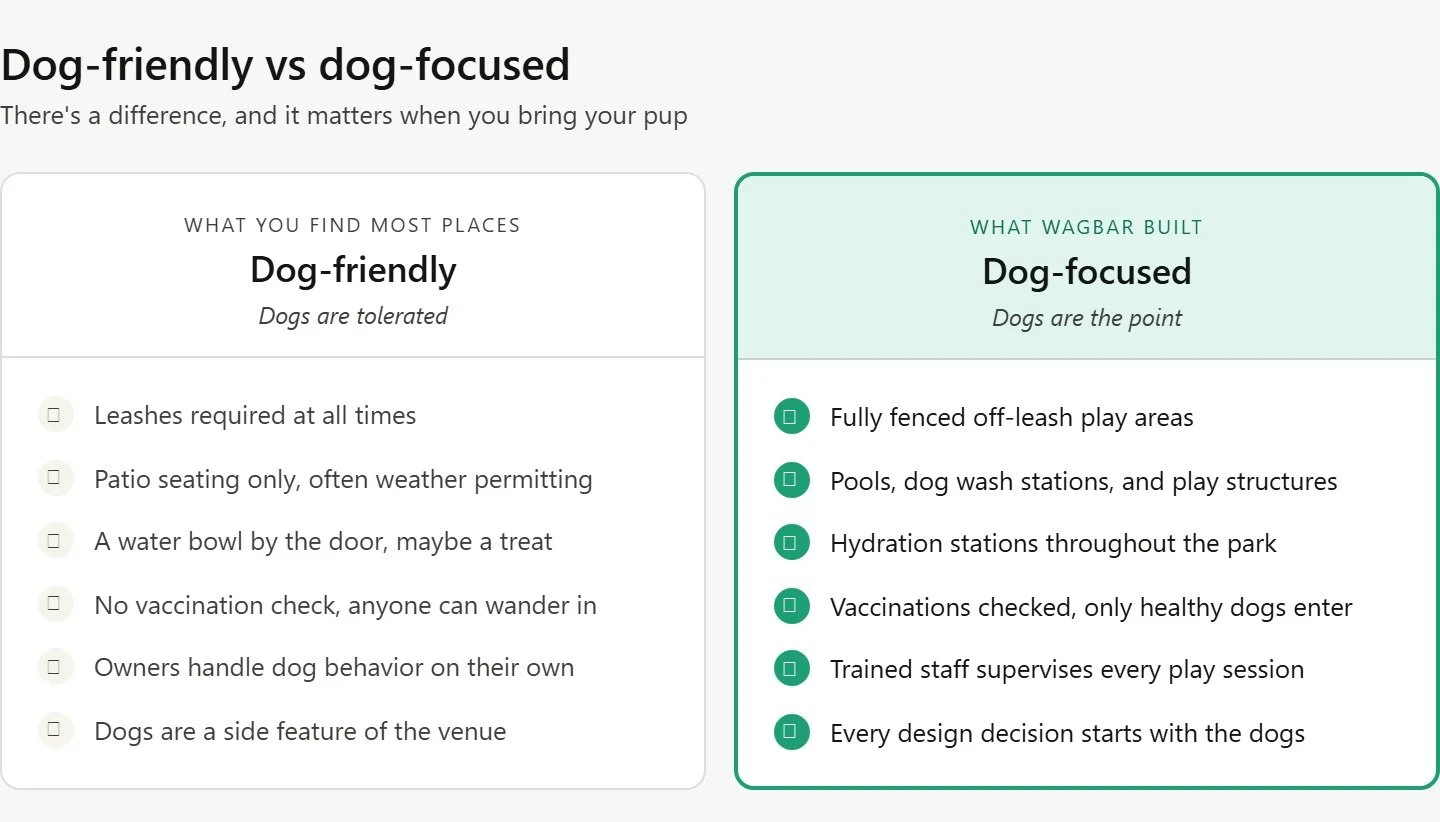
Wagbar is currently the most visible national franchise system in the dog park bar category, with locations operating and under development across the Southeast, Midwest, Southwest, and both coasts. The pet franchise industry has many established players in grooming, training, and veterinary services, but experience-based dog venues with a bar component remain sparsely populated at scale.
This creates the conditions for a concept that moves decisively to claim markets to build durable competitive advantages. First-mover benefits in the experience economy are real: a dog park bar that builds a loyal membership community in a given metro creates a social network effect that's difficult to replicate once established. The members become the marketing.
What This Means for Franchisees and Investors
The market data tells a consistent story: pet spending is large, durable, and shifting toward experiences. The experience economy is rewarding concepts that create genuine community rather than transactional visits. The dog park bar category is early enough that positioning now means entering a market before it's crowded, while late enough that the concept has been proven by actual operating businesses.
For anyone evaluating the off-leash dog bar franchise opportunity specifically, the investment decision isn't a bet on whether dog park bars will work. That's already been answered. The question is which markets still have the opportunity to be first, and what the right operator looks like for those markets.
Wagbar's expansion has consistently followed markets where the conditions for success already exist: communities with high dog ownership rates, strong outdoor and social culture, and demographics that skew toward the millennial and Gen Z dog owners driving category growth. Markets like Atlanta, Denver, Charleston, and Jacksonville all fit that profile, and they're all markets where Wagbar is actively recruiting franchisees.
The $500 billion global pet market projection for 2030 doesn't just represent an industry getting bigger. It represents a category of spending that is moving toward experiences, social connection, and premium services. The dog park bar sits directly in the path of that spending.
Frequently Asked Questions
How large is the dog park bar market?
The dog park bar market is an emerging category within the broader $147+ billion U.S. pet industry. As of 2025, there is no standardized market sizing for dog park bars specifically because the category is still in early development. Analysts and operators typically benchmark it against the experiential hospitality and pet services segments, both of which are growing at above-average rates. Bloomberg Intelligence's projection of a $500 billion global pet market by 2030 provides the broader demand context.
What is driving growth in the pet experience market?
The primary drivers are the humanization of pets (owners treating animals as family members), the generational shift toward experience spending over product spending, and the structural demand created by urban dog ownership. Millennials now represent the largest cohort of dog owners in the U.S. and spend more per pet annually than prior generations.
Is the dog park bar concept recession-resistant?
Pet spending has grown every year for more than 30 years without a single year of decline, including through major recessions. The experience component is more discretionary than food and veterinary spending, but the membership model used by concepts like Wagbar creates habitual, recurring visits that are more stable than one-off entertainment spending. The combination of a pet necessity (off-leash exercise and socialization) with an entertainment format provides more insulation than a pure entertainment concept would.
How many dog park bars are operating in the U.S.?
The category remains very early-stage. Independent dog park bars have opened in various markets, but there is no dominant national chain. Wagbar is the most active franchise system in the space, with an operating flagship in Weaverville, NC, a second open location in Knoxville, TN, and 16+ franchise agreements signed across the country.

What is the total initial investment to open a Wagbar franchise?
The initial investment ranges from $470,300 to $1,145,900, which includes the $50,000 franchise fee along with buildout, equipment, licensing, training, and pre-opening costs. Wagbar provides complete financial details to interested and qualified candidates through the formal franchise inquiry process.
Which markets are best suited for a dog park bar?
Markets with high dog ownership rates, strong millennial and Gen Z demographics, outdoor lifestyle culture, and limited existing off-leash social venues tend to perform best. Urban and dense suburban markets are particularly strong because dog owners in those settings have fewer alternatives for off-leash socialization. Wagbar currently has franchise development active in markets across the Southeast, mid-Atlantic, Midwest, Southwest, and both coasts.
Summary
The dog park bar industry sits at the convergence of a $147 billion U.S. pet market, a global pet economy projected to reach $500 billion by 2030, and a durable shift in consumer spending toward experiences over products. The category is early-stage, which means the competitive landscape remains wide open and first-mover advantages are still available in most U.S. markets. Wagbar's track record since 2019 provides real operating proof that the concept generates loyal, returning communities. For investors and franchisees, the combination of category growth, proven concept, and available markets makes this one of the more compelling moments in recent memory to evaluate a pet franchise opportunity. Contact the Wagbar franchising team for full financial disclosures and market availability.
Bottom TLDR: The dog park bar industry is positioned at the intersection of durable pet spending growth and the broader shift toward experience-based consumer habits, with a global pet market projected to reach $500 billion by 2030. Wagbar is the leading franchise system in this early-stage category, with operating locations and 16+ franchise agreements signed nationally. Franchisees entering now still have access to markets with no existing competition in the concept.