

Dog Daycare vs. Dog Bar Franchise: Complete Cost & Profitability Comparison
Top TLDR: Dog daycare vs. dog bar franchise comparison reveals distinct investment profiles with daycare requiring $150,000-$500,000 initial capital generating 15-20% profit margins on high-volume, low-price transactions, while dog bar franchises demand $470,000-$1.15 million investment producing 25-35% margins through premium membership model and ancillary beverage revenue creating superior unit economics. Customer lifetime value differs dramatically—daycare averages $3,600-$7,200 annually from daily drop-off customers paying $30-$45 per visit versus dog bar member CLV of $1,200-$2,400 annually from $45-$65 monthly memberships supplemented by food and beverage purchases adding $140-$260 per member yearly. Market saturation varies regionally with daycare facing intense competition in urban markets (12-20 facilities per 100,000 dog owners in major metros) while dog bar concept maintains first-mover advantages in most markets with limited direct competition. Prospective dog franchise investors should evaluate personal capital capacity, risk tolerance, operational preferences for high-volume daily operations versus social venue management, and local market conditions determining which model fits individual circumstances and maximizes return potential.
Understanding two distinct dog business models
The pet services industry offers diverse franchise opportunities serving different customer needs, operational models, and investment requirements. Dog daycare franchises provide essential care services for working pet owners needing reliable, safe supervision during business hours Monday through Friday, operating on high-volume, transaction-based models processing 30-80 dogs daily at $30-$45 per visit generating revenue through frequency and capacity utilization. Facilities typically operate 10-12 hours weekdays with limited weekend hours, requiring substantial square footage (5,000-10,000+ sq ft) accommodating multiple play groups segregated by size, temperament, and activity level under constant supervision by trained staff maintaining safety protocols.
Dog bar franchises create social venues where dogs play off-leash in monitored parks while owners relax at bars enjoying beverages, snacks, and community atmosphere. The membership-based model generates recurring revenue through monthly or annual subscriptions ($45-$65 monthly or $480-$720 annually) providing unlimited or frequent access, supplemented by day passes for occasional visitors and significant food and beverage sales creating multiple revenue streams within single customer experience. Operating hours extend into evenings and weekends capturing leisure time versus daycare's workday focus, with facilities requiring 5,000-8,000 sq ft combining outdoor fenced areas, indoor bar spaces, and seating accommodating 80-120 dogs simultaneously.
These fundamental operational differences create distinct cost structures, revenue patterns, profit potential, and scaling characteristics that investors must evaluate against personal goals, available capital, and market conditions. Neither model universally superior—optimal choice depends on individual circumstances including financial capacity, operational preferences, lifestyle goals, and competitive dynamics in target markets. Understanding tradeoffs enables informed decisions aligning business investments with entrepreneurial objectives rather than chasing generic "best franchise" recommendations ignoring personal fit and local opportunity.
Complete investment comparison analysis
Initial capital requirements
Investment Component Dog Daycare Franchise Dog Bar Franchise Franchise Fee $25,000-$50,000 $50,000 Real Estate/Buildout $80,000-$300,000 $180,000-$450,000 Equipment & Technology $30,000-$100,000 $85,000-$175,000 Initial Inventory $5,000-$15,000 $15,000-$35,000 Working Capital $10,000-$35,000 $80,000-$120,000 TOTAL INVESTMENT $150,000-$500,000 $470,000-$1,150,000
Dog daycare franchises require lower total investment primarily through reduced working capital needs and flexible facility options. Existing retail or warehouse spaces convert to daycare facilities with moderate renovations installing rubber flooring, fencing for separate play areas, ventilation systems, and basic amenities. Franchise fees vary from $25,000-$50,000 depending on brand recognition and support systems, with major national brands commanding premium fees while regional concepts offer lower entry costs. Equipment needs include limited technology (basic POS, webcam systems for parent monitoring), cleaning supplies and tools, dog toys and enrichment items, and minimal furniture for small reception areas.
Dog bar franchise costs exceed daycare investment by 200-230% driven by higher-quality facility requirements, comprehensive bar equipment and licensing, and substantial working capital reserves. Outdoor space requirements for off-leash dog parks limit available properties versus daycare's indoor focus allowing more location options, while bar components add significant costs including draft beer systems, refrigeration, point-of-sale technology, and liquor licensing fees ranging $1,500-$5,000 annually depending on state regulations. Working capital requirements of $80,000-$120,000 cover 6-month operational runway as membership-based model builds recurring revenue base more gradually than daycare's immediate transaction revenue.
Multi-unit discount structures benefit scaling operators in both models—daycare franchisors often reduce per-unit fees 25-40% for second and third locations, while Wagbar offers 50% franchise fee reduction on units 2+ for franchisees committing to 3+ locations. These discounts substantially reduce incremental unit costs for portfolio builders, with three-location daycare portfolios potentially costing $375,000-$1.2 million versus $540,000-$1.8 million without volume pricing, and three-location dog bar portfolios running $1.36-$3.32 million versus $1.41-$3.45 million at full franchise fee rates.
Financing considerations and accessibility
Lower investment requirements make daycare franchises more accessible to broader franchisee pool qualifying for financing with more modest net worth and liquid asset positions. SBA loans for pet franchises typically require net worth of 1.5-2x loan amount and liquid assets covering 20-30% of total investment—$300,000 daycare investment requires approximately $450,000-$600,000 net worth and $60,000-$90,000 liquid assets, achievable for middle-class professionals with home equity and retirement savings. By comparison, $700,000 dog bar investment demands $1.05-$1.4 million net worth and $140,000-$210,000 liquid assets excluding retirement accounts, restricting franchisee pool to higher-net-worth individuals or requiring partnership structures pooling capital.
Down payment requirements of 10-20% create $15,000-$100,000 equity injection for daycare versus $47,000-$230,000 for dog bars, representing significant absolute dollar difference though proportionally equivalent. Smaller absolute numbers enable more franchisees self-funding down payments through savings, while larger dog bar requirements often necessitate home equity loans, retirement account rollovers (ROBS), or investor partnerships introducing complexity and potentially diluting ownership stakes.
Debt service obligations differ substantially impacting cash flow during vulnerable startup phase. $300,000 SBA loan at 8.5% over 10 years creates $3,690 monthly payment, while $700,000 under same terms requires $8,610 monthly—$4,920 difference representing approximately 16-20 additional daycare visits or 8-10 dog bar memberships monthly. Higher fixed obligations increase break-even requirements and extend timeline to profitability, though potentially justified by superior profit potential once operational maturity achieved.
Profit margin analysis across models
Revenue composition and gross margins
Dog daycare revenue derives almost entirely from service fees with minimal ancillary income beyond occasional retail (collar, leash, toy sales) contributing 3-5% of total revenue. Gross margins on daycare services run 60-70% after direct labor costs (staff supervising dogs represents primary variable expense), though fixed overhead including rent, utilities, insurance, and management salaries consume substantial portions leaving 15-20% EBITDA margins typical for well-managed facilities. Revenue concentration creates vulnerability to service pricing competition and capacity constraints—once facility reaches maximum daily capacity of 60-80 dogs, revenue growth requires price increases (facing competitive resistance) or expanded facilities (requiring new capital investment).
Dog bar revenue streams diversify across membership fees (45-50% of revenue), day passes (20-25%), food and beverage sales (25-30%), retail merchandise (3-5%), and special events (5-8%) creating multiple profit centers with varying margin profiles. Membership revenue provides highest margins at 70-80% after payment processing fees and minimal direct costs, while F&B generates 70-75% gross margins (25-30% beverage costs typical for alcohol) and retail contributes 45-55% margins depending on product mix. Blended gross margins of 65-75% exceed daycare performance, while operating leverage from relatively fixed staff costs regardless of attendance levels (unlike daycare scaling labor with daily dog count) produces 25-35% EBITDA margins at mature operations.
This 10-15 percentage point EBITDA advantage translates to substantial absolute dollar differences at scale—$800,000 revenue daycare generating 18% EBITDA produces $144,000 annual profit, while dog bar at equivalent revenue achieving 28% EBITDA yields $224,000 profit, representing $80,000 or 56% superior profitability on same revenue base. However, dog bars face higher absolute investment requiring larger revenue base achieving equivalent return on investment metrics—$224,000 profit on $700,000 investment equals 32% ROI versus $144,000 on $300,000 producing 48% ROI despite lower absolute profits.

Operational efficiency and margin improvement opportunities
Daycare margin improvement focuses on capacity optimization and labor productivity. Maximizing daily dog count within licensed capacity limits (typically 1 staff per 10-15 dogs depending on state regulations) increases revenue without proportional cost increases, though practical capacity constraints from facility size, play group compatibility issues, and customer service expectations typically cap utilization at 70-85% of theoretical maximum. Premium service upsells including training sessions, grooming services, or private play time add higher-margin revenue, though require additional staff capabilities and potentially licensing.
Dog bars improve margins through F&B optimization and event revenue expansion. Beverage cost management through draft beer systems, volume purchasing, and strategic menu pricing protects gross margins, while craft beer selections and cocktail programs command premium pricing without proportional cost increases. Special events including birthday parties ($200-$400 per booking), training classes, and corporate functions leverage existing facilities during off-peak hours generating incremental high-margin revenue with minimal additional costs. Retail merchandise programs featuring branded items create passive income and marketing benefits as customers wearing Wagbar apparel provide free advertising.
Seasonal variations impact models differently—daycare experiences consistent year-round demand as work schedules remain stable regardless of season, providing predictable revenue streams simplifying financial planning. Dog bars demonstrate seasonal patterns with higher summer utilization (pleasant evening weather encourages outdoor social activities) and lower winter performance in cold climates, creating 20-30% revenue swings between peak and trough periods. However, geographic diversification mitigates seasonality as portfolio operators in multiple climates balance offsetting patterns.
Scaling potential and multi-unit economics
Path to multi-location portfolios

Daycare franchises support faster expansion timelines given lower per-unit investment and shorter construction periods. Converting existing retail spaces to daycare operations requires 8-12 weeks from lease signing to opening versus 14-20 weeks for dog bars involving outdoor space development, liquor licensing applications, and bar equipment installation. Operators achieving profitability at location one can potentially open location two within 12-18 months, with subsequent locations following at 9-12 month intervals as processes systematize and management teams develop. Five-location portfolios potentially achievable within 4-5 years for well-capitalized operators in strong markets versus 5-7 years for comparable dog bar portfolios.
Dog bar expansion proceeds more deliberately given higher per-unit capital requirements and longer development timelines. However, premium profit margins at mature locations generate stronger cash flow supporting debt service on subsequent locations—mature location producing $200,000-$280,000 annual EBITDA can support $1.2-$1.5 million debt if all cash flow directed toward expansion financing. Conservative operators reinvest first-location cash flow building capital reserves before unit two, while aggressive portfolio builders leverage location one performance securing financing for multiple subsequent locations simultaneously accepting higher risk for faster growth.
Portfolio operational efficiencies emerge through shared infrastructure including centralized accounting and administrative functions reducing per-location overhead, regional management supervising multiple locations at lower cost than individual general managers, bulk purchasing power reducing cost of goods across beverage, supplies, and equipment, standardized marketing creating regional brand recognition, and knowledge transfer accelerating new location ramp-up as lessons from established locations apply to startups. Three-location dog daycare operators often reduce administrative costs from 8-10% of revenue per location to 5-7% through centralization, while maintaining quality and service standards.
Market density and cannibalization concerns
Daycare markets support higher location density given essential service nature and customer convenience prioritization. Urban markets often sustain 12-20 daycare facilities per 100,000 dog owners, as 2-3 mile travel distances represent practical limits for daily drop-off and pickup routines. Operators can successfully deploy multiple locations within single metropolitan area with 5-7 mile separation without significant cannibalization, particularly if targeting distinct neighborhoods or demographic segments. However, market saturation concerns arise in mature metros where incumbent operators occupy prime locations and customer acquisition costs escalate as awareness advertising reaches diminishing returns.
Dog bar concepts maintain wider spacing requirements given discretionary nature and destination venue positioning. Most markets currently support 1-3 dog bar locations before saturation concerns emerge, as members willing to travel 10-15 miles for premium social experiences accepting longer distances than daily-necessity services. First movers establish significant advantages through brand recognition and community network effects as existing members recruit friends and neighbors creating self-reinforcing growth. However, limited market density restricts portfolio growth within single metro areas versus daycare models supporting 5-10 locations in major metropolitan regions.
Geographic expansion strategies differ accordingly—daycare portfolios concentrate in single metros achieving market leadership and operational efficiencies through proximity, while dog bar portfolios disperse across multiple metros (150+ miles apart) capturing first-mover advantages in different markets. This geographic distribution creates tradeoffs between operational complexity (managing distant locations) and market opportunity (avoiding cannibalization while capturing growth in multiple regions).
Customer lifetime value and revenue predictability
Membership economics versus transaction-based models
Dog bar membership models create superior customer lifetime value through recurring revenue and extended relationship duration. Average member tenure of 18-24 months at $45-$65 monthly dues generates $810-$1,560 membership revenue, supplemented by average $12-$22 per visit F&B spending across 12-18 monthly visits totaling $140-$260 additional annual revenue per member. Total annual customer value of $1,200-$2,400 multiplied by 18-24 month average tenure creates lifetime value of $1,800-$4,800 per customer relationship. Higher-touch service model and community building activities extend retention beyond typical gym membership patterns (8-12 months average), as social networks formed within venues and genuine attachment to familiar dogs create switching costs beyond purely economic calculations.
Daycare customers generate higher annual revenue—2-3 weekly visits at $30-$45 per visit creates $3,120-$7,020 annual spending, with premium frequent users visiting 4-5 times weekly spending $6,240-$11,700 annually. However, relationship duration often runs shorter at 12-18 months average as lifestyle changes (return to work-from-home arrangements, relocation, career changes affecting schedules) create volatility in customer base. Lifetime value calculations of $3,900-$10,550 appear superior to dog bar metrics, though higher customer concentration risk emerges as losing 3-5 high-frequency users materially impacts monthly revenue by $1,500-$4,900 versus losing equivalent number of dog bar members affecting revenue by only $405-$975.
Revenue predictability strongly favors membership models providing high-confidence forward revenue forecasting. Location with 500 active members at $50 average monthly dues forecasts $25,000 monthly membership revenue with 95% confidence (accounting for 5% monthly churn), enabling accurate expense budgeting and investment planning. Daycare transaction revenue fluctuates based on weather, holiday schedules, economic conditions, and competitive activities creating 15-25% month-to-month variance complicating financial planning. While higher average customer spending benefits daycare economics, revenue volatility creates management challenges and potentially higher working capital requirements maintaining buffers against unexpected soft periods.
Customer acquisition costs and retention strategies
Dog franchise customer acquisition costs vary dramatically between models—daycare typically spends $75-$150 per new customer through local advertising, Google Ads, and promotional discounts, with 60-90 day payback periods given high initial visit frequency. Marketing emphasizes convenience, safety, and professional care appealing to practical needs versus emotional benefits, with digital advertising and Google local search optimization driving majority of customer acquisition. Word-of-mouth referrals contribute 30-40% of new customers once facilities establish reputation, reducing blended acquisition costs for mature locations versus startups building initial customer base.
Dog bar customer acquisition runs $120-$200 per member through social media advertising, launch promotions, and community events, with 90-120 day payback periods accounting for slower visit frequency versus daycare. Marketing emphasizes experience, community, and lifestyle positioning through visual storytelling and user-generated content showcasing happy dogs and relaxed owners. Community events, partnerships with local pet retailers and veterinarians, and founding member programs create awareness and trial, with strong network effects as existing members invite friends to join social experiences. Member acquisition costs decline substantially once community critical mass achieved (300-400 members) as organic growth supplements paid advertising.
Retention strategies diverge according to business model characteristics. Daycare focuses on operational excellence and reliability given essential service positioning—consistent quality care, convenient hours, flexible scheduling, professional staff training, and rapid communication addressing concerns maintains high retention as switching costs emerge through established relationships and trusted care providers. However, lifestyle changes create involuntary churn beyond operational control as customers relocate, change jobs, or experience income disruptions forcing service elimination.
Dog bar retention leverages community building and membership benefits enhancement. Regular events, themed activities, breed-specific meetups, and social programming create engagement beyond basic facility access, while member recognition, loyalty rewards, and referral incentives encourage ongoing participation. Community formation represents critical retention driver as members develop friendships through venue, their dogs establish play relationships, and social calendar organizes around regular visits. These intangible benefits create powerful switching barriers as leaving venue means disrupting multiple relationship dimensions beyond simple service substitution.
Market saturation and competition analysis
Current competitive landscape assessment
Dog daycare markets demonstrate mature saturation in urban metros with 8-15 established facilities per 100,000 dog owners in cities like Seattle, Portland, San Francisco, and Boston. High density reflects both strong market demand and relatively low barriers to entry enabling numerous operators establishing presence over past 15-20 years as industry matured. Competitive intensity creates pricing pressure limiting premium pricing strategies, with most markets clustering around $30-$40 daily rates regardless of facility quality or brand differences. Differentiation challenges arise as core service attributes (safety, supervision, socialization) represent table stakes rather than competitive advantages, leaving minor service enhancements, convenience factors, or brand preferences driving customer selection among comparable options.
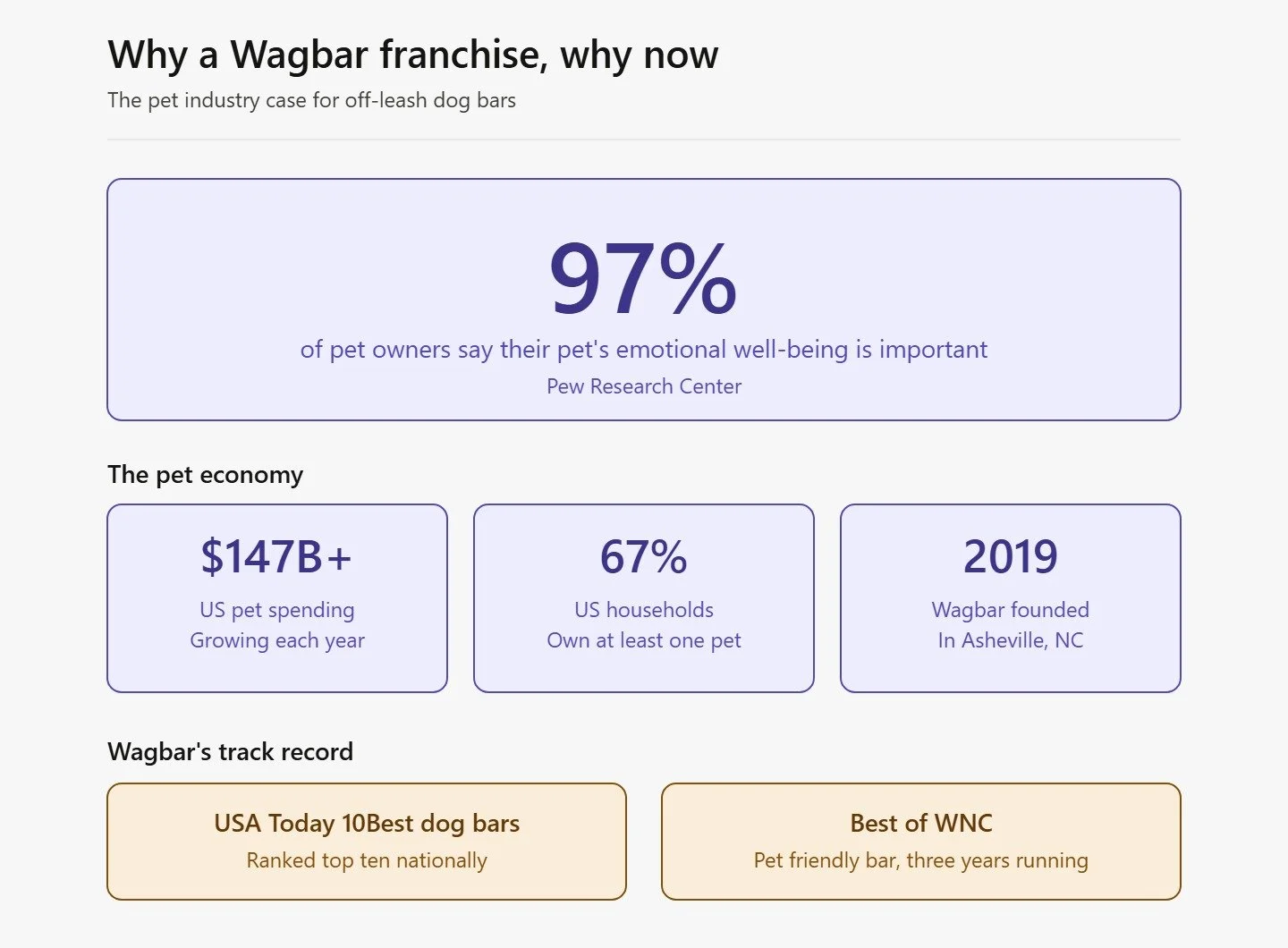
Dog bar concept maintains first-mover advantages in most U.S. markets with limited direct competition—fewer than 30 off-leash dog park bar facilities operate nationally despite 77 million pet dogs creating substantial addressable market. Wagbar pioneered concept in Asheville, North Carolina (2019), with franchise expansion establishing locations in 10+ cities and territories under development in additional markets. Limited competition creates market entry opportunities for entrepreneurs establishing category presence before competitors recognize opportunity, though concept requires customer education as novel experience versus familiar daycare positioning.
However, indirect competition exists through free public dog parks, dog-friendly restaurants and bars, traditional boarding kennels, and home-based pet sitting services collectively addressing dog socialization and owner leisure needs. Differentiating premium off-leash experience with integrated food and beverage against free alternatives requires marketing education emphasizing safety advantages (controlled entry, vaccination requirements, trained staff), community benefits (regular attendees forming relationships), and convenience (combined experience versus separate park and bar visits). Success requires convincing target customers that premium pricing ($15-$25 day passes or $45-$65 monthly memberships) delivers sufficient value over free alternatives justifying expenditure.
Barriers to entry and competitive moats
Daycare faces relatively low barriers to entry enabling new competition—suitable real estate, moderate capital investment ($150,000-$300,000 for independent operators), and basic licensing requirements (business license, facility inspections, minimal staff certifications in most states) allow entrepreneurs establishing operations within 6-9 months. Franchise affiliation provides brand recognition, operational systems, and training support accelerating timeline and potentially commanding premium pricing, though independent operators remain viable in most markets given local service nature and customer preferences for proximity over brand.
Dog bar barriers significantly exceed daycare through liquor licensing requirements (3-9 month approval process in many states), higher capital investment deterring casual entry, specialized facility requirements combining outdoor space and bar operations, operational complexity managing both alcohol service and animal supervision, and necessary insurance coverage costing $25,000-$45,000 annually versus $12,000-$20,000 for daycare. These obstacles create competitive moats protecting established operators, though also potentially limiting expansion pace as franchise system scales—each new location requires navigating complex regulatory landscape and substantial capital deployment creating inherent growth constraints.
Sustainable competitive advantages in both models derive from location quality, operational excellence, community network effects, and brand reputation rather than proprietary technology or protected intellectual property. Prime real estate with high visibility, convenient access, adequate parking, and appropriate surrounding demographics creates location-based moats difficult for competitors to replicate once secured. Operational excellence and reputation establish customer preferences resistant to price-based competition as pet owners prioritize trust and quality over cost savings when selecting care providers. Community network effects in membership-based dog bars create social switching costs as members risk losing established friendships, familiar dog relationships, and integrated social calendars by changing venues.
Bottom TLDR: Dog daycare vs. dog bar franchise comparison reveals daycare offering lower-barrier entry at $150,000-$500,000 investment with faster break-even (9-12 months) but limited scaling potential and 15-20% mature margins in saturated markets supporting 12-20 facilities per 100,000 dogs, while dog bars require $470,000-$1.15 million capital producing superior 25-35% margins with extended break-even (14-18 months) compensated by membership model creating $1,800-$4,800 customer lifetime value and first-mover advantages in undersaturated markets. Transaction-based daycare revenue volatility swings 15-25% monthly versus membership models providing 95% predictable forward revenue from 500-700 members generating $22,500-$45,500 monthly recurring base supplemented by F&B and event income, though daycare customers spending $3,120-$7,020 annually creates higher annual per-customer revenue than $1,200-$2,400 dog bar member spending. Multi-unit economics favor daycare expansion given lower per-location capital ($300,000-$400,000 incremental units after franchise fee discounts) and faster development timelines (8-12 weeks) enabling 4-5 location portfolios within 4-5 years, while dog bars require 5-7 years reaching comparable portfolio size despite superior per-location profitability funding subsequent expansion through reinvested cash flow. Optimal model selection depends on available capital (daycare accessible to broader franchisee pool with $60,000-$90,000 liquid assets versus $140,000-$210,000 dog bar requirements), operational preferences (high-volume daily transactions versus social venue management and alcohol service), risk tolerance (proven daycare model versus innovative dog bar concept), and local competitive dynamics where saturated daycare markets favor differentiated dog bar positioning capturing underserved experience-seeking pet owner segments willing to pay premiums for combined socialization and leisure activities.