

Complete Guide to Indoor Dog Park Franchising: Investment, Operations, and Success Strategies

Top TLDR: Complete guide to indoor dog park franchising reveals investment requirements of $235,000-$600,000 with realistic 12-24 month break-even timelines. Indoor facilities offer weather-proof year-round operation but face higher rent costs, HVAC challenges, and space limitations versus outdoor alternatives. Success requires minimum 3,000-4,000 square feet with proper ventilation, concrete flooring, and adequate parking. Mature facilities generate 15-30% profit margins with 300-500 members in medium markets. Evaluate franchise value carefully against independent operation costs before committing to either approach.
Indoor dog park franchising emerged as a weather-independent alternative to traditional outdoor facilities, promising year-round revenue and controlled environments. However, the reality of indoor operations differs substantially from the theoretical appeal. Space constraints, ventilation challenges, and customer expectations create complications outdoor models avoid. Understanding both advantages and limitations helps prospective franchisees make informed decisions about whether indoor, outdoor, or hybrid models best suit their market and goals.
This comprehensive guide examines the indoor dog park franchise model: operational requirements, space and location needs, equipment and safety considerations, marketing strategies, investment analysis, and real-world performance data. The guide also addresses why some franchise concepts choose outdoor or hybrid approaches despite indoor models' theoretical advantages.
According to IBISWorld, the pet care services industry generates $8+ billion annually with consistent growth. Indoor facilities represent a subset of this market with specific advantages and challenges requiring careful evaluation before investment.
Understanding the Indoor Dog Park Model
Indoor dog parks provide climate-controlled off-leash spaces for dogs to exercise and socialize year-round. The model appeals particularly to regions with extreme weather—harsh winters, intense summers, or extended rainy seasons limiting outdoor use.
Core Business Components
Play space: Enclosed area where dogs run off-leash. Size varies from 2,000 to 15,000+ square feet depending on market, budget, and building availability.
Membership or day-use model: Most facilities operate on monthly memberships providing unlimited access plus day-pass options for occasional visitors. This creates predictable recurring revenue.
Additional services: Many indoor parks add grooming, retail (toys, treats, supplies), training classes, or daycare services creating multiple revenue streams beyond basic play access.
Social component: Some models incorporate coffee bars or seating areas for owners. However, adding alcohol requires separate licensing and compliance with different regulations than pet-only facilities.
Indoor vs. Outdoor: The Trade-Offs
Indoor advantages:
Year-round operation regardless of weather
Climate control (heating/cooling)
Protected from rain, snow, extreme heat
Easier to control environment cleanliness
Potential for evening hours under artificial lighting
Indoor disadvantages:
Significantly higher rent per square foot than outdoor land
Substantial HVAC costs for climate control and odor management
Limited space relative to equivalent outdoor investment
Sound amplification (barking echoes in enclosed spaces)
Ventilation challenges managing smell and air quality
Building codes and zoning more restrictive
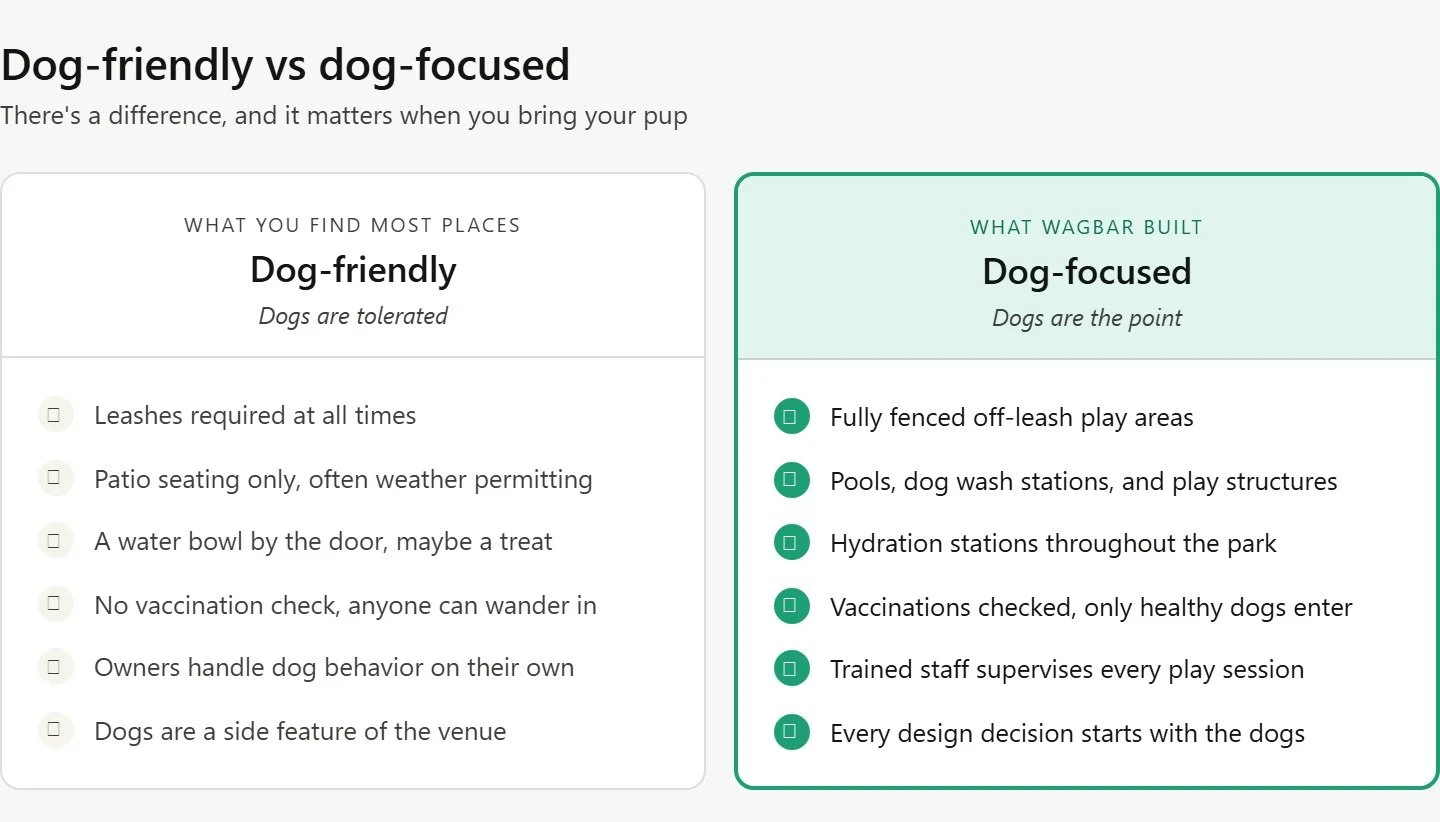
Why some franchises choose outdoor: Wagbar's model uses outdoor spaces specifically because dogs benefit from natural environments, outdoor spaces cost less per square foot allowing larger play areas, and the bar component works naturally with outdoor patio culture. Weather considerations are addressed through covered areas and seasonal operation adjustments rather than full indoor enclosure.
Space Requirements and Location Selection
Finding appropriate indoor space presents the first major challenge. Most commercial real estate wasn't designed for dozens of dogs running simultaneously.
Minimum Viable Space
Small market (populations under 100,000): Minimum 3,000-4,000 square feet dedicated play area. Less than this creates overcrowding problems quickly. Add 500-1,000 square feet for lobby/retail/office space.
Medium market (100,000-300,000 population): 5,000-8,000 square feet play area provides adequate capacity. Multiple separate areas by dog size recommended at this scale.
Large market (300,000+ population): 10,000-15,000+ square feet needed to serve demand adequately. Consider multiple smaller locations rather than single massive facility for better geographic coverage.
Building Requirements
High ceilings: Minimum 12-14 feet. Higher better for noise dissipation and air quality. Standard 9-10 foot commercial ceilings amplify noise unbearably.
Concrete flooring: Absolutely required. Carpet harbors bacteria and odors. Vinyl/laminate won't withstand claws. Epoxy coating over concrete provides cleanable, durable surface. Budget $3-$6 per square foot for proper epoxy application.
Drainage capability: Commercial-grade floor drains required for proper cleaning. Ideally sloped floor directing liquids toward drains. Retrofitting drainage into existing buildings costs $15,000-$40,000 depending on scope.
Separate ventilation zones: Play area needs independent HVAC from any retail/office spaces. Dog areas generate heat, humidity, and odors requiring different air handling than human-only spaces.
Loading/service access: Need to bring equipment, supplies, waste disposal in/out without traversing customer areas.
Parking: Minimum 15-20 spaces for small facility, 30-40 for medium, 50+ for large. Inadequate parking creates immediate customer frustration.
Location Analysis
Accessibility: Easy access from major roads without residential neighbors complaining about noise and traffic. Industrial/commercial zones ideal. Avoid residential areas where barking complaints cause problems.
Demographics: Target areas with households earning $60,000+ annually (discretionary income for pet services), dog ownership rates above 35%, and limited existing competition.
Visibility vs. rent trade-off: High-visibility locations (retail corridors) cost substantially more per square foot. Indoor parks can succeed in lower-visibility industrial areas since customers seek destination rather than impulse visit. Save $3-$8 per square foot monthly accepting reduced visibility.
Competition analysis: Identify existing dog parks (indoor and outdoor), dog daycares, and similar facilities within 15-minute drive time. Markets supporting multiple facilities demonstrate strong demand but also create price competition.
Zoning and Permits
Zoning compliance: Most municipalities classify dog parks as either "kennel" or "pet services" requiring specific zoning. Many areas prohibit these uses in retail zones. Confirm zoning before signing leases.
Business licensing: Standard business license plus pet-specific permits. Requirements vary dramatically by jurisdiction.
Health department approval: Some jurisdictions regulate dog facilities through health departments similar to food service. Others have no oversight. Confirm local requirements.
Noise ordinances: Indoor facilities reduce but don't eliminate noise concerns. Confirm compliance with local noise regulations, especially if neighbors share walls.
Building code compliance: ADA accessibility, egress requirements, fire safety systems. Indoor modifications often trigger building code reviews requiring updates to entire building, not just your space.
Equipment and Safety Considerations
Proper equipment differentiates professional operations from amateur attempts that fail within a year.
Essential Play Area Equipment
Flooring: Epoxy-coated concrete provides best durability-to-cost ratio. Rubber mat systems ($8-$15 per square foot installed) provide cushioning but harbor bacteria between seams. Artificial turf ($12-$25 per square foot installed) looks appealing but requires expensive replacement every 3-5 years and creates cleaning challenges.
Fencing/barriers: Commercial-grade panels separating small dog areas from large dog sections. Height minimum 4 feet for small dogs, 6 feet for large dogs. Chain link works but looks institutional. Powder-coated welded mesh provides cleaner aesthetic.
Play equipment: Agility obstacles, tunnels, platforms, ramps. Budget $5,000-$15,000 for quality equipment. Cheap consumer-grade equipment breaks rapidly under commercial use.
Waste management: Commercial waste stations every 800-1,000 square feet. Plan on 3-5 waste pickups daily with commercial service. Interior dog waste generates far more odor than outdoor equivalent.
Water stations: Automatic fill water bowls in multiple locations. Budget $150-$300 per station for commercial-grade units. Cheap bowls tip constantly creating slip hazards.
Seating for owners: Benches or chairs positioned for line-of-sight to dogs. Minimum 15-20 seats per 5,000 square feet of play area.
Environmental Control Systems
HVAC sizing: Standard commercial HVAC calculations don't account for dozens of dogs generating heat and humidity. Size systems 50-75% larger than standard calculations suggest. Undersized systems create miserably hot conditions.
Air filtration: Hospital-grade HEPA filtration recommended. Standard filters don't capture fine dander and odor particles. Budget $8,000-$15,000 for proper filtration system beyond basic HVAC.
Ventilation rates: Minimum 8-12 complete air exchanges hourly. More better. Stagnant air creates overwhelming odor problems. Each dog generates approximately 200-300 BTUs of heat.
Dehumidification: Dogs generate substantial humidity through panting and waste. Dehumidification system separate from AC often required. Budget $5,000-$12,000.
Odor control: Despite best efforts, indoor facilities develop persistent dog smell. Commercial-grade air purification systems help but don't eliminate. Factor this into customer experience expectations.
Safety Systems
Video surveillance: Camera coverage of entire play area. Allows staff monitoring from desk. Provides liability protection when incidents occur. Budget $3,000-$8,000 for 8-12 camera system with 30-day recording storage.
Emergency exits: Building code requires multiple exits. Indoor dog parks need exits controllable to prevent dog escapes while meeting egress requirements. Specialized door systems with double-gate entries.
First aid supplies: For both dogs and humans. Basic veterinary supplies including styptic powder, bandages, muzzles. Human first aid for slip/fall injuries.
Incident protocols: Written procedures for dog fights, injuries, medical emergencies. Staff training on execution. Liability protection requires documented processes actually followed.
Cleaning and Maintenance Equipment
Commercial floor scrubbers: $3,000-$8,000 for quality machine. Daily scrubbing required maintaining sanitary conditions.
Pressure washer: For deep cleaning. Budget $500-$1,500.
Disinfectants and cleaning chemicals: $300-$600 monthly for proper commercial-grade products effective against parvo, kennel cough, and other diseases.
Maintenance budget: Plan $1,000-$2,500 monthly for equipment repairs, filter replacements, and facility upkeep.
Marketing Strategies for Indoor Dog Parks
Marketing indoor facilities requires different approaches than outdoor dog park bars which benefit from visible outdoor activity and bar culture appeal.
Pre-Opening Marketing
Local dog community engagement: 3-6 months before opening, engage local dog groups on Facebook, Instagram, through trainers, veterinarians, groomers. Build awareness and waitlist for opening.
Grand opening promotion: Heavily discounted or free memberships for first 50-100 members creates instant community and word-of-mouth. Loss leader strategy that pays off long-term.
Partnerships with veterinarians: Veterinary offices refer clients regularly. Provide them information to share with patients.
Pet store partnerships: Local independent pet stores (not chains) often promote complementary businesses.
Digital Marketing
Google Business Profile optimization: Critical for local search. Most customers search "indoor dog park near me" or similar local queries. Optimize for these searches.
Social media content: Daily photos/videos of dogs playing. User-generated content from customers posting their dogs. Instagram and Facebook primary platforms.
Website essentials: Clear pricing, membership options, requirements (vaccinations, spay/neuter), hours, location, virtual tour. Mobile-optimized absolutely required.
Local SEO: Target neighborhood-specific searches. "Indoor dog park [neighborhood name]" "Dog park [zip code]"
Online reviews: Actively request reviews from satisfied customers. Respond to all reviews (positive and negative) professionally. Reviews critically influence decision-making.
Community Building
Member events: Monthly themed events (puppy socials, breed meetups, holiday events) create community beyond basic play access.
Loyalty programs: Referral bonuses, anniversary discounts, upgraded memberships rewarding long-term members.
Social media engagement: Highlight regular members' dogs, celebrate birthdays, share training tips. Create feeling of belonging not just service transaction.
Retention Marketing
Membership retention focus: Acquiring new members costs 5-7x more than retaining existing. Focus on keeping current members happy.
Regular communication: Monthly newsletters with tips, upcoming events, facility updates. Maintain visibility between visits.
Addressing concerns promptly: When members complain, resolve quickly and generously. Losing member costs months of dues.
Investment Overview and Financial Analysis
Understanding complete investment requirements and realistic revenue projections prevents costly mistakes.
Initial Investment Breakdown
Franchise fee (if franchising): $30,000-$60,000 for most dog park franchises. Pet franchise opportunities vary widely in fees and value provided.
Real estate:
Security deposit: 3-6 months rent
First month rent
Leasehold improvements: $75,000-$250,000 depending on building condition and required modifications
Equipment and fixtures:
Play equipment: $5,000-$15,000
Flooring: $15,000-$45,000 (epoxy coating)
Fencing/barriers: $8,000-$20,000
Furniture and fixtures: $5,000-$12,000
Point-of-sale system: $2,000-$5,000
Security cameras: $3,000-$8,000
HVAC and environmental:
HVAC system upgrade: $25,000-$75,000
Air filtration: $8,000-$15,000
Dehumidification: $5,000-$12,000
Professional services:
Architect/designer: $8,000-$20,000
Permits and fees: $3,000-$10,000
Legal fees: $3,000-$8,000
Insurance (first year): $5,000-$12,000
Operating capital: 6 months operating expenses: $40,000-$80,000
Total estimated investment: $235,000-$600,000 depending on market, size, and building condition.
Revenue Model
Monthly memberships: Most common model. Unlimited access for monthly fee.
Individual dog: $40-$80 monthly
Multiple dogs (same household): $65-$130 monthly
Premium memberships (extended hours, perks): $80-$150 monthly
Day passes: One-time visitors
Single visit: $12-$25 per dog
10-visit punch card: $100-$200
Additional revenue streams:
Retail (toys, treats, supplies): $2,000-$8,000 monthly
Grooming services: $3,000-$15,000 monthly (if offered)
Training classes: $2,000-$10,000 monthly
Birthday parties/private events: $500-$2,000 monthly
Daycare (if adding): $8,000-$30,000 monthly
Revenue Projections
Small facility (3,000-4,000 sq ft) mature operation:
Members: 150-250
Membership revenue: $9,000-$15,000 monthly
Day pass revenue: $1,500-$3,000 monthly
Additional services: $3,000-$8,000 monthly
Total monthly: $13,500-$26,000
Annual: $162,000-$312,000

Medium facility (5,000-8,000 sq ft) mature operation:
Members: 300-500
Membership revenue: $18,000-$32,000 monthly
Day pass revenue: $3,000-$6,000 monthly
Additional services: $6,000-$15,000 monthly
Total monthly: $27,000-$53,000
Annual: $324,000-$636,000
Operating Expenses
Fixed costs:
Rent: $5,000-$20,000 monthly (market dependent)
Insurance: $500-$1,200 monthly
Utilities (including HVAC): $1,200-$3,500 monthly
Software/systems: $200-$500 monthly
Professional services: $300-$800 monthly
Variable costs:
Staff wages: 30-45% of revenue
Cleaning supplies: $300-$800 monthly
Marketing: $500-$2,000 monthly
Equipment maintenance: $400-$1,000 monthly
Waste disposal: $200-$500 monthly
Retail inventory: Matches revenue
Typical profit margins: 15-30% EBITDA for well-run facilities after reaching maturity (12-24 months).
Break-Even Timeline
Optimistic scenario: Break-even month 8-12 with strong pre-opening marketing and immediate traction.
Realistic scenario: Break-even month 12-18 for most markets.
Challenging scenario: Break-even month 18-24+ if market saturated, competition fierce, or execution problems.
Plan for 18-24 months to profitability. Undercapitalization causes most failures.
Success Factors and Common Failure Points
Understanding what separates successful operations from failures helps prospective franchisees evaluate their capabilities honestly.
Critical Success Factors
Staff quality: Employees must genuinely love dogs and understand canine behavior and communication signals. Poor staff create safety incidents destroying business reputation rapidly.
Consistent enforcement: Dog park etiquette and safety rules must apply equally to all members. Playing favorites creates resentment and safety issues.
Cleanliness obsession: Indoor facilities fighting persistent odor perceptions. Spotless cleaning standards required maintaining positive reputation.
Community building: Successful facilities create belonging not just service. Members become advocates recruiting friends organically.
Location accessibility: Convenient access from target demographics. Inconvenient locations struggle regardless of quality.
Common Failure Points
Undercapitalization: Running out of money before reaching profitability. Most common cause of failure. Need 18-24 months operating capital.
Poor location selection: Wrong demographics, difficult access, or zoning problems. Can't overcome bad location with good operations.
Inadequate HVAC: Undersized or poorly designed climate control creates unbearable conditions. Expensive to fix after opening.
Weak safety protocols: Single serious injury lawsuit can destroy business. Insurance helps but reputation damage often fatal.
Ignoring maintenance: Deferred maintenance creates accumulating problems. Equipment failures, facility deterioration, safety hazards.
Competition miscalculation: Market won't support unlimited facilities. Saturated markets force price wars destroying profitability.
Indoor vs. Outdoor vs. Hybrid Models: Choosing Your Approach
The "best" model depends on climate, market, budget, and goals.
When Indoor Makes Sense
Extreme climates (very hot summers, harsh winters, excessive rain)
Urban markets with limited land availability
Higher-income demographics willing to pay premium prices
Year-round consistency more important than maximum space
When Outdoor Works Better
Moderate climates allowing year-round outdoor use
Lower real estate costs enabling larger play areas
Customers prioritizing natural environment over climate control
Hybrid Approach Advantages
Some facilities use outdoor primary space with indoor backup area. Combines advantages while mitigating disadvantages. Requires more total space and investment but provides maximum flexibility.
Real-World Performance Data
Industry performance data helps calibrate expectations versus marketing hype.
Membership Retention Rates
Excellent facilities: 75-85% annual retention. Members stay active for years.
Average facilities: 60-70% annual retention. Constant member churn requires aggressive acquisition.
Poor facilities: 40-50% annual retention. Struggle to grow because losses offset new members.
Small improvements in retention dramatically affect profitability because acquisition costs are high.
Actual vs. Projected Timeline
Franchise marketing claims: Break-even in 6-12 months.
Reality for most: 12-24 months to break-even, 24-36 months to meaningful profitability.
Gap between marketing and reality causes financial stress for undercapitalized franchisees.
Market Saturation Dynamics
Markets typically support one facility per 75,000-100,000 population. Additional facilities possible but usually requires differentiation (premium positioning, unique services, superior locations).
Making the Franchise Decision
Indoor dog park franchising requires substantial capital, operational expertise, and realistic expectations.
Franchising vs. Independent
Franchise advantages:
Established brand recognition (if quality franchisor)
Proven operational playbook
Training and ongoing support
Vendor relationships and purchasing power
Franchise disadvantages:
Franchise fees ($30K-$60K+)
Ongoing royalties (5-8% of revenue)
Less operational flexibility
Franchisor quality varies dramatically
Independent advantages:
No franchise fees or royalties
Complete operational control
Keep all profits
Adapt quickly to market needs
Independent disadvantages:
Build systems from scratch
No brand recognition initially
Solve every problem independently
Longer ramp-up to profitability
Is This Right for You?
This business suits people who:
Genuinely love dogs and understand behavior
Have 18-24 months operating capital available
Can work evenings/weekends (peak hours)
Tolerate mess, noise, and chaos calmly
Enjoy community building and service
Can enforce rules consistently without favoritism
This business does NOT suit people who:
View it purely as financial investment
Can't handle animals or mess
Lack patience for operational details
Need immediate profitability
Struggle with customer service
Undercapitalized hoping for quick returns
Case Studies: Real-World Indoor Dog Park Performance
Examining actual facility performance provides realistic expectations beyond franchise marketing materials.
Case Study 1: Suburban Success (Medium Market)
Market: Suburb of 180,000 population, affluent demographics, harsh winters
Facility: 6,500 square feet, industrial location, opened 2022
Investment: $385,000 total
Leasehold improvements: $185,000
Equipment: $62,000
Working capital: $75,000
Franchise fee: $45,000
Other: $18,000
Performance timeline:
Month 6: 85 members, $6,800 monthly revenue
Month 12: 185 members, $14,200 monthly revenue
Month 18: 310 members, $23,500 monthly revenue (break-even achieved)
Month 24: 375 members, $28,900 monthly revenue
Month 36: 420 members, $32,400 monthly revenue
Current operation (year 3):
Monthly revenue: $32,400
Operating expenses: $22,100
Monthly profit: $10,300 ($123,600 annually)
ROI: 32% annually on initial investment
Success factors: Strong demographics, limited competition, excellent staff hired from start, owner actively involved daily first two years.
Challenges overcome: Initial HVAC undersizing required $28,000 upgrade at month 9. Marketing took 6 months to gain traction. Competition from outdoor park 15 minutes away required differentiation through superior cleanliness and customer service.
Case Study 2: Urban Struggle (Large Market)
Market: Major city 850,000 population, dense urban core
Facility: 4,200 square feet, retail district location, opened 2021
Investment: $525,000 total
Leasehold improvements: $245,000 (extensive building code work required)
Equipment: $72,000
Working capital: $110,000
Franchise fee: $50,000
Other: $48,000
Performance timeline:
Month 6: 95 members, $7,200 monthly revenue
Month 12: 165 members, $12,800 monthly revenue
Month 18: 205 members, $16,100 monthly revenue
Month 24: 220 members, $17,400 monthly revenue (still not break-even)
Month 30: Business sold at loss
Failure analysis:
Rent $8,500 monthly (too high for facility size)
Parking inadequate (street parking only)
Three competitors opened within 18 months
Owner absentee (hired manager immediately)
Staff turnover created inconsistent customer experience
Lessons: Premium rent location doesn't guarantee success. Absentee ownership rarely works in customer service businesses. Market saturation happens quickly in attractive markets.
Case Study 3: Small Town Winner
Market: College town 65,000 population plus university
Facility: 3,800 square feet, warehouse district, opened 2023
Investment: $245,000 total
Leasehold improvements: $95,000
Equipment: $38,000
Working capital: $50,000
No franchise fee (independent)
Other: $12,000
Performance timeline:
Month 6: 115 members, $8,100 monthly revenue
Month 12: 225 members, $15,800 monthly revenue (break-even achieved)
Month 18: 285 members, $19,400 monthly revenue
Month 24: 310 members, $21,200 monthly revenue
Current operation (year 2):
Monthly revenue: $21,200
Operating expenses: $13,800
Monthly profit: $7,400 ($88,800 annually)
ROI: 36% annually on initial investment
Success factors: Zero competition in market. Moderate rent ($3,200 monthly). University population cycles created challenge but also opportunity (student memberships, alumni returning). Owner with prior dog daycare experience understood operations.
Unique approach: Added university discounts attracting graduate students and faculty. Partnered with veterinary school for behavioral assessments and training workshops creating credibility.
Operational Best Practices for Indoor Facilities
Day-to-day operations determine long-term success more than grand opening excitement.
Staffing Requirements and Training
Minimum staffing: One staff per 15-20 dogs. Never operate with fewer than two staff present (safety and liability).
Staff characteristics needed:
Genuine love for dogs (can't be faked)
Calm under pressure
Physical fitness (breaking up fights, cleaning)
Customer service skills
Reliable (this business requires weekend/evening work)
Training essentials:
Fight breaking techniques
Emergency protocols (medical, evacuation, severe weather)
Customer service standards
Cleaning protocols and disease prevention
Membership system operation
Compensation: Pay above minimum wage attracting quality candidates. High turnover costs more than higher wages through training time, customer relationship disruption, and quality inconsistency.
Schedule management: Peak times weekday evenings (5-8 PM) and weekend mornings/afternoons (9 AM-3 PM). Staff accordingly. Off-peak requires minimum coverage only.
Daily Operational Routines
Opening procedures (30-45 minutes before first customers):
Facility walkthrough checking for hazards
Equipment functionality check
Temperature/climate control verification
Computer systems and camera check
Waste stations supplied
Water bowls filled and clean

Throughout operating hours:
Active dog monitoring (not sitting on phone)
Waste pickup every 45-60 minutes minimum
Water bowl refilling/cleaning
Incident logging (even minor)
Customer check-ins
Handling behavioral issues immediately
Closing procedures (30-45 minutes after last customers):
Complete floor cleaning (sweep and scrub)
Equipment sanitization
Waste removal
Climate control adjusted for unoccupied hours
Security system activation
Next day prep
Health and Safety Protocols
Vaccination requirements: Rabies, DHPP (distemper), Bordetella (kennel cough), Canine Influenza recommended. Verify records before first visit.
Entry screening: Visual health check at each visit. Refuse entry for coughing dogs, limping dogs, dogs with injuries/open wounds, or obviously ill dogs. Better to lose one visit fee than spread disease to entire facility.
Spay/neuter requirement: Dogs over 7 months must be altered. Un-altered dogs create behavioral problems and increase fighting.
Age restrictions: Minimum age 4-6 months (after vaccination series complete). Maximum age none, but frail seniors need supervision in separate area.
Incident response: Written protocols for fights, injuries, aggressive dogs, medical emergencies, and customer disputes. Train all staff. Document everything.
Disease outbreak protocols: If infectious disease suspected (multiple dogs showing symptoms), close facility temporarily, deep clean entire space, notify all members, determine exposure risk.
Financial Management
Key metrics to track daily:
New member sign-ups
Cancellations
Daily attendance (members and day pass)
Retail sales
Incident reports
Weekly review:
Revenue vs. projections
Expense variances
Staff hours vs. attendance
Customer feedback trends
Monthly analysis:
Member retention rate
Customer acquisition cost
Average revenue per member
Profit margins by revenue stream
Marketing ROI
Quarterly planning:
Marketing campaign adjustments
Pricing strategy review
Equipment replacement budgeting
Staff training updates
Hybrid Model Considerations
Some operators combine indoor and outdoor spaces creating weather flexibility.
Hybrid Facility Design
Indoor component: 2,000-3,000 square feet climate-controlled backup space for extreme weather.
Outdoor component: 5,000-8,000+ square feet primary play area with covered sections.
Combined advantages:
Lower per-square-foot costs (outdoor space cheaper)
More total space for same investment
Natural environment dogs prefer
Weather backup when needed
Can add bar/restaurant component outdoors
Combined challenges:
More total space to maintain
Staff monitoring both areas simultaneously
Customer expectations (outdoor preference creates indoor underutilization)
Higher total facility costs
When Hybrid Makes Sense
Climate patterns: Regions with seasonal extremes but not year-round harsh weather. Use outdoor spring/summer/fall, indoor during winter or extreme heat/rain.
Market positioning: Premium pricing justified by superior space and flexibility versus indoor-only competitors.
Bar integration: Outdoor bar/restaurant components work naturally with hybrid model. Indoor-only facilities face complications adding alcohol service.
Franchise Comparison Considerations
Not all dog park franchises offer equal value. Evaluate carefully before committing.
Franchise Evaluation Criteria
Brand strength: Does brand recognition exist in your target market? Unknown brands provide little value over independent operation.
Support quality: Initial training comprehensiveness, ongoing support responsiveness, operations manual completeness, technology systems quality.
Territory protection: Exclusive territory preventing franchisor from opening competing locations nearby? Territory size adequate for viable business?
Financial terms: Franchise fee reasonable for value provided? Royalty structure sustainable at projected revenue levels? Required purchases from franchisor priced competitively?
Franchisee satisfaction: Talk to existing franchisees. Ask about franchisor responsiveness, support quality, hidden costs, whether they'd buy franchise again knowing what they know now.
Litigation history: Research franchisor legal disputes. Pattern of franchisee lawsuits indicates problems.
Questions to Ask Franchisors
How many franchises operating currently?
How many have closed in past 3 years?
Average timeline to profitability for existing franchisees?
What percentage of franchisees achieve projections?
What support provided beyond initial training?
References from franchisees in similar markets?
Total investment range actual franchisees experienced?
Any required vendor relationships or purchasing obligations?
Independent vs. Franchise: Making the Choice
Choose franchise if:
Lacking industry experience
Value brand recognition
Prefer structured systems
Want ongoing support
Can afford fees while maintaining profitability
Choose independent if:
Have relevant experience
Want maximum profitability (no royalties)
Prefer operational flexibility
Can develop systems independently
Franchisor options don't provide sufficient value
The Path Forward
Indoor dog park franchising offers legitimate opportunities in appropriate markets with proper execution. It also creates substantial risks for undercapitalized or poorly-located operations.
Success requires realistic expectations, adequate capital, genuine passion for dogs, and willingness to execute operational details consistently. The businesses that thrive build genuine communities around shared love of dogs rather than treating it as purely financial transaction.
Alternative models like outdoor facilities or hybrid approaches may better suit certain markets and operators. Evaluate all options honestly against your specific situation before committing to any model.