

Brand Recognition vs. Local Identity: How Franchise and Independent Dog Bars Compete Differently
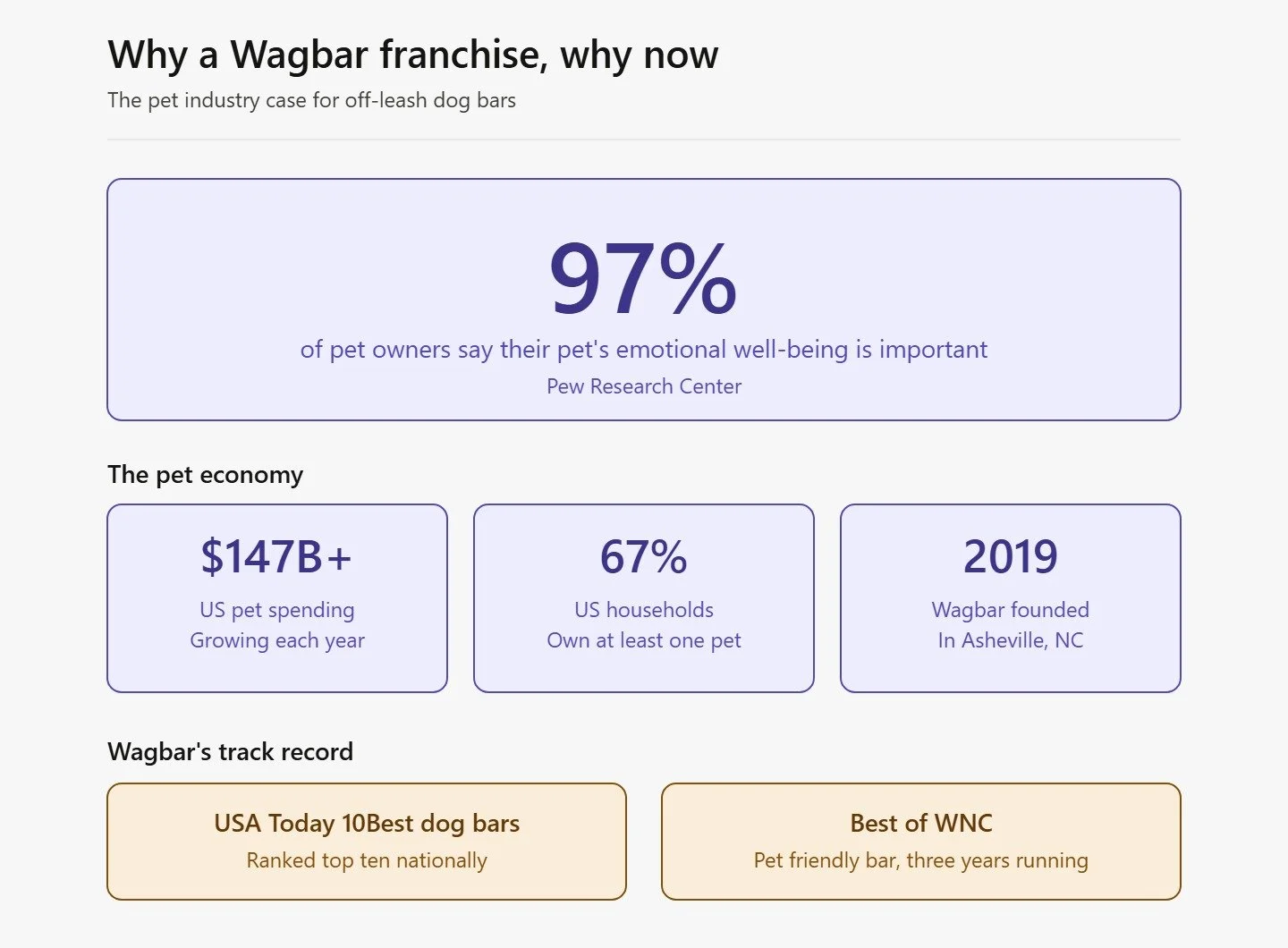
Top TLDR: Brand recognition and local identity are the two ways franchise and independent dog bars compete for members. Franchise brand recognition solves the stranger problem at opening — customers arrive with a framework before their first visit. Local identity builds the loyalty brand recognition alone cannot sustain. The best locations use both, regardless of whether they operate under a franchise flag or a locally invented name.
Walk into a Wagbar in Richmond, Virginia and walk into one in Knoxville, Tennessee, and you'll recognize it. The concept is familiar, the entry requirements are the same, and the core experience — dogs running off-leash while people relax at the bar — is consistent. Walk into an independent dog bar in Austin or Raleigh that someone built from scratch, and what you find is entirely shaped by the person who built it.
Neither model is trying to compete with the other the same way. They're playing different games. Understanding how brand recognition and local identity function as competitive assets — and how each type of business uses them differently — matters whether you're an owner deciding which path to take or a customer choosing where to bring your dog.
What Brand Recognition Actually Does for a Franchise
Brand recognition is not just about being known. It solves a specific problem that every new business faces: the stranger problem. When a business has no track record in a market, every potential customer has to decide whether to try it without any basis for doing so. They don't know if it's safe for their dog. They don't know if it's worth the membership fee. They don't know if the experience is any good.
Brand recognition short-circuits that problem. A customer who has heard about Wagbar — from media coverage, from a friend in another city, from reading about the concept online — arrives with a framework. They understand what they're walking into. The off-leash model is familiar. The vaccination entry requirements make sense. The concept has been validated by others before they ever visit.

This head start is most valuable in the first year of operations, when memberships are being built and the local community is still deciding whether this is a place worth becoming a regular. A franchise location with established brand recognition enrolls its early members more efficiently than an independent concept that has to explain itself before it can sell anything.
For prospective franchisees evaluating what a dog bar franchise opportunity actually includes, brand recognition is a genuine asset — not a line item you can quantify exactly, but one that affects how fast the business reaches sustainable membership levels.
What Local Identity Does for an Independent Dog Bar
An independent dog bar has no inherited brand recognition. What it has — or can build — is something arguably more powerful in a specific market: genuine local identity.
Local identity means the business exists as a character in the neighborhood's story, not as an outpost of a national brand. The name might reference a local landmark, neighborhood, or inside joke that only people from that city understand. The design choices reflect the owner's specific aesthetic and the culture of the community. The events calendar is built around what that particular group of dog owners actually wants to do on a Tuesday evening.
People support businesses that feel like theirs. When a truly local independent concept builds a strong identity — one that's woven into the neighborhood, that regulars describe as part of the community rather than as a service they use — it creates the kind of loyalty that is genuinely difficult for a franchise to replicate.
This is especially true in markets with strong independent business cultures. Cities where people actively seek out local alternatives over chains, where "I found this great local place" is a social currency, are markets where an independent dog bar with a compelling identity can build a durable advantage over a franchise brand that arrived from outside.
The community dynamics that drive dog bar loyalty apply to both models — but the independent has the option to build an identity that is inseparable from its specific place in a way a franchise never can.
Where Franchise Brand Recognition Has Limits
A national or regional brand name generates awareness, but awareness doesn't automatically convert to community feeling. The regulars who make a dog park bar successful are not primarily loyal to the brand — they're loyal to the experience, the staff, the other dogs they've come to know, and the place itself. The brand gets them through the door. The local experience keeps them coming back.
This is why franchise execution matters so much. A franchise location that operates well — that builds genuine relationships with its members, runs events people actually want to attend, and maintains the safe and welcoming environment the brand promises — will develop the same kind of local loyalty that a successful independent builds. The brand provides the initial credibility. The owner builds what makes people stay.
A franchise location that coasts on brand recognition without investing in the local experience learns quickly that the brand alone isn't enough. Members who feel like they're visiting an interchangeable corporate concept, rather than a place that knows them and their dog, eventually find somewhere else to go.
This is something every Wagbar franchisee navigates. The brand opens doors. The community that forms around each location is shaped by the owner's choices about how to run it, what events to host, and how present they are in the day-to-day.
Where Local Identity Has Limits
Local identity creates fierce loyalty — among the people who have it. Building it takes longer than leveraging an established brand, and until it's established, an independent concept has a customer acquisition problem that every new member enrollment makes harder or easier.
An independent dog bar entering a market where no one knows the concept faces a dual challenge: explaining what it is and convincing people to try it. A franchise location has already solved the first part. The second part — getting people to actually visit — is shared, but starts from a better position when the brand is known.
Local identity also doesn't transfer. An independent dog bar that builds a beloved community presence in one city has nothing to carry into a second market. Everything starts from zero. For owners with regional ambitions, the independent path requires building that identity work twice, three times, as many times as they expand — without any of the compounding effect that a franchise network produces.
There's also the question of what happens when the owner leaves or sells. A strong independent local identity is often inseparable from the founder. When the founder exits, some of what made the place feel local may go with them. A franchise location's identity is more portable because it's rooted in a documented system rather than a single person's presence.
The Middle Path: How Franchise Locations Build Local Identity Within Brand Standards
The most successful franchise dog bar locations don't choose between brand recognition and local identity. They use brand recognition to get started and build genuine local identity through how they run the business day to day.
This isn't about bending brand standards. It's about what the brand standards don't prescribe. The events calendar, the staff culture, the way members are welcomed, the local causes the business participates in, the relationships between staff and the regulars who come every weekend — none of that is determined by the franchise agreement. Those are the choices the owner makes, and they're the choices that determine whether a franchise location feels like a local institution or just another outpost of a concept.

Wagbar franchisees bring their own backgrounds and values to this work. AJ Sanborn comes to Richmond with 20 years of financial services and a genuine love for animals — his version of the Wagbar community will reflect who he is and what he values in a business. Liz and Shelby arrive in Knoxville with deep roots in animal rescue and community leadership — the Knoxville location will carry that identity. These aren't interchangeable operators. They're people building real places in real communities who happen to be operating under a shared brand.
The experiences of Wagbar's expanding franchisee network reflect this pattern: each location is Wagbar in the sense that the concept, safety standards, and membership model are consistent. Each location is also somewhere specific, built by someone specific, for a community that deserves to feel like the place was made for them.
How Customers Choose: What Actually Drives Membership Decisions
Understanding how franchise brand recognition and local identity function as competitive tools requires understanding what actually drives a dog owner's membership decision.
The decision to join a dog park bar as a paying member is primarily driven by: proximity, the dog's experience, the community feel, and confidence that the environment is safe. Brand recognition affects primarily the last item — it provides initial confidence before a first visit. Everything else is determined by the location itself.
After the first visit, the decision to keep coming back is driven almost entirely by local factors. Is the dog happy here? Are the people welcoming? Does the owner or staff seem to genuinely care about the experience? Is there a community building around this place? These questions have nothing to do with whether the sign says Wagbar or a locally invented name.
This is good news for both models. The franchise location that competes on brand recognition alone will eventually run out of new customers to convert on that basis. The one that builds a community is building something that renews itself. The independent location that is still explaining its concept at month twelve has a marketing problem, not a quality problem. The one that has become the place where people in that neighborhood feel at home has solved the only problem that actually matters long-term.
The dynamics of off-leash dog park communities are consistent regardless of brand structure: people come for the dogs, stay for the people, and remain loyal to the place that made both feel possible.
Frequently Asked Questions
Can a franchise location ever feel as local as an independent dog bar?
Yes. Local identity is built through choices about staffing, events, community participation, and relationships — not through whether the business is franchised. A franchise location run by an owner who is genuinely present in their community and invests in the local identity of their location can feel deeply local. The brand sets the framework; the owner shapes what lives inside it.
Does brand recognition help or hurt in markets with strong independent business cultures?
It can create slight friction in markets where consumers actively prefer local over national brands. Most franchise operators in those markets address this by being deliberately present in the local community, participating in local events, and letting the local character of the location speak louder than the national brand name. The community-building strategies that drive customer loyalty work regardless of brand structure.
Does an independent dog bar have a competitive advantage over a franchise in the same market?
In the long run, neither model has a structural advantage. The competitive outcome is determined by execution — which location does the better job creating a safe, welcoming, community-driven experience for dogs and their owners. An independent with a compelling local identity and a loyal following can hold its own against a franchise brand. A well-run franchise location will outperform a poorly run independent regardless of name recognition.
How long does it take for a franchise location to develop its own local identity?
The timeline varies, but most franchise locations in categories like this develop meaningful local identity within 12 to 24 months of consistent, community-focused operation. The first year is typically about converting brand awareness into trial visits and initial members. The second year is when those members become evangelists and the location's specific identity begins to consolidate.
Do Wagbar locations compete with each other in the same region?
Franchise territory agreements are designed to prevent direct overlap between locations. Markets are structured so that each location serves a distinct membership base. When Wagbar opens in a second location in a market, the intention is to serve customers who found the first location inconveniently located — not to split the same customer base between two locations.
Bottom TLDR
Brand recognition vs. local identity describes how franchise and independent dog bars compete, but the real competitive outcome is determined by execution. Franchise locations with strong brand recognition still have to build genuine community to retain members long-term. Independent dog bars with compelling local identity still need awareness to fill the park. After the first visit, every member's decision to return is shaped entirely by what the location itself is like.