

Dog bars charge an entry fee because they provide six services that public dog parks do not. Trained staff who supervise every interaction. Vaccine verification at the gate. Three-times-daily sanitization. Insurance and alcohol licensing. Maintained turf, water stations and covered areas. And a yard where dogs are not fed and toys are not allowed, preventing resource guarding, allergic reactions, choking and surface contamination. A public dog park is “free” because taxpayers already paid for it and because it provides none of these services. When you add up the vet bills from unsupervised fights, disease treatment from unvaccinated dogs, behavioral damage from bad experiences and the stress of being the sole supervisor, the “free” park often costs more than a membership at a professional dog bar.
- The fee pays for trained staff, vaccine checks, insurance, sanitization and maintained facilities.
- A public park provides zero of these services. That is why it is free.
- Hidden costs of “free” parks include vet bills, disease treatment and behavioral damage.
- Humans always enter free at Wagbar. The fee covers the dog’s access to the supervised yard.
The most common pushback against dog bars is the price. “Why would I pay to go to a dog park when the one down the street is free?” It is a fair question with a concrete answer. The fee is not for the fence or the grass. The fee is for everything a public park does not provide and cannot provide because it has no staff, no revenue and no accountability for what happens inside that fence.
Where Your Entry Fee Actually Goes
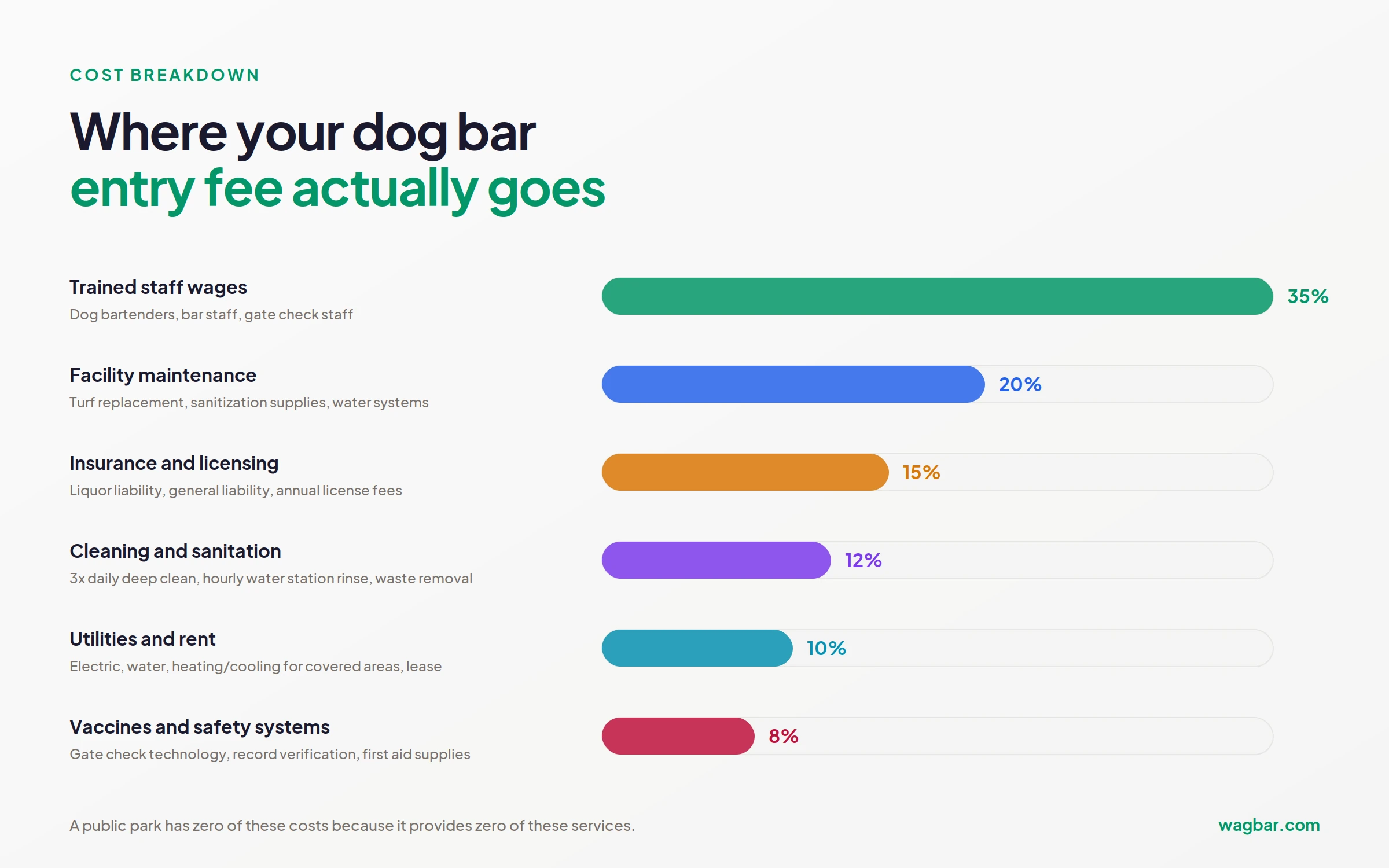
The largest share of every entry fee goes to staff wages. Staff are trained employees who are on-site to enforce the rules and step in when situations escalate. They are not volunteers. They are not part-time teenagers. They are paid staff who enforce the rules of the venue, like lifeguards at a pool. Add in bar staff, gate check staff and management, and labor accounts for roughly 35% of the fee.
Facility maintenance takes the next 20%. Synthetic turf wears out under heavy paw traffic and needs regular replacement. Sanitization supplies, drainage systems, water station components and covered patio maintenance all cost money that nobody is paying at a public park. Insurance and licensing consume another 15%, covering alcohol liability, general liability and the annual costs of holding a state alcohol license. Cleaning and sanitation at 12% covers three-times-daily deep cleans, hourly water station rinses and continuous waste removal by staff. Utilities, rent and vaccine verification systems round out the rest.
A public dog park has zero of these line items because it provides zero of these services. The grass gets mowed by the parks department when the schedule allows. The waste bags run out. The water fountain breaks. Nobody is supervising the dogs. Nobody is checking vaccines. Nobody is cleaning the surfaces. And nobody is accountable when something goes wrong.
What “Free” Actually Costs You
The real cost of a public dog park does not show up at the gate because there is no gate. It shows up at the vet’s office.
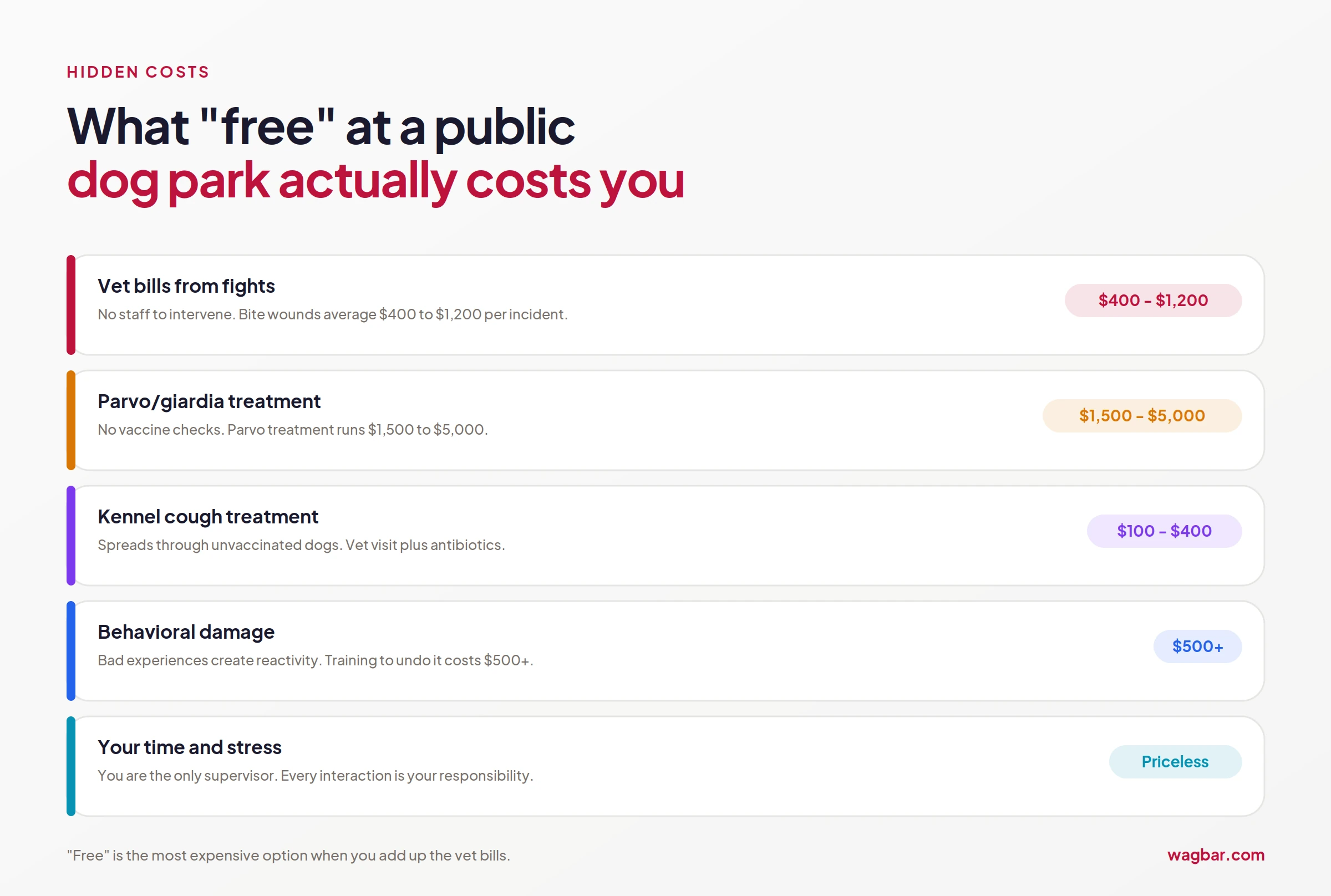
Bite wounds from unsupervised fights average $400 to $1,200 per incident, depending on severity. At a professional dog bar, staff step in in under 60 seconds using a rule-enforcement by on-site staff that prevents most fights from happening at all. At a public park, two owners yelling their dogs’ names from 50 yards away is the entire intervention system.
Parvovirus treatment runs $1,500 to $5,000 and is fatal in many cases. Giardia, kennel cough and other transmissible diseases spread freely at parks that do not check vaccination records. A single visit to an unvaccinated park can generate a vet bill that exceeds a full year of dog bar membership.
Then there is the cost that nobody invoices. A bad experience at a public park, whether a fight, a mounting incident or an intimidation encounter with a larger dog, can create lasting behavioral reactivity. A dog that was social and confident before a bad park visit may become leash-reactive, dog-aggressive or fearful in group settings afterward. Undoing that damage with a professional trainer costs $500 or more and takes months. The “free” park visit that caused it is the most expensive outing your dog ever had.
What You Get That a Public Park Cannot Provide
The fee buys six things that no public park in the country offers.
Vaccine-verified entry means every dog in the yard has been checked for rabies, DHPP and Bordetella. This is the single most effective disease prevention measure and it is impossible at a park with an open gate. Trained staff supervision means someone is always watching, always reading body language and always ready to step in. A no-dog-feeding and no-toys policy eliminates resource guarding, allergic reactions, choking during play and surface contamination. Feeding dogs or allowing toys in a group of off-leash dogs triggers all four of those problems. Wagbar removes the risk by not allowing owners to feed their dogs inside the yard and not allowing toys by keeping food out of the yard.
Beyond the safety layers, the fee covers maintained facilities that degrade quickly at a public park. Clean turf, functioning water stations, shaded areas with fans, self-serve wash stations and a sanitized environment. At a public park, these amenities either do not exist or exist in a state of disrepair because no one is funding their upkeep.
The Math on Membership vs. Vet Bills
A monthly dog bar membership typically costs $30 to $60 per month for unlimited visits. A single emergency vet visit for a bite wound starts at $400. One round of parvo treatment starts at $1,500. One session with a behavioral trainer to address park-related reactivity starts at $150.
An owner who visits a dog bar twice a week for a year pays roughly $400 to $700 in membership fees and gets rule-enforced, vaccine-verified, insured, maintained, clean off-leash play at every visit. An owner who visits a public park twice a week for a year pays nothing at the gate and absorbs the full financial risk of every unsupervised interaction their dog has. One bad visit can erase years of “savings” from the free park.

Entry Fee FAQs
Do humans pay to enter a dog bar
At Wagbar, humans always enter free. The fee covers the dog’s access to the supervised off-leash yard. You pay for your drinks at the bar. Your presence costs nothing.
Is a membership worth it if I only go once a week
Yes. A single visit per week at membership rates costs roughly $7 to $15 per visit. That buys trained supervision, vaccine-verified dogs, clean surfaces and zero vet bill risk from the visit. One unsupervised park fight can cost more than a full year of membership.
Why do some dog bars charge more than others
Pricing reflects staff levels, facility quality, location costs and the scope of services. A venue with higher staff-to-dog ratios, better maintained surfaces, more covered space and stronger insurance coverage will charge more because those things cost more to provide. Lower pricing usually means fewer staff and less maintenance.
Can I visit once without a membership
Most dog bars, including Wagbar, offer single-visit options for first-timers and occasional visitors. The per-visit price is higher than the membership per-visit rate, which incentivizes regular visits. Bring your dog’s vaccination records for the first visit.
Why can’t public parks just add these services
Public parks are funded by tax revenue allocated through municipal budgets. Adding trained staff, vaccine checks, insurance and daily sanitization would require either significant tax increases or user fees that effectively turn the park into a paid facility. The political and logistical barriers make it unlikely. Dog bars solve this by operating as private businesses that fund these services through entry fees and bar revenue.
You Are Not Paying for a Fence
You are paying for trained eyes on the yard, verified vaccines at the gate, clean surfaces under paw, insurance behind every interaction and a food-free environment that keeps play calm. See how Wagbar builds venues where every dollar of the fee goes to your dog’s safety and experience.

Wagbar does not represent what a franchise owner will earn. Verified performance data is available only in Item 19 of the FDD, provided to qualified candidates during formal disclosure. Published cost figures are FTC-required regulatory estimates and are not profitability guarantees.
Safe Play Has a Price. Vet Bills Have a Bigger One.
The fee pays for what the free park cannot give you. Bring your pup’s vaccine records and see the difference at the nearest Wagbar.
Dog bars charge an entry fee because they provide trained staff supervision, vaccine-verified entry, three-times-daily sanitization, insurance, maintained facilities and a yard with no dog feeding and no toys. Public parks are free because they provide none of these. The hidden costs of “free” parks include vet bills from fights ($400 to $1,200), parvo treatment ($1,500 to $5,000), kennel cough treatment ($100 to $400), behavioral damage from bad experiences ($500+ in training) and the stress of being the sole supervisor. A dog bar membership of $30 to $60 per month covers unlimited supervised visits. One bad park visit can cost more than a full year of membership. Humans enter free at Wagbar.