
The Puppy Food Switch Almost Every First-Time Owner Gets Wrong
Your puppy has been eating the same food since the day you brought her home. She's growing fast, the bag is almost empty, and the adult version of the same brand is sitting right there on the shelf. So you grab it, pour it in the bowl, and assume everything will be fine.
Two days later she has diarrhea. She's gassy. She's turning her nose up at meals she used to inhale. And you're Googling "why is my puppy sick" at midnight wondering what you did wrong.
What you did wrong is what almost every first-time owner does. You switched the food too fast, at the wrong time, and probably to the wrong formula. It sounds like a small thing. It's not. The puppy food transition is one of those decisions that looks simple from the outside but actually involves your dog's gut bacteria, skeletal development, breed-specific growth rates, and long-term health outcomes that ripple well past the puppy stage.
The Overnight Switch Problem
The single most common mistake is dumping the old food and replacing it with new food in one meal. Owners do this because it seems logical. The puppy is old enough now. Time for adult food. Done.
But your dog's digestive system doesn't work like a light switch. The gut houses billions of bacteria that have adapted to processing specific ingredients, protein sources, fat levels, and fiber types in the current food. When you replace all of that overnight, those bacteria get overwhelmed. They can't break down the new formula efficiently, which leads to loose stool, gas, vomiting, and sometimes a full refusal to eat.
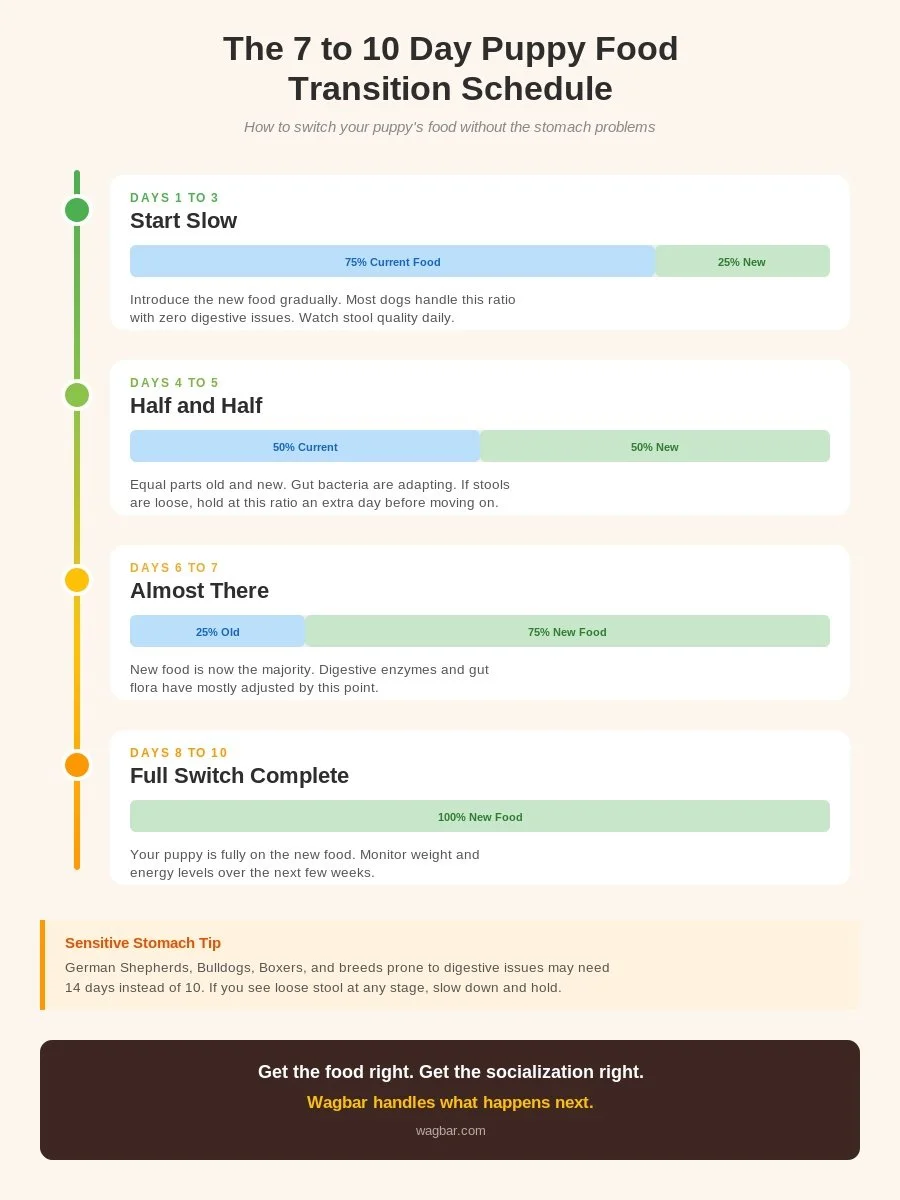
The fix is boring but important. Transition gradually over 7 to 10 days. Start by mixing roughly 25% new food with 75% current food for the first two to three days. Move to a 50/50 split for days four and five. Then shift to 75% new food and 25% old for days six and seven. By day eight through ten, you should be feeding 100% of the new food with no digestive drama.
Dogs with sensitive stomachs may need even longer. Some vets recommend stretching the transition to two full weeks for breeds prone to digestive issues like German Shepherds, Bulldogs, and Boxers. If your dog shows loose stool at any stage, slow down and hold at the current ratio for an extra day or two before moving forward.
Switching at the Wrong Time
The second mistake is timing. Most first-time owners assume that once a puppy looks grown up, it's time for adult food. But looking full-sized and being nutritionally mature are two different things. Your puppy might physically resemble an adult dog months before her bones, joints, and organs have finished developing.
The right time to switch depends almost entirely on breed size.
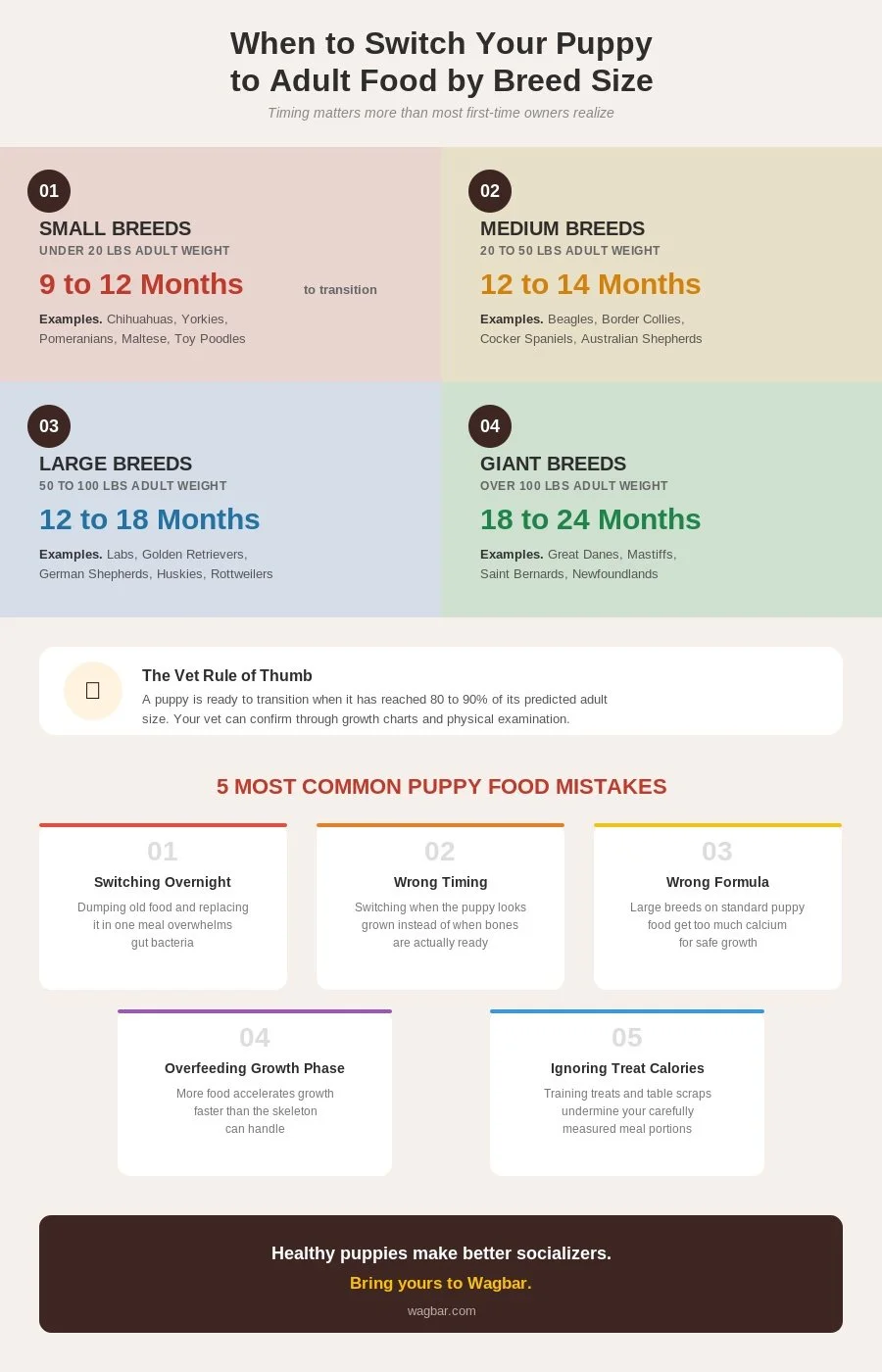
Small breeds (under 20 pounds at adult weight) mature faster. They typically reach full size by 6 to 8 months and are ready for adult food between 9 and 12 months of age. Toy breeds like Chihuahuas, Yorkies, and Pomeranians often hit this milestone on the earlier end.
Medium breeds (20 to 50 pounds at adult weight) take a bit longer. Most are ready between 12 and 14 months. Think Beagles, Border Collies, Cocker Spaniels, and Australian Shepherds.
Large breeds (50 to 100 pounds at adult weight) need significantly more time. Labs, Golden Retrievers, German Shepherds, and similar breeds typically aren't ready until 12 to 18 months. Their skeletal systems are still developing well after they look fully grown.
Giant breeds (over 100 pounds at adult weight) take the longest. Great Danes, Mastiffs, Saint Bernards, and Newfoundlands may not reach full skeletal maturity until 18 to 24 months. Switching these dogs to adult food at 12 months because they look enormous is one of the most harmful timing mistakes an owner can make.
The general rule veterinarians use is that a dog is ready to transition when it has reached 80 to 90% of its predicted adult size. Your vet can assess this through growth charts and physical examination. If you're unsure, ask. It's a quick conversation that can prevent months of nutritional imbalance.
The Large Breed Calcium Problem Nobody Talks About
Here's where the stakes get serious, especially for owners of large and giant breed puppies.
Puppy food is formulated with higher levels of calcium, phosphorus, protein, and calories than adult food because growing dogs need those nutrients to build bone, muscle, and tissue. That's fine for small and medium puppies who grow quickly and reach maturity relatively fast. But for large and giant breeds, the growth period is long and the window for nutritional mistakes is wide.
The specific danger is excess calcium. Puppies under six months old cannot effectively regulate calcium absorption. Their bodies absorb whatever calcium is in the food regardless of whether they need it. In small breeds, this rarely causes problems because growth happens fast and the excess gets used. In large breeds, too much calcium disrupts bone mineralization and remodeling, increasing the risk of osteochondrosis, hip dysplasia, and other developmental skeletal diseases.
This is why large breed puppy food exists as a separate category. It's not a marketing gimmick. Large breed puppy formulas are specifically designed with controlled calcium levels (typically 1.0 to 1.8% of dry matter) and an optimized calcium-to-phosphorus ratio between 1.1 and 1.3 to 1. Standard puppy food can contain calcium levels up to 3% of dry matter, which is fine for a Yorkie but potentially harmful for a Great Dane.
The mistake first-time owners make is feeding their large breed puppy a standard puppy formula because it was cheaper, more available, or because nobody told them the difference mattered. It matters a lot. And it's compounded by owners who add calcium supplements on top of a complete puppy food, which pushes calcium well above safe limits and is one of the most common causes of skeletal disease in large breed puppies.
If you own a large or giant breed puppy, feed a food specifically formulated for large breed puppies and do not add calcium supplements unless your veterinarian explicitly prescribes them. This is not optional. It directly affects whether your dog develops healthy joints or spends its adult life managing preventable orthopedic problems.
Overfeeding During the Growth Phase
First-time owners tend to assume that a growing puppy needs as much food as it will eat. The puppy is hungry all the time, so more food must be better. This is wrong, and for large breeds, it's dangerous.
Overfeeding during the growth phase doesn't just make a puppy chubby. It accelerates the growth rate itself. The skeleton grows faster than it should, producing bones that are larger but less dense. The result is a heavier body being supported by a skeletal structure that hasn't had time to develop the strength it needs. Research consistently links overfeeding in large breed puppies to higher rates of developmental orthopedic disease.
Follow the feeding guidelines on your puppy food label as a starting point, then adjust based on your vet's assessment of your individual dog's body condition. A healthy puppy should have a visible waist when viewed from above and you should be able to feel (but not prominently see) the ribs. If you can't feel the ribs, you're likely overfeeding.
Free-feeding (leaving food out all day for the puppy to graze) makes portion control nearly impossible and should be avoided during the growth phase. Measured meals at consistent times give you control over intake and make it easier to spot changes in appetite that could signal health issues.
The Picky Eater Trap
Some puppies slow down their eating as they approach the transition period. First-time owners panic, assume the dog hates its food, and start adding toppers, mixing in wet food, or switching to a different brand entirely.
This usually makes things worse. What looks like picky eating is often just a natural decrease in appetite as growth slows. A puppy that was eating voraciously at four months doesn't need the same caloric intake at ten months. The appetite adjusts before the owner's expectations do.
Adding rich toppers and highly palatable extras teaches the puppy that refusing food gets rewarded with something tastier. You're training the puppy to be picky rather than solving an actual problem. And switching brands or formulas without a gradual transition creates the digestive issues we already covered.
If your puppy is otherwise healthy, maintaining energy levels, and growing at the expected rate, a temporary dip in enthusiasm for meals is normal. Offer the food for 15 to 20 minutes, then pick it up. Don't add anything to it. The puppy will eat when hungry. If reduced appetite lasts more than a few days or is accompanied by lethargy, vomiting, or other symptoms, consult your vet.
The Treat Blind Spot
You've carefully measured your puppy's meals, followed the transition schedule, and chosen the right formula for the breed size. But you're also handing out training treats every 30 seconds during walks, giving dental chews after dinner, and letting everyone in the house slip the puppy pieces of cheese throughout the day.
Treats are food. They count. And if you're feeding measured portions of adult food but supplementing with high-calorie puppy treats or table scraps, you're undermining the entire nutrition plan. As a general rule, treats should make up no more than 10% of your dog's daily caloric intake. When you switch from puppy to adult food, switch the treats too. And make sure everyone in the household knows what the dog is and isn't allowed to have.
What the Right Transition Actually Looks Like
Putting it all together, here's what a well-executed puppy food switch looks like from start to finish.
Step 1. Determine the right timing based on your dog's breed size and actual development, not just age or appearance. Confirm with your vet.
Step 2. Choose an adult food appropriate for your dog's breed size. If you've been feeding a large breed puppy formula, transition to a large breed adult formula. Don't assume all adult foods are the same.
Step 3. Begin the gradual transition over 7 to 14 days using the 25/50/75/100 mixing schedule. Monitor stool quality daily and slow down if you see digestive upset.
Step 4. Adjust portion sizes. Adult dogs need fewer calories per pound of body weight than growing puppies. Follow the feeding guide on the new food's label and adjust based on body condition.
Step 5. Switch treats to adult-appropriate options and make sure total treat calories stay under 10% of daily intake.
Step 6. Monitor weight and body condition over the following month. Your dog's caloric needs may change as the metabolism shifts from growth mode to maintenance. A quick vet check at 2 to 4 weeks post-transition confirms everything is on track.
When Your Puppy Needs to Switch Foods Early
Sometimes a food change happens before the planned transition to adult food. Allergies, ingredient sensitivities, digestive problems, or a vet recommendation can all trigger an unplanned switch during the puppy phase.
The same rules apply. Transition gradually. Choose a formula appropriate for your puppy's current life stage and breed size. Don't downgrade to adult food early unless your vet specifically advises it.
Food allergies in dogs are more commonly triggered by protein sources (chicken, beef, dairy) than by grains, despite what some marketing would have you believe. If your puppy is showing signs of food sensitivity like itching, ear infections, or chronic digestive issues, work with your vet to identify the actual trigger through an elimination diet rather than randomly switching between brands hoping something sticks.
Socialization and Nutrition Go Together
A well-fed puppy with a healthy gut is a puppy that shows up to socialization experiences feeling good. Digestive problems from a botched food switch can make puppies lethargic, uncomfortable, and less willing to engage with new environments, other dogs, and new people during the exact developmental window when socialization matters most.
If you're bringing your puppy to an off-leash dog park or group play environment for the first time, make sure the food transition is stable before that visit. A puppy dealing with loose stool and stomach cramps is not going to have a positive first experience, and negative early experiences in social settings can create behavioral patterns that are much harder to fix later.
Nutrition and socialization are two pillars of early puppyhood that affect each other more than most owners realize. Get the food right and your puppy has the physical foundation to make the most of every new experience. Get it wrong and you're managing symptoms during the most important developmental period of your dog's life.
Frequently Asked Questions
Can I switch my puppy to adult food at 6 months?
Only if you have a very small breed (under 10 pounds at full adult weight) that has already reached close to its predicted adult size. For medium, large, and giant breeds, 6 months is far too early. Most dogs should stay on puppy food until at least 12 months, with large and giant breeds continuing until 18 to 24 months.
Is grain-free food better for puppies?
There is no evidence that grain-free food is healthier for most puppies. In fact, the FDA has investigated a potential link between certain grain-free diets and dilated cardiomyopathy (DCM) in dogs. Unless your vet has identified a specific grain allergy, standard formulas with grains are generally the safer choice.
My puppy has diarrhea after switching food. Should I switch back?
Don't switch back entirely. Instead, increase the proportion of old food in the mix and slow the transition down. Go back to a ratio your puppy tolerated well and hold there for a few extra days before progressing again. If diarrhea persists for more than 48 hours despite slowing down, consult your vet.
Should I add supplements to my puppy's food?
Not unless your vet prescribes them. Complete puppy foods are formulated to provide everything a growing dog needs. Adding calcium, phosphorus, or vitamin supplements on top of a complete food can push nutrient levels above safe limits and cause more harm than good, particularly in large breed puppies.
How do I know if my puppy food is actually good quality?
Look for foods that meet AAFCO (Association of American Feed Control Officials) standards for growth or all life stages. Check that the food has undergone feeding trials rather than just meeting nutrient profiles through formulation alone. Your vet can recommend specific brands based on your puppy's breed, size, and any health considerations.
When should I stop feeding large breed puppy food?
Large breed puppies (50 to 100 pounds adult weight) should stay on large breed puppy formula until 12 to 18 months. Giant breeds over 100 pounds may need to continue until 18 to 24 months. The key indicator is skeletal maturity, not physical size. Your vet can confirm readiness through growth assessment.
Can switching food too fast cause long-term digestive problems?
A single bad transition usually won't cause permanent damage, but repeated abrupt switches can disrupt the gut microbiome and create chronic sensitivity. Dogs that go through multiple rapid food changes sometimes develop ongoing digestive issues that make future transitions even harder.
Get Your Puppy's Social Life Started on the Right Foundation
Once your puppy is eating well, fully vaccinated, and feeling good, the next step is getting them into positive social environments where they can learn to interact with other dogs and people safely. Wagbar's off-leash dog park provides a supervised, secure space where puppies and adult dogs can socialize while owners enjoy the bar and connect with other dog owners in their community. Find a Wagbar location near you or learn about bringing Wagbar to your city through franchise ownership.