
The Fresh Dog Food Subscription Services Ranked by Actual Ingredient Quality
Key Takeaways
Only one major fresh dog food subscription has passed an AAFCO feeding trial with real dogs, real bloodwork, and 26 weeks of clinical monitoring.
The Farmer's Dog keeps its beef recipe to just 8 ingredients while most competitors pad their panels with 15 to 25.
Fresh dog food sales have risen 86.5% since 2021, and the US fresh pet food market is growing at 21.3% CAGR through 2030 (Technavio, 2025).
Daily costs range from $1.30 for toy breeds to over $20 for giant breeds, but partial fresh feeding at 25 to 50% still delivers measurable results.
We pulled every ingredient panel, cross checked every AAFCO statement, verified every facility certification, and compared what seven fresh dog food subscription services actually put in the bowl versus what they put on the landing page. What came back was a ranking most of these brands would rather you not see.
Every brand in this category says "real ingredients" and "vet formulated" on the homepage. But when you dig into the sourcing documentation, the AAFCO substantiation method, and whether a board certified veterinary nutritionist (DACVN) actually developed the recipe or just "consulted," the gap between the best and the rest gets wide fast. One brand runs open kitchens you can walk through in person. Another keeps its beef recipe to eight total ingredients. And one cooks each ingredient separately at its own optimal temperature before combining them. Most of the others? They're working hard on their Instagram grid.
If your dog spends time at an off leash dog park running hard with other dogs, you already know nutrition shows up in how they play. Dogs on higher quality diets carry steadier energy, better muscle tone, and calmer behavior during group sessions. Wagbar members in Weaverville and Knoxville talk about food almost as much as they talk about fetch. This ranking comes from a community that watches what happens when diet meets daily movement.
How We Ranked These Brands
Every brand was scored across five categories, and marketing claims counted for zero.
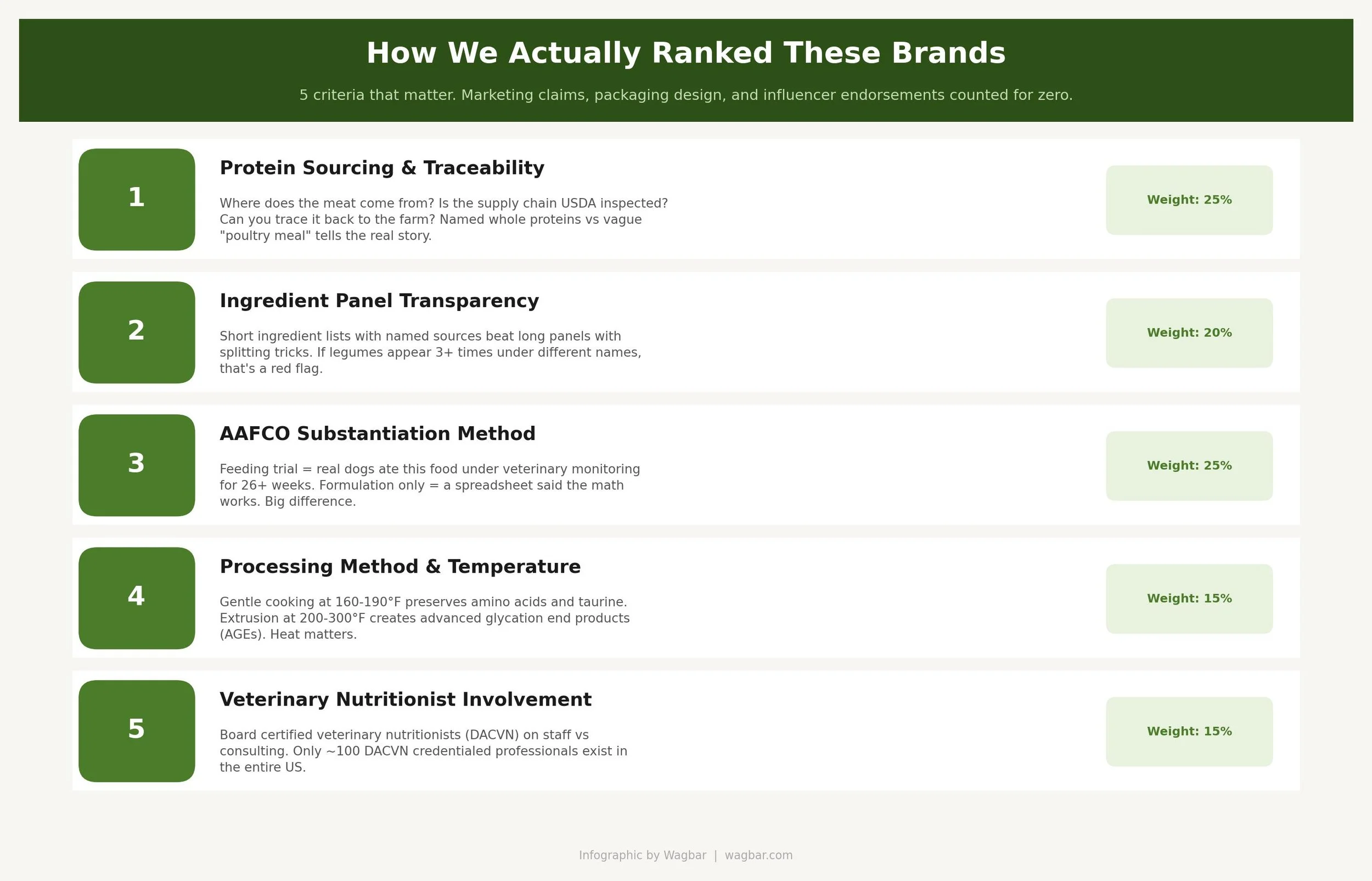
These five pillars determined the final rankings. Packaging design and influencer endorsements didn't make the list.
Protein sourcing and traceability carries the heaviest weight at 25%, tied with AAFCO substantiation method. A brand that checks all five boxes is working at a different level than one that checks two and fills the gap with paid ads. The distinction matters because the global pet food market hit $134 billion in 2026 (Grand View Research, 2025), and the fresh segment is growing faster than any other category. That growth attracts serious operators and opportunists alike. Knowing the difference protects your dog and your wallet.
1. JustFoodForDogs: The Clinical Standard
Ingredient Quality Score: 9.5/10
JustFoodForDogs holds a position no other fresh food brand currently matches. It's the only major subscription service with AAFCO feeding trial substantiation. That means real dogs ate this food under controlled veterinary protocols with bloodwork monitoring, body condition scoring, and health tracking for a minimum of 26 weeks. Every other brand on this list uses the cheaper "formulated to meet AAFCO nutrient profiles" statement, which is a spreadsheet calculation rather than a clinical validation.
The brand operates tourable open kitchens in Los Angeles, Chicago, and Brea, California where you can physically watch meals being prepared. Every recipe uses USDA inspected proteins. Dr. Oscar Chavez, a board certified veterinary nutritionist (DACVN), developed the recipes. That's a credential held by only about 100 professionals in the entire United States (American College of Veterinary Nutrition).
"Fresh is a rapidly growing part of the dog food industry," notes Dr. Vincent Michels. He recommends dog owners research "the organization's commitment to high quality nutrition" before subscribing (dvm360, 2024).
Top recipe example: Beef and Russet Potato. USDA inspected beef leads a short ingredient list, followed by russet potato and carrots. No fillers, no unnamed by products, no artificial preservatives.
Cost: Starting from $1.30/day for small dogs with autoship discount. Medium dogs run $5 to $8/day.
Best for: Owners who want the highest evidentiary standard for nutritional completeness.
If you've read our breakdown of what pet food labels actually hide, you know the gap between feeding trial and formulation only is not a small detail. It's the difference between "we tested this on real dogs" and "the math looked right."
2. The Farmer's Dog: Ingredient Panel Brevity Champion
Ingredient Quality Score: 9.3/10
The Farmer's Dog built its brand on simplicity, and the ingredient panel shows it. Their beef recipe carries an 8 ingredient food panel. That's it. USDA human grade beef, sweet potato, lentils, carrots, sunflower oil, fish oil, and a vitamin/mineral premix. Every ingredient is sourced from supply chains destined for human consumption, and both the meat and kitchens hold USDA certification.
What makes this brand stand apart is the absence of what you'd expect to find. No pea protein isolate. No unnamed "natural flavors." No ingredient splitting that buries legume content across four separate line items. If you've read about ingredient splitting tactics on pet food labels, The Farmer's Dog is basically the anti splitting option.
Meals arrive pre portioned and frozen based on your dog's weight, breed, age, and activity level. The recipes use gentle cooking at lower temperatures (around 160 to 190 degrees Fahrenheit) rather than the 200 to 300 degree extrusion process that creates advanced glycation end products (AGEs) in kibble. At least 50% of each recipe is whole muscle and organ meat, with the rest coming from fresh vegetables like carrots, green beans, and fiber rich foods like sweet potatoes and lentils (Forbes, 2026).
Cost: $2.31/day for extra small dogs, $7 to $9/day for medium dogs, $20+/day for giant breeds.
Best for: Owners who want clean, short ingredient lists with verified USDA human grade sourcing.
3. Nom Nom: The Precision Cooking Specialist
Ingredient Quality Score: 9.0/10
Nom Nom takes a different approach to ingredient quality by cooking each ingredient separately rather than batch cooking everything together. That sounds minor until you understand what it means for nutrient retention. When you cook chicken, sweet potatoes, and spinach together in one pot, the delicate compounds in the greens degrade at the temperature needed to fully cook the protein. Nom Nom cooks each component at its optimal temperature, then combines them. No other brand in this ranking does that.
The brand offers four core recipes: beef, chicken, pork, and turkey. All formulations are developed with input from board certified veterinary nutritionists and designed to meet AAFCO nutrient standards for all life stages. USA sourced ingredients throughout. No artificial preservatives, no fillers, no by products.
According to Dr. Brett Shorenstein, "feeding your dog fresh, whole foods can lead to improved digestion, increased energy levels, and a shinier coat" (VIP Vet, 2024).
Cost: Approximately $20 to $30/week for dogs under 15 pounds, about $40/week for 30 pound dogs, roughly $65/week for 60 pound dogs.
Best for: Owners who want maximum nutrient retention through precision cooking methods.
4. A Pup Above: The Sous Vide Innovator
Ingredient Quality Score: 8.8/10
A Pup Above does something no other brand on this list does. They cook meals using sous vide, a method where ingredients are vacuum sealed and cooked slowly at lower, precisely controlled temperatures. This approach gets better nutrient retention than conventional batch cooking and preserves amino acids that degrade under high heat, including taurine, which plays a critical role in cardiac muscle function.
After cooking, meals are flash frozen before shipping. Every recipe uses 100% human grade ingredients with no artificial preservatives, fillers, or unnamed by products. The result sits between fresh cooked and raw in terms of how much nutritional value survives from farm to bowl. For breeds like Golden Retrievers that carry particular cardiac risk factors, taurine preservation matters. Our Golden Retriever breed guide covers the full health profile worth monitoring.
The brand's focus on heat management is worth paying attention to given the ongoing conversations about diet associated dilated cardiomyopathy (DCM) and how processing temperatures affect taurine availability. If you've followed the grain free dog food concerns vets are still raising, processing method is one of the variables cardiologists watch closely.
Cost: Mid range pricing comparable to The Farmer's Dog, varying by dog size.
Best for: Owners who prioritize processing method and nutrient preservation above all else.
5. Open Farm: The Traceability Leader
Ingredient Quality Score: 8.6/10
Open Farm made traceability its entire identity. Every recipe uses 100% humanely certified, traceable proteins, and here's the detail that sets them apart: you can trace every ingredient back to its specific farm of origin using the lot code on your package. No other major fresh food delivery service offers that level of supply chain transparency.
The brand sources from farms certified by third party animal welfare organizations. No artificial flavors, no fillers, no unnamed by products. Every protein is humanely raised and the sourcing documentation is publicly accessible rather than hidden behind vague corporate language.
For dog owners who care about the ethical sourcing chain as much as nutritional content, Open Farm fills a gap that the other top brands don't fully address. Ingredient quality is high across the board, and the lot code tracing system means any claim about sourcing can be independently verified by the customer.
Cost: Premium tier pricing, generally $8 to $14/day for medium dogs.
Best for: Owners who want full supply chain transparency and humanely certified proteins with verifiable sourcing.
6. Ollie: The All Rounder
Ingredient Quality Score: 8.4/10
Ollie delivers human grade fresh food with no preservatives, no artificial ingredients, and recipes developed with veterinary nutritionist input. The brand offers both fresh cooked and baked options, giving owners flexibility based on budget and storage capacity. Ingredient panels are clean and straightforward, with named protein sources leading every recipe.
What Ollie does well is balance. It's not the cheapest and not the most expensive. Not the most clinical and not the most marketing driven. For owners looking to switch from kibble to fresh without diving into the deep end of the ingredient transparency pool, Ollie represents a solid entry point with good sourcing standards. City dog owners in apartments or condos who need a low friction entry into fresh feeding will find this practical. Our urban dog living guide covers other quality of life wins for urban dog households.
Cost: $4 to $8/day depending on dog weight, recipe, and portion size. Half fresh plans for small dogs start around $20 to $35/month.
Best for: First time fresh food buyers who want a reliable middle ground brand.
7. Spot and Tango: The Budget Friendly Option
Ingredient Quality Score: 8.0/10
Spot and Tango earns its spot here by offering two product lines that serve different budgets. Their gently cooked fresh recipes compete with the premium brands above, while their UnKibble line offers a whole ingredient, gently dried alternative for owners who can't afford or store fully fresh meals. Three protein options in the fresh range: turkey and quinoa, beef and brown rice, and lamb and sweet potato. All non GMO, gluten free, and human grade.
Fresh plans start at $2/day with free shipping. UnKibble starts at $1/day. That pricing opens the fresh food conversation to owners who look at $9/day for a 50 pound dog and close the browser tab. The beef and brown rice recipe carries a dry matter protein reading of 34.7% and fat level of 22.2% (Dog Food Advisor, 2026).
Cost: Fresh from $2/day, UnKibble from $1/day, free shipping on both.
Best for: Budget conscious owners who want better than kibble without the premium fresh food price tag.
The Full Comparison at a Glance
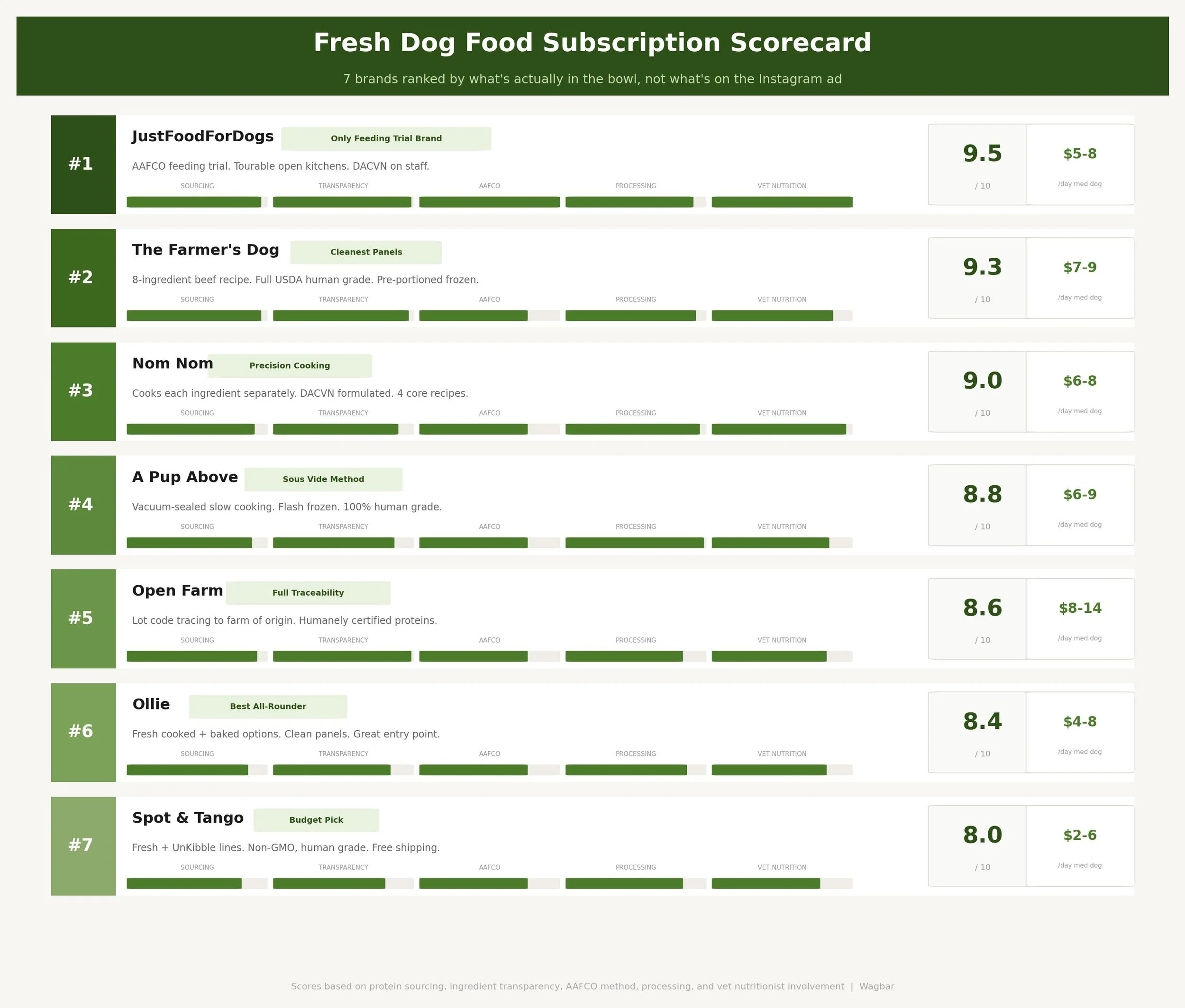
Scores based on protein sourcing, ingredient transparency, AAFCO method, processing, and vet nutritionist involvement.
Brand Score AAFCO Method Human Grade DACVN Staff Daily Cost (Med Dog) Traceability JustFoodForDogs 9.5/10 Feeding Trial Full Yes $5-8 Open kitchens The Farmer's Dog 9.3/10 Formulation Full Consult $7-9 USDA certified Nom Nom 9.0/10 Formulation Full Yes $6-8 USA sourced A Pup Above 8.8/10 Formulation Full Consult $6-9 Sous vide verified Open Farm 8.6/10 Formulation Full Consult $8-14 Lot code tracing Ollie 8.4/10 Formulation Yes Consult $4-8 Named sources Spot & Tango 8.0/10 Formulation Fresh line only Consult $2-6 Named sources
The "Human Grade" Problem Nobody Talks About
Here's something that gets buried in the marketing noise. The term "human grade" has a specific AAFCO defined meaning that most brands claiming it don't actually meet. True human grade requires every single ingredient to be edible for humans at every step of the supply chain AND the manufacturing facility to hold human food licensing. Not "our ingredients come from human grade sources." Not "our proteins are human quality." The full standard requires end to end compliance from farm through processing through packaging.
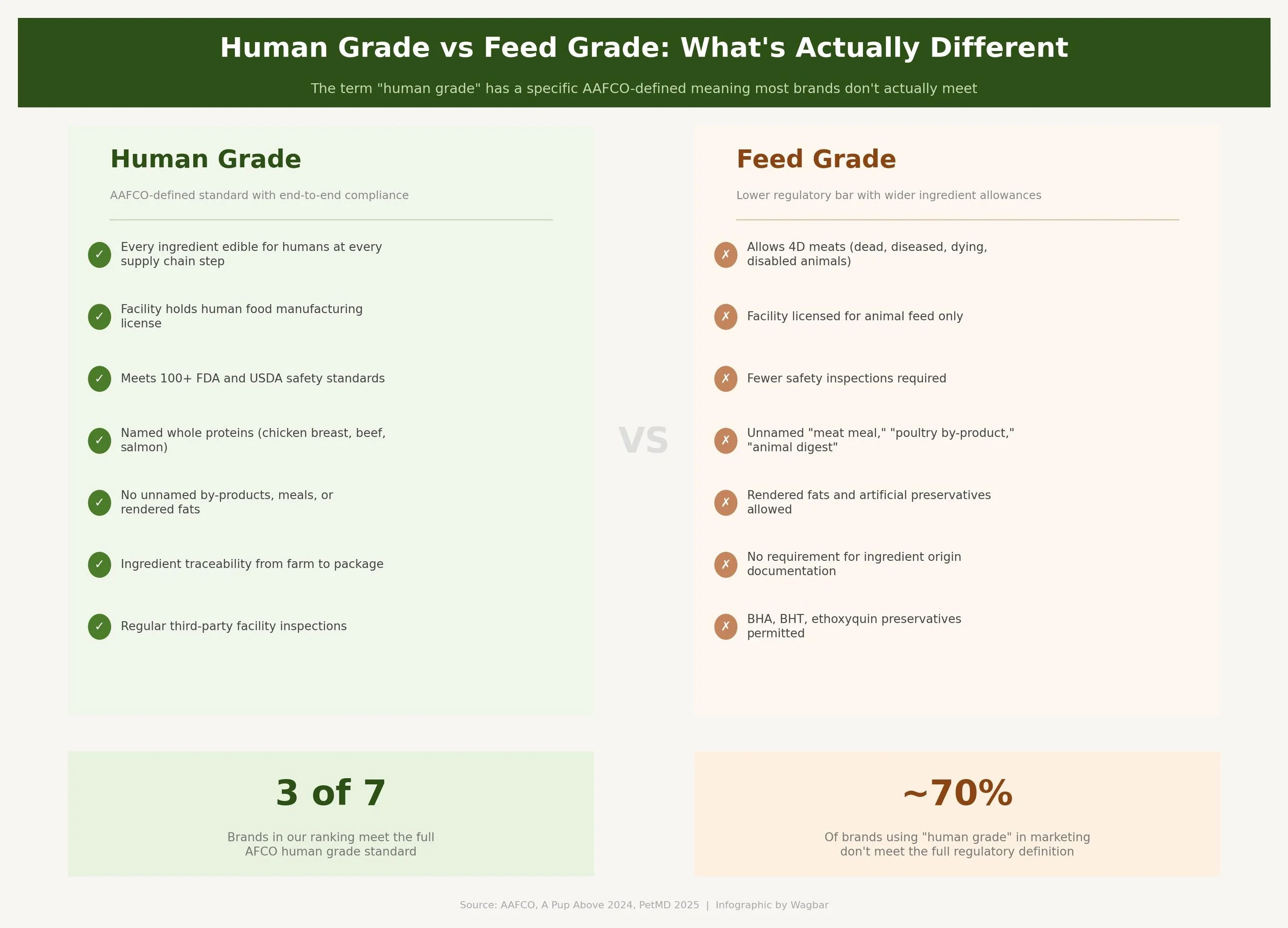
Feed grade rules allow components like 4D meats (dead, diseased, dying, or disabled animals), meat meals, and rendered fats. Human grade requires 100+ FDA and USDA safety standards from farm to package.
According to pet food regulatory standards, feed grade food can include "non human edible ingredients like 4D meats, meat meals, and artificial preservatives" while human grade must meet "100+ safety standards set by the FDA and USDA" that "apply all the way throughout the production process, from the farm where the ingredients are grown to the packaging facility" (A Pup Above, 2024).
Brands in our top three all meet the full standard. As you move down the list, the claims get softer and the documentation gets thinner.
Fresh Food Market Growth: Why This Matters Right Now
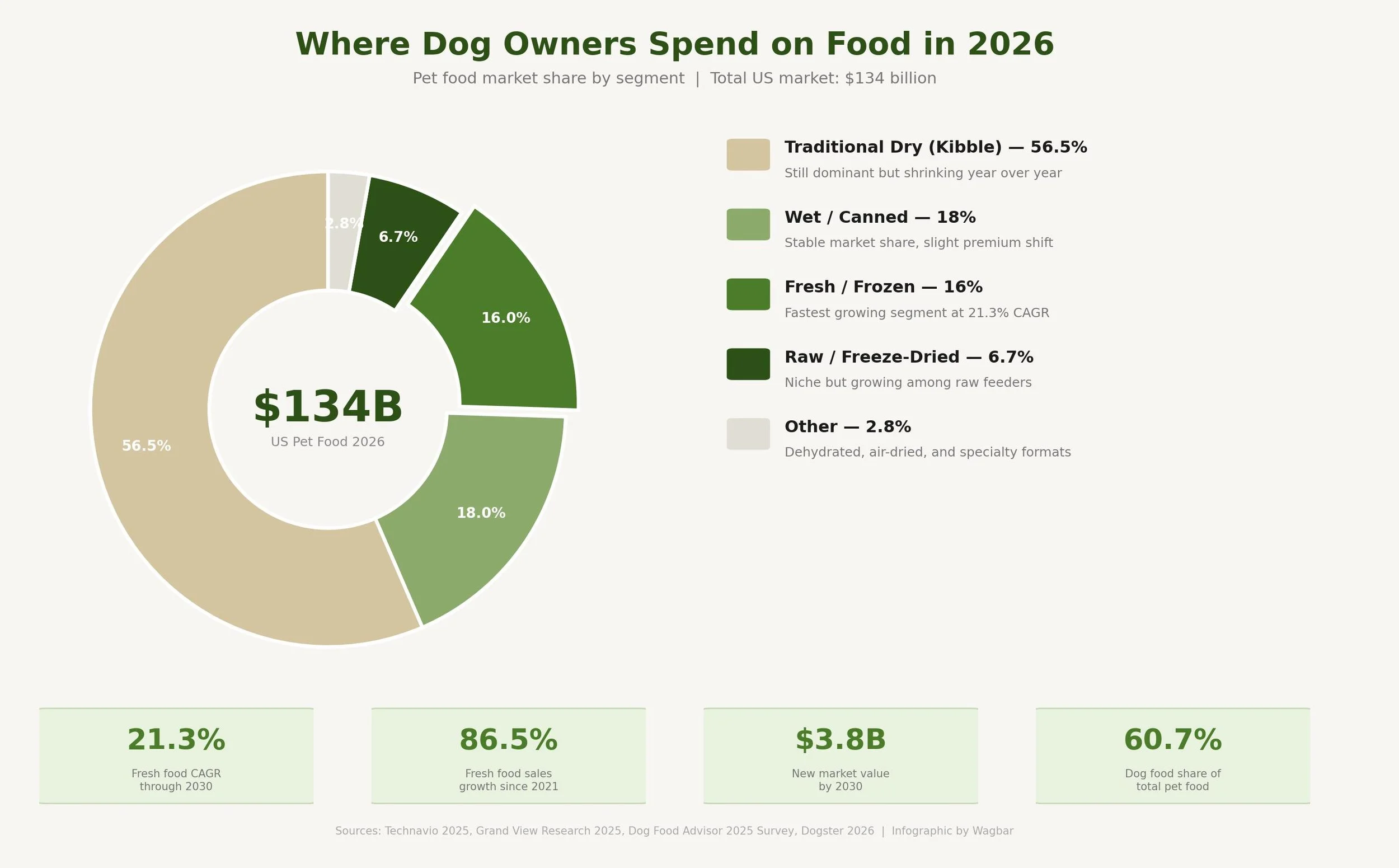
The US fresh pet food market is adding $3.80 billion in value through 2030, growing more than four times faster than traditional pet food categories.
The fresh dog food category isn't a fad. Fresh dog food sales have risen 86.5% since 2021 (Dogster, 2026). The US fresh pet food market is projected to grow by $3.80 billion between 2025 and 2030 at a 21.3% compound annual growth rate (Technavio, 2025). Globally, the pet fresh food market was valued at $4.5 billion in 2025 and is expected to reach $7.8 billion by 2033 at 8.1% CAGR (Market Size and Trends, 2025).
Dogs account for 60.7% of all pet food market revenue (Grand View Research, 2025). That growth pulls serious investment into the category, which means more brands, more marketing, and more confusion for owners trying to figure out which subscription actually delivers on quality. A survey by Food Fur Life found that 55% of pet owners would prefer to give their pets fresh food (Food Fur Life, 2025), while 53% of dog owners now report caring more about their dog's nutrition than their own (Pet Food Industry, 2025).
Dr. Katie Tolbert, a board certified veterinary nutritionist at Texas A&M College of Veterinary Medicine, puts it simply: "Consistency and quality are both important" when evaluating any pet food (Texas A&M VMBS).
What We Feed Our Dogs at Wagbar
Wagbar members don't agree on a single brand, and that's the point. What they do agree on is that nutrition matters alongside movement, socialization, and community. A dog running off leash at Wagbar Weaverville or the upcoming Knoxville location burns real energy and needs real fuel. Members who switched to fresh food consistently report steadier play behavior, less reactivity during group sessions, and better recovery between visits.
If you're curious what happens biologically when you make the switch, our deep dive on what actually happens inside a dog when you switch from kibble to fresh food walks through the gut microbiome shifts, coat changes, and energy stabilization that happen in the first six weeks.
The connection between food quality and play quality is real, and it's something you can see at the park. Dogs on well sourced fresh diets tend to read other dogs better, play more balanced, and skip the manic zoomie meltdown that ends in a snap. Good food plus real exercise plus social time is the whole equation. If you haven't tried an off leash social environment with your pup, check your nearest Wagbar location or sign up for a Wagbar membership and see what it looks like when nutrition meets the grass.
The Vibe Check
Let's be direct about something. Every fresh dog food brand on this list is better than the $22 bag of mystery pellets at the grocery store. If you're reading this and thinking "I can't afford $9/day for my Lab," that's valid. Cost is real. A partial swap of 25 to 50% fresh mixed with good quality kibble still captures meaningful benefits in digestibility, coat quality, and gut health. You don't have to go all or nothing.
The ranking exists because when someone does decide to spend more on their dog's food, they deserve to know which brands actually earn the premium and which ones just photograph well. A pie chart on an Instagram ad doesn't make your dog healthier. Verified sourcing, clinical testing, and a short ingredient list do.
And honestly, if your dog's gut is working right and their energy is steady, the park becomes a completely different experience. They're not the one hiding under the bench or snapping at a Golden who got too close. They're the one inviting play and reading the room. A dog on fresh food with steady energy tends to play more balanced, initiate politely, and skip the manic episodes. Pet parents at Wagbar say it all the time: their dog just started acting like themselves again.
How to Pick the Right Subscription for Your Dog
Start with your dog's size. Giant breeds (80+ pounds) on full fresh plans will cost $15 to $25/day. If that's out of range, look at partial fresh feeding or Spot and Tango's UnKibble as a middle option.
Check the AAFCO statement. If feeding trial substantiation matters to you, JustFoodForDogs is currently the only option. If you're comfortable with formulation only, the entire top seven qualifies.
Read the ingredient panel, not the landing page. Count the ingredients. Look for named protein sources (chicken breast, beef, turkey) versus vague terms (poultry meal, animal fat). Check for ingredient splitting with legumes appearing multiple times under different names.
Verify human grade claims. Ask whether the facility holds human food manufacturing licenses. If the answer is vague, the claim is soft.
Consider your freezer. Fresh food requires refrigerator or freezer space. Two weeks of food for a 70 pound dog takes real room. If storage is tight, brands with smaller pre portioned packaging or shelf stable options like UnKibble solve that problem.
For households running multiple dogs on different diets, our multi dog household breed compatibility guide covers feeding station management so nobody steals from anybody else's bowl.
Frequently Asked Questions
Is fresh dog food actually better than kibble?
Fresh dog food is more digestible per gram than extruded kibble, with absorption rates around 80 to 90% compared to 60 to 70% for most dry foods. The lower processing temperatures preserve more amino acid integrity, and the higher moisture content (roughly 70% versus 10%) supports hydration and kidney function. A 2024 review in Today's Veterinary Practice confirmed that increased media attention about ultraprocessed foods in human health is driving veterinarians to evaluate how processing affects pet food quality (Today's Veterinary Practice, 2024).
How much does fresh dog food cost per month?
Monthly costs vary dramatically by dog size. For a small dog under 15 pounds, expect $60 to $120/month on most brands. Medium dogs (30 to 50 pounds) typically run $180 to $280/month. Large and giant breeds can exceed $500/month on full fresh plans. Partial fresh feeding at 25 to 50% of the diet reduces costs proportionally while still delivering measurable benefits.
What does "human grade" actually mean on dog food?
True human grade requires every ingredient to be edible for humans at every step of the supply chain and the manufacturing facility to hold human food licensing. It's an AAFCO defined term with specific regulatory requirements. Many brands use "human grade" loosely in marketing without meeting the full standard. Brands like JustFoodForDogs, The Farmer's Dog, and Nom Nom meet the complete definition.
Can I mix fresh food with kibble?
Yes. Mixing fresh food with quality kibble is a common and effective approach that reduces cost while improving overall diet quality. Start with 25% fresh and 75% kibble, then adjust based on your budget and your dog's response. The digestibility and nutrient density benefits show up even at partial feeding levels.
Which fresh dog food has the best ingredients for sensitive stomachs?
Nom Nom and The Farmer's Dog both offer limited ingredient recipes with short, clean panels that work well for dogs with sensitivities. The key is finding a single protein source (turkey or beef tend to be well tolerated) and transitioning slowly over 7 to 10 days. Our guide on what happens when you switch from kibble to fresh food covers the transition timeline in detail.
Are fresh dog food subscriptions worth the cost?
For most owners, the answer depends on what "worth it" means. If your dog has chronic digestive issues, dull coat, low energy, or behavioral problems tied to diet, fresh food often produces visible improvements within three to six weeks. The long term argument is that better nutrition may reduce veterinary costs over a dog's lifetime, though longitudinal data on that claim is still limited. Our page on pet insurance and monthly premiums breaks down whether the math works for your household.
How do I transition my dog from kibble to fresh food safely?
Move over seven to ten days. Start with 25% fresh and 75% old food for two days. Move to 50/50 for two days. Then 75/25. Then full fresh. Watch stool consistency. If things get loose, hold at the current ratio for an extra day or two before advancing. Puppies, seniors, and breeds with sensitive stomachs like French Bulldogs, Boxers, and Yorkies may need two to three weeks. For the full biological walkthrough, check our piece on what actually happens inside a dog during the switch.
Does the cooking method really affect ingredient quality?
Yes. Extrusion (how kibble is made) pushes food through heated barrels at 200 to 300 degrees Fahrenheit, triggering the Maillard reaction and creating advanced glycation end products (AGEs). Gentle cooking at 160 to 190 degrees preserves more amino acids, taurine, and vitamin integrity. Sous vide (used by A Pup Above) and separate ingredient cooking (used by Nom Nom) push nutrient retention even higher. Processing temperature is one of the least discussed and most impactful variables in pet food quality.
Fresh Food at Wagbar
Fresh dog food subscriptions range from clinically validated (JustFoodForDogs with AAFCO feeding trials) to marketing forward brands that lean on "human grade" claims without full regulatory backing. The top three brands in this ranking all use verified USDA human grade ingredients, employ or consult board certified veterinary nutritionists, and cook at lower temperatures that preserve amino acid and vitamin integrity. For owners who can't commit to full fresh feeding, partial swaps of 25 to 50% still deliver measurable digestibility and coat improvements. Match your choice to your dog's size, your storage capacity, and whether clinical feeding trial data or ingredient traceability matters more to your household.