

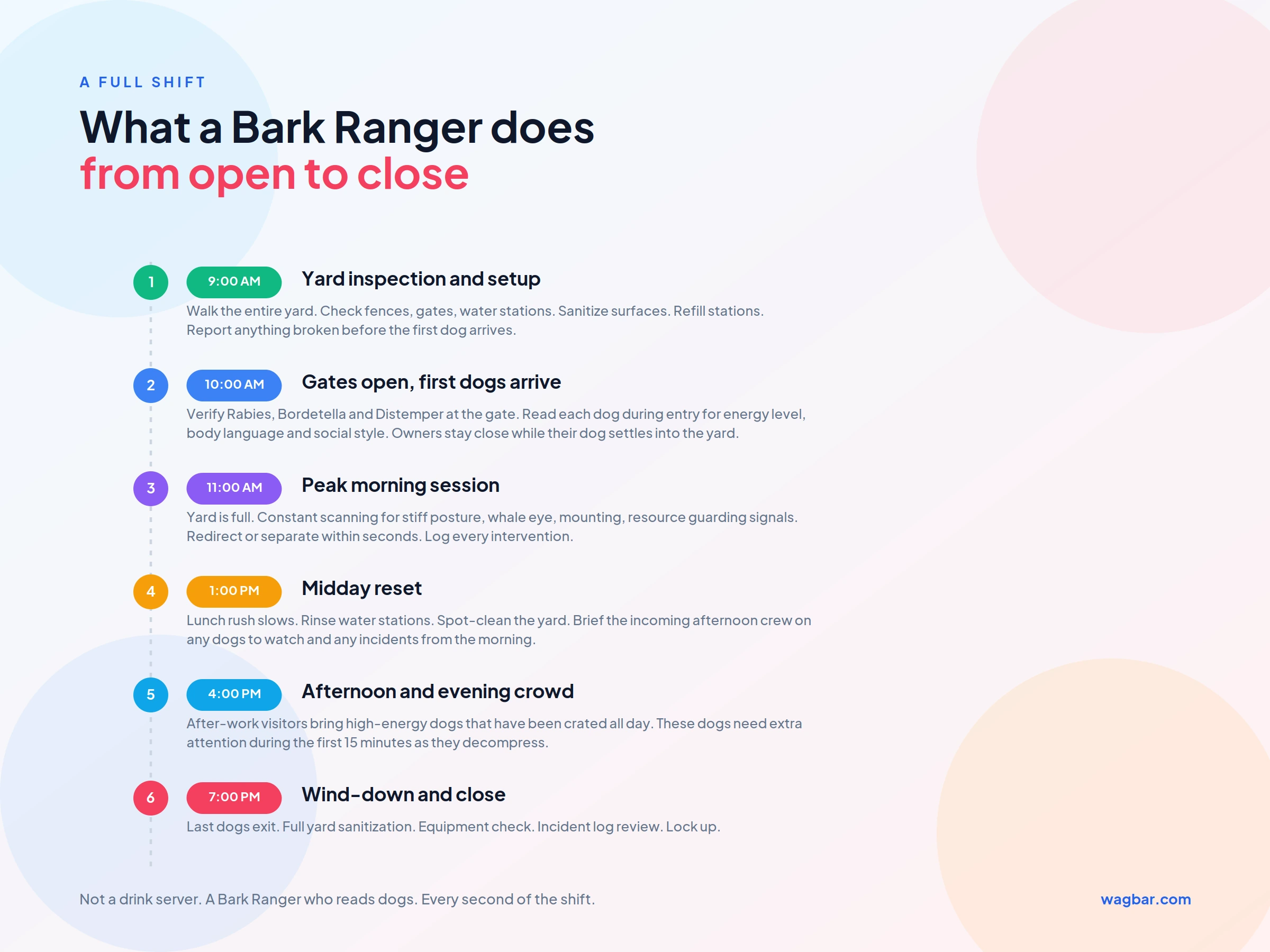
A Bark Ranger is not a drink server. () At Wagbar, a Bark Ranger is a trained member of the yard team — eyes moving, hands free, walking the pack. We don’t supervise your dog. Owners do that. We watch the whole yard, read group energy, and step in when things shift. Here’s what that actually looks like over a Saturday shift.
A Bark Ranger is not a drink server. At Wagbar, Bark Rangers watch the yard as a whole — reading canine body language in real time, stepping between dogs when tension rises, running the gate for vaccine verification, keeping water stations full, logging incidents and closing out the yard with a full sanitization. Owners watch their own dog; Bark Rangers watch the pack. A typical shift runs 8 to 10 hours, keeping eyes on 15 to 30 dogs at a time. It’s one of the most physically and mentally demanding jobs in the pet industry — part body-language reader, part de-escalator, part yard operator.
- Not a Bark Ranger who serves dogs. A professional who reads and manages dogs in real time.
- Body language recognition in 2 to 3 seconds. Play bows, stiff posture, whale eye, mounting.
- De-escalation before contact. Body blocking, redirection, separation within 60 seconds.
- 8 to 10 hour shifts on your feet, in heat or cold, watching 15 to 30 dogs simultaneously.
Before the Gates Open
A Bark Ranger’s shift starts before the first dog arrives. The yard gets a full walkthrough. Every fence panel is checked for gaps or damage. The double-gate airlock is tested to confirm both gates latch properly. The turf is inspected for standing water, debris or waste left by wildlife overnight. Water stations are rinsed, scrubbed and refilled with fresh water. Sanitization spray goes down on all high-contact surfaces.
This takes 30 to 45 minutes and happens every single morning. The purpose is not just cleanliness. It is a safety audit. A loose fence panel that goes unnoticed becomes an escape route. A standing puddle becomes a disease vector. A broken gate latch becomes an airlock failure that lets a dog bolt into the parking lot. The morning inspection catches problems when they are cheap to fix instead of after they become incidents.
The Gate: Where the Shift Really Starts
When the gates open, every arriving dog goes through a three-step check. Vaccination records are verified for Rabies, Bordetella and Distemper. The dog’s current energy is noted. And the Bark Ranger asks the owner a few quick questions about the dog’s energy level that day, any recent changes in behavior and whether the dog has eaten recently (dogs that just ate are more prone to nausea during active play).
First-time dogs get extra attention. The Bark Ranger watches the dog’s body language during the walk from the parking lot to the gate. A dog that is pulling hard, whining and fixated on the yard is overstimulated and needs a slower introduction. A dog that is tucked, low and reluctant is anxious and needs gentle encouragement with space from the group. Reading the dog before it enters the yard is the first act of supervised play management.
Peak Hours: Scanning 30 Dogs at Once
By mid-morning the yard is full. Fifteen to thirty dogs are running, wrestling, chasing, sniffing and negotiating social boundaries simultaneously. The Bark Ranger’s job during peak hours is continuous scanning. Not watching one dog. Watching all of them. The skill is called multi-dog awareness and it takes months to develop.
The Bark Ranger is looking for specific signals. A play bow (front legs down, rear up, tail wagging) means safe play. Loose, bouncy movement means relaxed energy. Those signals are good. The warning signals are subtler. Stiff posture where the dog’s entire body goes rigid. Whale eye where the whites of the eyes show because the dog is looking sideways at a perceived threat without turning its head. Lip licking and yawning in a non-tired dog, which signal stress. Mounting, which is not about dominance but about overstimulation that needs redirection. And the most critical signal: a hard stare with a closed mouth, which often precedes a snap or a lunge.
A trained Bark Ranger recognizes these signals in two to three seconds and acts on them immediately. The intervention is not yelling or grabbing. It is body positioning. The Bark Ranger steps between the two dogs, uses their physical presence to break the sight line, and redirects both dogs to different areas of the yard. This de-escalation happens dozens of times per shift. Most visitors never notice it because it is so smooth and fast that it looks like the Bark Ranger just happened to walk between two dogs.
When Things Go Wrong
Even with constant monitoring, conflicts happen. Two dogs lock onto each other. A resource guarding reaction flares over a stick or a spot near the water bowl. A new dog enters the yard at exactly the wrong moment and disrupts a fragile truce between two dogs that were already tense.
When this happens, the Bark Ranger runs the conflict de-escalation protocol. Spot the tension. Step between the dogs using body position, never grabbing collars during active tension. Separate both dogs to cool-down zones on opposite sides of the yard. Assess each dog individually for stress signs and any injury. Then decide whether to reintroduce gradually or exit one dog for the day. The entire sequence runs in under 60 seconds.
The critical insight is that the protocol is designed to prevent fights, not break them up. By the time two dogs are fighting, the Bark Ranger has already missed the window. The goal is to read the signals three to five seconds before contact and intervene during that window. A Bark Ranger who consistently catches conflicts before they become fights is doing the job at the highest level.
The Food Rule and Why It Makes the Job Possible
Wagbar prohibits all food, treats and edible items inside the play yard. This is not a preference. It is a safety system that directly affects how manageable the yard is for the Bark Ranger. Food in a group of off-leash dogs creates four problems that a single Bark Ranger cannot manage simultaneously. Resource guarding where one treat triggers a multi-dog pile-on. Allergic reactions when dogs grab food not meant for them. Choking hazards when dogs run with food in their mouths. And surface contamination that attracts insects and creates odor between sanitization cycles.
Removing food from the yard eliminates the single most common trigger for group conflict. A Bark Ranger managing 20 dogs in a food-free yard is scanning for play-style mismatches and energy escalations. A Bark Ranger managing 20 dogs around scattered treats, dropped scraps and owner-offered snacks would need eyes on every food item in addition to every dog. The food rule does not just protect the dogs. It makes the Bark Ranger’s job physically possible at the staff-to-dog ratios that dog bars operate at. Dogs eat before or after their visit.
Midday: The Reset
The lunch transition is when the morning Bark Ranger hands off to the afternoon crew. The handoff is a structured briefing, not a wave and a “good luck.” The outgoing Bark Ranger reviews every intervention from the morning. Which dogs were redirected and why. Which pairs should not be in the yard together. Any dogs showing signs of overheating, fatigue or escalating arousal. The incoming Bark Ranger takes the yard with a full mental map of the current group dynamic.
During the transition, water stations get rinsed and refilled. The yard gets a spot clean. Equipment is checked. The sanitation standard requires three full cleanings per day, and the midday cycle catches anything the continuous waste removal missed during the busy morning session.
Closing: The Part Nobody Sees
After the last dog leaves, the real cleaning begins. Full sanitization of every surface with pet-safe disinfectant. Water stations are drained, scrubbed and left to dry. The turf is raked and inspected. Any damaged equipment is tagged for repair. The incident log is completed with every intervention, every conflict, every new dog entry and any medical events documented in detail.
The incident log is not paperwork for the sake of paperwork. It builds a behavioral profile for every dog that visits. Over weeks and months, patterns emerge. Certain dogs pair well and should be in the yard together. Certain combinations create tension and should be managed with timing. A dog that was mildly reactive three weeks ago is now playing confidently because the Bark Ranger introduced it gradually. That progress exists in the log and informs every future shift.


Bark Ranger FAQs
What qualifications does a Bark Ranger need
Dog Bark Rangers at Wagbar complete a structured training program covering canine body language recognition, de-escalation techniques, first aid certification, multi-dog management and customer communication. Prior experience with dogs is preferred but the specific skills are trained on-site. The role requires physical stamina and the ability to make quick decisions under pressure.
How many dogs does one Bark Ranger supervise
Wagbar maintains a minimum 1-to-1 staff-to-yard ratio, meaning at least one trained Bark Ranger per active play zone. During peak hours with 25 to 30 dogs, additional staff are added. The exact ratio depends on yard size, dog count and the behavioral profile of the current group.
Is being a Bark Ranger dangerous
The risk is real but managed. Dog Bark Rangers are trained to use body positioning rather than physical restraint, which reduces the risk of bites during interventions. Injuries happen but are infrequent because the de-escalation protocol is designed to prevent fights rather than break them up. The most common occupational issue is physical fatigue from 8+ hour shifts on your feet.
How is a Bark Ranger different from a dog daycare attendant
The role is similar in function but different in environment. A daycare attendant works with dogs dropped off by owners who leave. A Bark Ranger works with dogs whose owners are on-site at the bar. This changes the communication dynamic because the Bark Ranger provides real-time feedback to owners about their dog’s behavior rather than a summary at pickup.
Can I become a Bark Ranger at Wagbar
Wagbar hires and trains Bark Rangers at each franchise location. The role suits people who are physically active, comfortable with animals, good at reading nonverbal signals and able to stay calm under pressure. Check your nearest Wagbar location for current openings.
The Job Behind the Fun
Every relaxed evening at a dog bar where dogs play and owners drink sits on top of a Bark Ranger who spent the last eight hours reading body language, de-escalating tension, cleaning surfaces and logging every interaction. The fun is the product. The work is invisible by design. See how Wagbar trains and staffs every location with the people who make it work.

Wagbar does not represent what a franchise owner will earn. Verified performance data is available only in Item 19 of the FDD, provided to qualified candidates during formal disclosure. Published cost figures are FTC-required regulatory estimates and are not profitability guarantees.
They Read Dogs. You Read the Menu.
Behind every calm yard is a Bark Ranger who caught the signal you missed. See it in action. Bring your pup’s vaccine records to the nearest Wagbar.
A Bark Ranger’s shift runs 8 to 10 hours and includes yard inspection, vaccine verification, continuous monitoring of 15 to 30 dogs, body language reading in 2 to 3 seconds (play bows, stiff posture, whale eye, mounting), de-escalation interventions using body positioning, water station maintenance, midday staff handoff with behavioral briefing, incident logging and full sanitization at close. The no-food yard policy eliminates the most common conflict trigger and makes the job physically possible at operational staff ratios. The de-escalation protocol runs in under 60 seconds and is designed to prevent fights, not break them up. Incident logs build long-term behavioral profiles for every visiting dog.