

Best Pet Franchises of 2026: Complete Investment Guide

Top TLDR: The best pet franchises of 2026 span dog training, mobile grooming, pet sitting, daycare, and innovative concepts like off-leash dog park bars, with initial investments ranging from $50,000 to $500,000 and varying revenue potential based on business model, location demographics, and operational complexity. Top-performing franchises combine recurring revenue models (memberships, subscriptions) with experience-based services meeting pet owners' growing demand for premium care beyond basic product sales. Evaluate franchises based on initial investment requirements, franchisor support systems, unit economics, market demand in your target location, and alignment with your skills and passion before committing to any opportunity.
The pet industry has evolved from basic product sales into a sophisticated ecosystem of services, experiences, and premium care options reflecting how Americans increasingly view pets as family members deserving quality of life investments. This shift has created unprecedented franchise opportunities for entrepreneurs seeking to enter a recession-resistant industry where consumer spending continues growing even during economic uncertainty.
Pet owners spent $147 billion on their animals in 2024, with spending projected to exceed $180 billion by 2028 according to the American Pet Products Association. This growth stems not just from more households owning pets (67% of U.S. households currently own at least one pet) but from fundamental changes in how owners care for their animals. Modern pet parents prioritize health, wellness, socialization, and quality of life—creating demand for services that didn't exist a decade ago.
Pet franchise opportunities have multiplied to meet this demand, ranging from traditional grooming and boarding operations to innovative concepts like off-leash dog park bars, mobile veterinary services, and specialty training facilities. Not all franchises offer equal investment potential, support systems, or growth prospects. This comprehensive guide examines the best pet franchises of 2026, providing the detailed information serious investors need to make informed decisions about entering this dynamic industry.
Understanding what makes a pet franchise "best"
Investment requirements and financial accessibility
The "best" franchise depends significantly on available capital and risk tolerance. Entry-level franchises requiring $50,000-$100,000 initial investment provide accessibility for first-time franchise owners but may offer limited revenue potential or require owner-operators working in the business daily. Mid-tier franchises ($150,000-$300,000) typically provide better unit economics and potential for semi-absentee ownership with proper management systems. Premium franchises ($300,000-$500,000+) often include real estate, extensive build-out, and equipment but may generate substantially higher revenue.
Total investment encompasses more than franchise fees. Include working capital for 6-12 months of operations while building clientele, equipment and inventory purchases, real estate deposits and buildout costs, marketing and launch expenses, insurance and licensing fees, and owner salary replacement during startup phase. Many failed franchisees adequately funded the franchise fee but grossly underestimated working capital needs, running out of money before achieving positive cash flow.
Financing availability matters when comparing franchises. Some franchisors have established relationships with lenders providing favorable SBA loan terms, reducing required cash investment. Veteran-owned businesses may qualify for fee discounts or preferential financing. Evaluate not just sticker price but realistic total capital requirements including adequate reserves weathering slower-than-projected initial growth.
Franchisor support and training systems
Franchise value comes primarily from proven systems and ongoing support reducing trial-and-error learning and accelerating profitability. Superior franchisors provide comprehensive pre-opening training covering operations, marketing, hiring, and financial management, ongoing field support through regular check-ins and troubleshooting assistance, centralized marketing materials and campaigns franchisees customize locally, and technology platforms managing scheduling, CRM, and business intelligence.
Evaluate franchisor support by speaking with current franchisees beyond the approved referral list. Ask specifically about response time when problems arise, quality and actionability of advice received, whether the franchisor delivers promised support, and if franchisees feel supported or abandoned post-opening. Weak support systems leave franchisees recreating solutions the franchisor should provide, defeating the franchise model's efficiency advantages.
Training depth matters particularly for franchises in specialized fields like dog training or behavioral modification where technical skill directly impacts results and client satisfaction. Dog training franchises requiring certification or extensive behavioral knowledge need robust training programs, while simpler operational concepts like mobile grooming may require less intensive preparation.
Revenue model and profitability potential
Revenue models fundamentally impact franchisee success and lifestyle. Transaction-based businesses (grooming, daycare, training sessions) require constant marketing generating new clients and high transaction volume achieving target revenues. Recurring revenue models (memberships, subscription boxes, monthly service contracts) provide predictable income and higher customer lifetime value but may take longer building initial membership base.
Labor intensity affects profitability and scalability. Owner-operator models requiring your direct involvement in service delivery (training, grooming) limit income to your personal capacity and make growth difficult. Semi-absentee models where trained staff deliver services under your management allow scaling across multiple locations. Consider your desired role when evaluating franchises—some entrepreneurs want hands-on involvement while others prefer oversight-focused management.
Market demand and competitive positioning
The best franchise in a saturated market offers limited opportunity compared to good franchises in underserved markets. Research local market demand before committing: pet ownership rates and demographics in your target area, existing competition for similar services, population density supporting customer acquisition, household income levels affording premium pet services, and growth trends indicating expanding or declining markets.
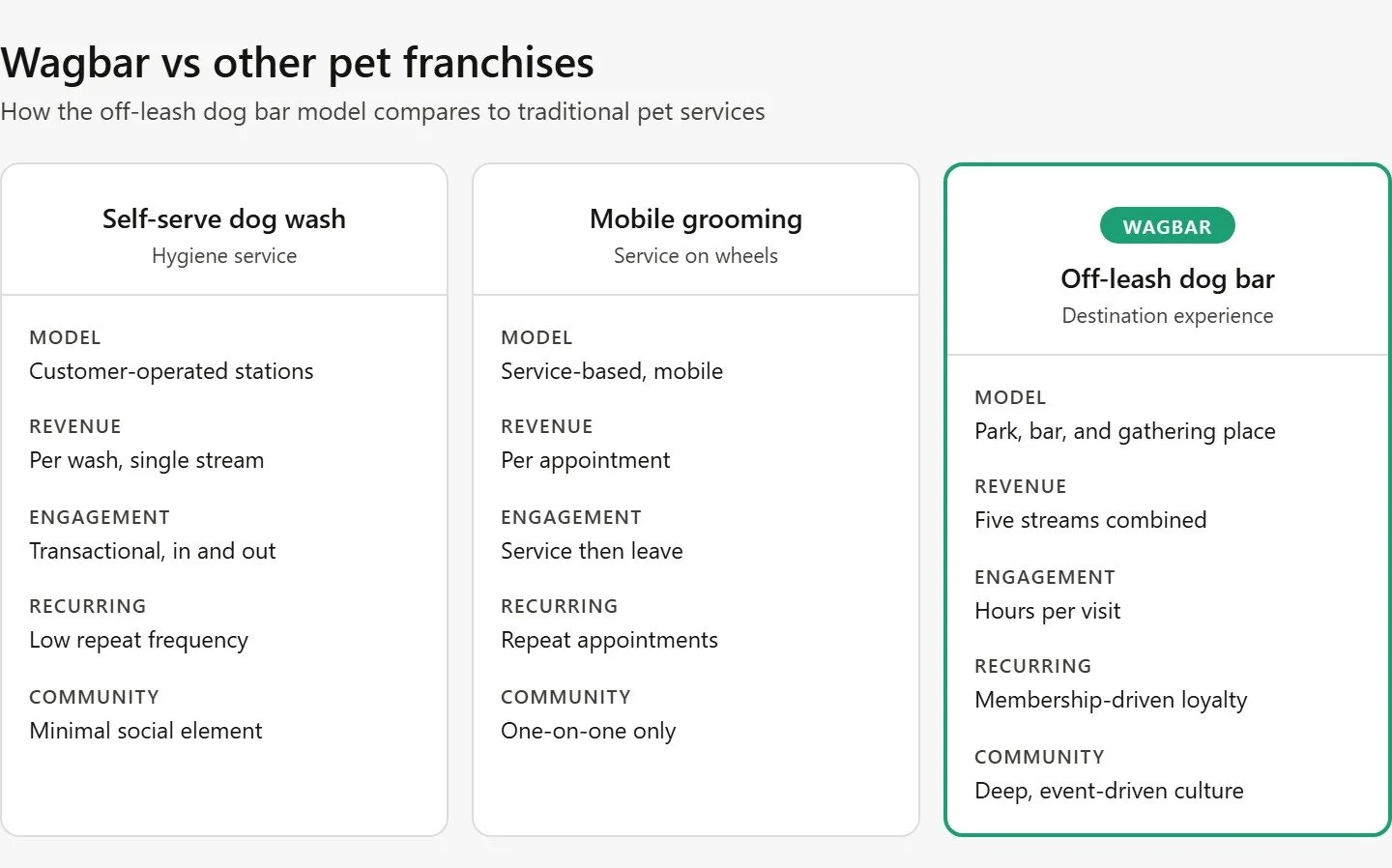
Competitive differentiation determines whether you compete on price (low margins, high volume) or value (premium pricing, loyal customers). Off-leash dog park bar franchises like Wagbar differentiate through unique experiences combining socialization, recreation, and hospitality unavailable from traditional competitors. Commodity services (basic grooming, standard boarding) face intense price competition unless you create differentiation through specialty services, exceptional customer experience, or convenience innovations.
Examine how the franchise concept addresses genuine pet owner pain points versus just offering another option in crowded categories. Mobile grooming solves transportation and stress issues. Specialized training addresses behavioral problems traditional obedience classes don't tackle. Understanding the specific problem your franchise solves helps assess whether adequate demand exists supporting viable operations.
Franchise system maturity and track record
Established franchises with 50+ locations and 5+ years operating history provide proven systems reducing execution risk. Newer franchises with fewer locations may offer more attractive financial terms, less territory competition, and greater flexibility but carry higher risk from unproven systems and potential franchisor business failure.
Analyze franchise disclosure documents (FDD Item 20) revealing franchisee turnover, system growth, and failures. High turnover rates indicate unhappy franchisees or unrealistic business models. Rapid expansion may signal either excellent opportunity or overly aggressive franchising potentially diluting support quality. Stable, measured growth typically reflects sustainable business models and adequate infrastructure supporting franchisees.
Talk to both successful franchisees and those who exited the system. Success stories reveal what works and best practices; departures expose weaknesses in systems, support, or financial performance. Both perspectives provide more accurate assessment than franchisor marketing materials alone.
Top 10 pet franchises of 2026
1. Wagbar: Off-Leash Dog Park Bar Franchise
Investment Range: $470,300 - $1,145,900 | Franchise Fee: $50,000 | Units: 16 locations operating or in development
Wagbar pioneered the off-leash dog park bar concept, creating unique venues where dogs play freely in supervised environments while owners socialize over craft beverages. This innovative model combines recurring membership revenue with per-visit fees and food/beverage sales, targeting the premium pet experience market where spending continues accelerating.
Strengths: First-mover advantage in emerging category, multiple revenue streams (memberships, day passes, beverage sales, events), creates genuine community around shared passion for dogs, experience-based model resistant to e-commerce disruption, and strong brand recognition in growing markets. Comprehensive training includes proprietary "Opener" app guiding pre-launch setup, week-long intensive training at Asheville headquarters, and on-site grand opening support.
Ideal For: Entrepreneurs passionate about dog-focused community building who can invest in real estate and buildout for unique outdoor/indoor facilities. Best suited for markets with high pet ownership rates, affluent demographics, strong craft beverage culture, and limited off-leash dog park options. Semi-absentee ownership possible with strong management team.
Financial Considerations: Higher initial investment due to real estate requirements and unique facility design, but multiple revenue streams and recurring membership model provide strong cash flow once established. Typical locations target 300-500 memberships plus daily visitors generating $600,000-$1.2M annual revenue with 35-45% EBITDA margins in mature locations.
2. Scenthound: Dog Grooming and Wellness Membership Franchise
Investment Range: $358,850 - $565,800 | Franchise Fee: $49,500 | Units: 200+ locations
Scenthound disrupts traditional grooming with membership-based preventative wellness rather than sporadic full grooming services. Monthly membership includes routine maintenance (bath, nail trim, ear cleaning, teeth brushing) focusing on health rather than aesthetics, creating predictable recurring revenue and regular client touchpoints.
Strengths: Recurring revenue model providing predictable cash flow, lower price point than traditional grooming attracting broader customer base, health-focused positioning differentiating from commodity grooming, simplified service menu enabling efficient operations, and strong unit economics with rapid break-even timelines.
Ideal For: Entrepreneurs without grooming experience (training provided) seeking semi-absentee business model with systems-driven operations. Works well in suburban areas with high density of dog owners seeking convenient, affordable maintenance rather than show grooming.
Financial Considerations: Mid-range investment with streamlined operations enabling faster profitability. Membership focus means slower revenue ramp initially but higher customer lifetime value and retention than transaction-based grooming. Average unit generates $650,000-$850,000 annual revenue with 25-35% EBITDA margins.

3. Dogtopia: Dog Daycare, Boarding, and Spa Franchise
Investment Range: $532,000 - $1,142,000 | Franchise Fee: $49,500 | Units: 200+ locations
Dogtopia provides premium dog daycare, overnight boarding, and spa services in purpose-built facilities with webcams allowing owners to check on their pets. Strong brand recognition and comprehensive operational systems support scaling to semi-absentee or multi-unit operations.
Strengths: Multiple revenue streams (daycare, boarding, grooming, retail) within single location, strong franchisor support and proven systems, recurring daycare clients provide stable base revenue, high barriers to entry (real estate, licensing, buildout) limit competition, and growing demand for premium daycare as remote work normalizes creating "only child syndrome" for dogs home alone.
Ideal For: Multi-unit or experienced franchisees with capital for significant real estate investment. Requires facility 5,000-10,000 square feet in visible, accessible location. Best suited for affluent suburban markets with dual-income professional families needing regular daycare services.
Financial Considerations: Higher investment but strong revenue potential and scalability. Typical locations generate $1-$1.5M+ annual revenue with 30-40% EBITDA margins once fully ramped. Real estate costs and staffing intensity affect profitability significantly based on market.
4. Zoom Room: Indoor Dog Training Facility Franchise
Investment Range: $146,000 - $310,000 | Franchise Fee: $45,000 | Units: 30+ locations
Zoom Room operates indoor dog training facilities offering group classes, private lessons, and unique offerings like agility courses, creating destination training centers rather than generic classes in pet store back rooms. Focus on positive reinforcement training and community building through classes, workshops, and events.
Strengths: Multiple revenue streams (classes, private training, workshops, retail, facility rentals), lower real estate requirements than daycare, higher margins than service-based competitors, community-centered approach creating loyal customer base, and expertise in trending positive reinforcement methods appealing to modern dog owners.
Ideal For: Dog trainers seeking to scale beyond individual training or entrepreneurs passionate about dogs willing to become certified trainers. Works well in urban and suburban areas with engaged dog owner communities seeking training beyond basic obedience.
Financial Considerations: Mid-range investment with reasonable real estate requirements (2,500-4,000 square feet). Group class model provides strong margins. Average locations generate $400,000-$600,000 annual revenue with 35-45% EBITDA margins. Owner involvement in training initially common but can transition to certified staff trainers enabling semi-absentee operations.
5. Preppy Pet: Mobile Pet Grooming Franchise
Investment Range: $120,000 - $180,000 | Franchise Fee: $39,500 | Units: 50+ locations
Preppy Pet operates fully-equipped mobile grooming vans bringing professional grooming directly to customers' homes, eliminating transportation stress for pets and providing ultimate convenience for busy owners. Lower overhead than brick-and-mortar salons and ability to serve wider geographic areas.
Strengths: Lower investment than traditional salon, no real estate costs or buildout required, mobile convenience commands premium pricing, one-on-one attention reduces pet stress, growing market as busy pet owners prioritize convenience, and ability to start as owner-operator and scale with additional vans/groomers.
Ideal For: Experienced groomers wanting to own businesses or entrepreneurs willing to hire certified groomers. Ideal for suburban and affluent urban areas where customers value convenience and will pay premium pricing. Can start as solo operation and scale methodically adding vehicles and staff.
Financial Considerations: Lower initial investment and overhead enables faster break-even. Single van generates $150,000-$250,000 annual revenue with 40-50% margins. Scalability requires managing multiple groomers and vehicles. Weather dependency in some climates affects appointment reliability. Additional detail on mobile grooming franchises available for deeper analysis.
6. Camp Bow Wow: Dog Daycare and Boarding Franchise
Investment Range: $566,000 - $1,085,000 | Franchise Fee: $50,000 | Units: 150+ locations
Camp Bow Wow pioneered the premium dog daycare and boarding category, emphasizing happy, healthy dogs through structured play, webcams for owner peace of mind, and trained camp counselors monitoring interactions. Strong brand recognition and established systems support franchisee success.
Strengths: Early mover in premium daycare category with strong brand equity, comprehensive operational systems refined over 20+ years, webcam technology differentiating from traditional boarding, cabin-style overnight accommodations appealing to owners seeking comfort for their pets, and strong corporate support with established vendor relationships.
Ideal For: Experienced franchisees or those with business management background seeking semi-absentee opportunity. Requires significant capital and suitable real estate but systems enable professional management without daily owner involvement. Best in markets with high concentrations of dual-income professionals needing regular daycare.
Financial Considerations: Similar investment profile to Dogtopia with strong revenue potential. Average locations generate $900,000-$1.3M annual revenue with 25-35% EBITDA margins depending on real estate costs and labor markets. Build-out and licensing timeline typically 9-18 months from signing to opening.
7. Pet Supplies Plus: Neighborhood Pet Supply Store Franchise
Investment Range: $558,000 - $1,142,000 | Franchise Fee: $25,000 | Units: 600+ locations
Pet Supplies Plus operates neighborhood pet supply stores offering products, grooming, self-serve dog wash stations, and services creating destination shopping experiences competing against big-box retailers through convenience, expertise, and community connection.
Strengths: Established 35+ year brand with national recognition, diversified revenue from products and services reduces risk, neighborhood focus creates loyal local customer base, self-serve dog wash and grooming provide service revenue complementing retail, and comprehensive site selection and operational support from experienced franchisor.
Ideal For: Retail-experienced entrepreneurs or those seeking more traditional franchise model in pet industry. Requires strong retail management skills and capital for inventory and buildout. Works best in suburban communities without convenient big-box competition.
Financial Considerations: Higher initial investment for retail space, inventory, and equipment. Average store generates $1.5-$2.5M annual revenue but product margins lower than service businesses (typically 10-15% net margins). Success depends heavily on site selection and competition. Real estate typically 8,000-12,000 square feet.
8. Fetch! Pet Care: In-Home Pet Sitting and Dog Walking Franchise
Investment Range: $85,000 - $125,000 | Franchise Fee: $30,000 | Units: 35+ locations
Fetch! Pet Care provides in-home pet sitting, dog walking, and pet transportation services through networks of trained pet sitters and walkers. Lower investment and no real estate requirements with technology platforms managing scheduling, communication, and payments between clients and sitters.
Strengths: Lowest investment in this comparison making it accessible entry point, no real estate or build-out costs, ability to start as solo owner-operator and scale with contractor network, growing market as pet owners seek alternatives to traditional boarding, and higher margins than product-based businesses. See our complete guide to pet sitting franchises for additional detail.
Ideal For: Entrepreneurs without significant capital seeking home-based business with flexible lifestyle. Requires recruitment and management of reliable pet sitters/walkers. Works in any market with sufficient pet density. Owner-operator initially but can transition to managing contractor network.
Financial Considerations: Lower initial investment but revenue ramps more slowly building contractor network and client base. Mature territories generate $200,000-$400,000 annual revenue with 30-40% margins after paying sitters/walkers. Success depends on recruiting and retaining quality service providers.
9. K9 Resorts Luxury Pet Hotel: Premium Dog Boarding and Daycare Franchise
Investment Range: $1,200,000 - $3,500,000 | Franchise Fee: $75,000 | Units: 30+ locations
K9 Resorts operates ultra-premium dog boarding and daycare facilities with luxury amenities like private suites, 24/7 webcams, full-service spa, and resort-style environments. Targets affluent pet parents willing to pay significantly more for luxury accommodations and peace of mind.
Strengths: Premium positioning commands higher prices and margins, luxury focus creates competitive differentiation in crowded boarding market, multiple revenue streams (daycare, boarding, grooming, training, retail), and strong cash flow from combination of daily daycare and overnight boarding.
Ideal For: Well-capitalized investors (not typically first-time franchisees) seeking premium market with higher investment but strong returns. Requires excellent real estate in affluent areas and professional management team. For experienced franchisees or investors with multi-unit plans.
Financial Considerations: Highest investment on this list but generates strong revenue. Average locations target $2-$3M+ annual revenue with 30-40% EBITDA margins once established. Longer ramp time and higher break-even point require adequate reserves but strong long-term returns for well-executed locations.
10. Citizen Hound: Dog Training and Walking Services Franchise
Investment Range: $75,000 - $125,000 | Franchise Fee: $42,500 | Units: 30+ locations
Citizen Hound combines professional dog training with premium dog walking services, emphasizing consistent training reinforcement during walks creating better outcomes than training alone. Operates with contractor model for walkers/trainers keeping overhead low.
Strengths: Dual services (training + walking) create differentiation and higher client value, contractor model limits overhead and staffing challenges, lower investment than facility-based franchises, growing demand for professional walking services in urban markets, and training expertise creates premium positioning versus commodity dog walking.
Ideal For: Dog trainers wanting structured business systems or entrepreneurs passionate about dogs willing to become certified. Works particularly well in urban markets where dog walking is established service. Can operate from home office initially, building to commercial space as business scales.
Financial Considerations: Lower investment with home-based operations initially. Mature territories generate $250,000-$500,000 annual revenue with 35-45% margins after contractor payments. Success depends on recruiting and training qualified walkers maintaining service quality and brand standards.

Comparing investment requirements and ROI potential
Investment and revenue comparison table
Franchise Initial Investment Franchise Fee Average Revenue EBITDA Margin Break-Even Timeline Wagbar $470K-$1.1M $50K $600K-$1.2M 35-45% 18-24 months Scenthound $359K-$566K $49.5K $650K-$850K 25-35% 12-18 months Dogtopia $532K-$1.1M $49.5K $1M-$1.5M 30-40% 18-24 months Zoom Room $146K-$310K $45K $400K-$600K 35-45% 12-18 months Preppy Pet $120K-$180K $39.5K $150K-$250K/van 40-50% 6-12 months Camp Bow Wow $566K-$1.1M $50K $900K-$1.3M 25-35% 18-24 months Pet Supplies Plus $558K-$1.1M $25K $1.5M-$2.5M 10-15% 24-36 months Fetch! Pet Care $85K-$125K $30K $200K-$400K 30-40% 9-15 months K9 Resorts $1.2M-$3.5M $75K $2M-$3M 30-40% 24-36 months Citizen Hound $75K-$125K $42.5K $250K-$500K 35-45% 9-15 months
Note: Revenue and margin figures represent typical mature locations and vary significantly based on market, location, management, and execution. Always request Item 19 financial disclosures from franchisors for actual franchisee performance data.
Understanding ROI calculations beyond simple payback
Return on investment calculations must account for opportunity cost, owner compensation, and lifestyle factors beyond simple payback period. A franchise with $300,000 investment generating $100,000 annual profit reaching break-even in three years may seem attractive, but compare to salary you'd earn in corporate job plus investment returns if capital deployed in index funds.
Calculate comprehensive ROI including owner compensation, cash-on-cash return from actual investment (not total including financed amounts), equity building if purchasing real estate, tax benefits from business ownership, and intangible lifestyle value if franchise provides flexibility, passion work, or family business opportunities.
Service-based franchises typically show faster break-even than retail or real estate-intensive models but may generate lower absolute returns. Mobile or home-based franchises offer lowest investment and fastest break-even but may limit revenue ceiling without scaling to multiple territories or units. Pet business startup costs vary dramatically across franchise types, affecting both initial capital requirements and ongoing financial performance.
Financing structure significantly impacts returns. Cash purchases provide higher ROI percentages but may leave franchisees undercapitalized. SBA loans preserve working capital but reduce cash-on-cash returns. Understand how financing affects your specific situation and what returns you need justifying investment versus alternative uses of capital.
How to choose the right pet franchise for you
Assessing your skills, experience, and interests
Successful franchising starts with honest self-assessment matching your capabilities and passions to appropriate concepts. Technical service franchises (grooming, training) require either existing expertise or genuine interest learning specialized skills. Retail franchises demand inventory management and merchandising abilities. Management-intensive franchises need strong hiring, training, and operational oversight capabilities.
Your previous work experience indicates franchise types you'll excel in: corporate managers often succeed with systems-driven, multi-unit concepts requiring strategic oversight; hands-on operators prefer day-to-day involvement in service delivery; salespeople excel at customer-facing businesses requiring relationship building and local marketing; technical specialists thrive in skill-based franchises where expertise creates competitive advantage.
Passion for animals varies in importance across pet franchise categories. Innovative concepts like off-leash dog park bars require genuine enthusiasm for creating dog-centric community. Retail or product-focused franchises may succeed with general business acumen even without deep animal passion. Evaluate how much animal interaction you desire in daily operations versus business management.
Lifestyle goals affect franchise selection as much as financial factors. Owner-operator models require 50-60+ hour weeks initially with limited flexibility. Semi-absentee opportunities provide freedom but require trusting staff and management systems. Multi-unit operations demand strategic oversight versus tactical execution. Choose franchises aligning with desired work-life balance, not just revenue potential.
Evaluating market opportunity in your target location
Franchise success depends heavily on selecting appropriate markets with adequate demand supporting your unit. Research local pet ownership statistics, demographic composition (age, income, education levels), competition from existing similar businesses, population density and growth trends, and cultural factors affecting pet spending behaviors.
High-performing markets for premium pet services typically feature: household income above $75,000 median, college education rates above 30%, pet ownership rates above 60%, population density supporting customer acquisition efficiency, and limited quality competition in the specific franchise category.
Different franchise concepts suit different market types. Urban markets support mobile services and facility-based operations with high density driving demand. Suburban markets suit facility-based franchises with parking and accessibility. Rural markets often lack density supporting premium services. Use the regional pet spending patterns guide to analyze your specific market opportunity.
Territory rights and exclusivity matter particularly in franchise categories where multiple locations might compete. Understand exact territory boundaries, population included, restrictions on franchisor opening company-owned or additional franchised locations, and your rights if franchisor violates territory agreements. Vague territory definitions create future conflicts as systems expand.
Understanding total cost of ownership beyond initial investment
Franchise ownership costs extend well beyond initial investment and franchise fees. Ongoing royalties (typically 5-8% of gross revenue) represent permanent cost reduction from operating margins. Marketing fund contributions (typically 1-2% of revenue) fund system-wide advertising benefiting all franchisees but reducing individual location profitability. Technology fees for required systems and software average $200-$500 monthly per location.
Labor represents largest ongoing expense for service-based franchises, typically consuming 25-35% of revenue. Benefits, payroll taxes, workers compensation, and training costs add 20-30% beyond base wages. Real estate expenses for facility-based concepts include rent (typically 6-10% of revenue for well-negotiated leases), utilities, property insurance, and maintenance.
Insurance requirements vary by franchise type but typically include general liability, professional liability (for service businesses), workers compensation, property insurance, and often umbrella policies. Budget $500-$2,000 monthly depending on franchise type and coverage requirements. Review pet business insurance essentials for comprehensive coverage guidance.
Working capital reserves sustain operations during slower-than-projected initial growth. Budget minimum 6 months operating expenses beyond initial investment, preferably 12 months for real estate-intensive concepts with long break-even timelines. Undercapitalization causes more franchise failures than poor locations or weak systems.
Conducting thorough due diligence before signing
Never rely solely on franchisor-provided information when making six-figure investment decisions. Independent verification protects against misrepresentation and unrealistic projections. Essential due diligence steps include: reviewing Franchise Disclosure Document (FDD) with franchise attorney, analyzing Item 19 financial disclosures showing actual franchisee performance, interviewing minimum 10 current franchisees including recent openings and mature locations, talking to franchisees who left the system understanding why they exited, and visiting operating locations unannounced observing actual operations.
Franchise attorneys review FDD terms identifying red flags: unusual transfer restrictions limiting exit options, mandatory renovation requirements costing six figures, inadequate territory protections, or unreasonable default provisions. Attorneys typically charge $2,000-$5,000 for FDD review but prevent costly mistakes worth multiples of fees.
Financial analysis should independently verify franchisor projections using conservative assumptions. If franchisor projects $800,000 revenue, model with $600,000 to ensure viability if growth slower than projected. If they project 30% margins, model with 25% accounting for unexpected costs. Conservative analysis reveals whether franchise works even with below-average performance.
Understand franchisor's financial stability through FDD disclosures. Franchisors in bankruptcy or with frequent leadership changes may lack resources supporting franchisees. Rapid expansion without adequate infrastructure leads to poor support and underperforming units. Stable, profitable franchisors invest in franchisee success knowing it drives system growth.
Frequently asked questions about pet franchises
What is the most profitable pet franchise?
Profitability depends on investment level, market, and operator skill rather than franchise brand alone. Service-based franchises with recurring revenue models (memberships, subscriptions) typically generate higher margins (30-45%) than retail concepts (10-15%) but may have lower absolute revenue. Lower-investment franchises like mobile grooming or pet sitting show higher ROI percentages but lower absolute dollars than facility-based concepts. The dog franchise market trends indicate experience-based concepts consistently outperform traditional product-focused models.
How much can you make owning a pet franchise?
Owner income varies dramatically based on franchise type, market, and involvement level. Owner-operators of service franchises typically earn $75,000-$150,000 annually once established. Semi-absentee owners of well-performing facilities may earn $100,000-$250,000 per location. Multi-unit operators with several established locations can earn $300,000-$500,000+ but require significant invested capital and management infrastructure. These figures represent EBITDA before owner compensation; actual take-home depends on business structure and local taxes.
Do I need pet industry experience to buy a pet franchise?
Experience requirements vary by franchise type. Grooming and training franchises prefer or require background in those fields, though some provide comprehensive training for passionate but inexperienced franchisees. Daycare, boarding, and retail franchises typically don't require pet industry experience but need general business management and customer service skills. Innovative concepts like off-leash dog park bars benefit from passion for dogs and community-building but don't require technical pet skills. Evaluate each franchisor's training program and determine if adequate preparation is provided for your experience level.
What are the typical franchise fees and royalties?
Initial franchise fees range $25,000-$75,000 for most pet franchises, with higher fees ($75,000-$100,000) for luxury or proven concepts with extensive support. Ongoing royalties typically range 5-8% of gross revenue, paid weekly or monthly. Marketing fund contributions typically add 1-2% of gross revenue supporting system-wide advertising and brand development. Some franchisors charge technology fees ($200-$500 monthly) for required software and systems. Review FDD Item 5 and 6 for complete fee disclosures including any hidden or unusual fees.
How long does it take to break even on a pet franchise?
Break-even timelines depend on investment level, ramp time, and monthly operating costs. Lower-investment, home-based franchises (pet sitting, mobile grooming) typically break even in 6-15 months. Facility-based concepts requiring real estate and buildout (daycare, training centers) typically break even in 12-24 months. Large, real estate-intensive franchises with significant buildout (luxury boarding, large daycare) may require 24-36 months reaching break-even. These timelines assume adequate initial capitalization; underfunded franchisees take longer or never reach profitability. The comprehensive pet business legal guide covers regulatory timelines affecting opening schedules.
Can I run a pet franchise as a semi-absentee owner?

Semi-absentee potential depends on franchise systems, not just owner preference. Franchises with simple, repeatable operations (like membership-based grooming or established daycare systems) enable semi-absentee ownership with proper management teams. Complex operations requiring specialized skills (training, behavioral modification) typically require greater owner involvement initially, transitioning to semi-absentee as staff develops expertise. Owner-operator models (single mobile grooming van, solo training business) by definition require direct involvement. Honestly assess minimum owner involvement required and whether adequate management can be hired and retained in your market.
What financing options are available for pet franchises?
Most established pet franchisors have relationships with SBA-preferred lenders providing favorable financing terms. SBA 7(a) loans typically cover up to 90% of total project costs including franchise fee, equipment, buildout, and working capital. Interest rates vary based on creditworthiness but typically run prime + 2-3%. Veterans may qualify for SBA Express loans with expedited approval and potentially better terms. Alternative financing includes home equity lines of credit, 401(k) rollovers (ROBS), and franchisor financing programs, though terms vary significantly. Strong credit (680+ FICO) and 20-30% down payment generally required regardless of funding source.
How do I evaluate a franchise disclosure document (FDD)?
FDD contains 23 items disclosing franchise relationship details. Pay particular attention to: Item 1 (franchisor background and experience), Item 3 (litigation history revealing disputes or legal issues), Item 4 (bankruptcy history indicating financial stability), Item 7 (initial investment estimates), Item 19 (financial performance representations showing actual franchisee results), and Item 20 (franchisee tables showing turnover and system growth). Have franchise attorney review entire document identifying concerning provisions or unusual terms. Never sign agreements without thorough FDD review and independent verification of claims.
Conclusion: Taking the next step toward pet franchise ownership
The pet industry offers diverse franchise opportunities ranging from accessible entry points requiring under $100,000 investment to premium concepts demanding million-dollar-plus commitments. The "best" franchise for you depends on available capital, skills and experience, desired lifestyle, and market opportunity in your target location. No universal best franchise exists—only best fit for your specific situation and goals.
Thorough due diligence separates successful franchisees from those regretting rushed decisions. Invest time interviewing multiple current franchisees, reviewing FDD with qualified franchise attorney, independently analyzing financial projections, and visiting operating locations before committing. The weeks spent in careful evaluation prevent years of regret trapped in unsuitable franchises or unprofitable operations.
Start by requesting FDDs from 3-5 franchises matching your interests and investment capacity. Schedule discovery calls with franchisors to understand their systems, support, and ideal franchisee profile. If initial conversations seem promising, attend discovery days meeting corporate teams and experiencing franchise culture firsthand. Use benefits of owning a pet franchise resources to deepen understanding of franchise ownership advantages and challenges.
The pet industry's continued growth trajectory suggests strong opportunity for well-selected franchises in appropriate markets with adequate capitalization and competent operation. Don't chase trends or flashy concepts; choose franchises with proven business models, adequate franchisor support, strong unit economics, and genuine market demand. The most successful franchisees match passion with pragmatism—loving animals while running disciplined businesses focused on profitability and sustainable growth.
Whether you're drawn to innovative concepts like Wagbar's off-leash dog park bars, established categories like grooming and daycare, or low-investment options like pet sitting and mobile services, opportunity exists for entrepreneurs committed to thorough evaluation and professional execution. The pet industry market analysis shows no signs of slowing as pet humanization trends continue intensifying and owners increasingly prioritize their animals' health, happiness, and quality of life.
Begin your franchise journey with realistic expectations, adequate capital, and commitment to following proven systems. Franchise ownership provides structure and support but requires work, perseverance, and business acumen achieving financial success. Those who approach franchising with eyes wide open, backed by thorough research and professional guidance, position themselves for rewarding entrepreneurship in one of America's most resilient and growing industries.
Bottom TLDR: The best pet franchises of 2026 balance investment requirements, revenue potential, and franchisor support across diverse concepts including off-leash dog park bars ($470K-$1.1M investment, $600K-$1.2M revenue), mobile grooming ($120K-$180K investment, $150K-$250K per van), membership-based wellness grooming ($359K-$566K investment, $650K-$850K revenue), and premium daycare/boarding ($532K-$3.5M investment, $1M-$3M revenue) serving different entrepreneur profiles and market opportunities. Choose franchises matching your capital availability, desired owner involvement level (owner-operator versus semi-absentee), market demographics and competition, and genuine passion for the concept rather than chasing highest revenue figures. Request FDDs from 3-5 franchises fitting your criteria, interview minimum 10 current franchisees per concept, review agreements with franchise attorney, and independently verify financial projections before committing to any opportunity to maximize success probability in this $147B growing industry.