

Dog bars are safe when they run six layers simultaneously. Vaccine-verified entry blocks disease at the gate. Trained dog bartenders supervise the yard and intervene before conflicts escalate. A strict no-feeding policy eliminates resource guarding, allergic reactions, choking hazards and surface contamination. A five-step conflict protocol prevents fights instead of breaking them up. A spay/neuter requirement removes hormonal tension from the group. And daily sanitization keeps surfaces, water stations and ground cover clean. Public dog parks run zero of these layers. The gap shows up in fight rates, injury rates, disease transmission and how many owners come back a second time.
- Six safety layers run at the same time. Remove any one and the system degrades.
- Trained staff watch the yard. Not owners. Not volunteers. Paid and trained dog bartenders.
- No food enters the play yard. Food triggers guarding, allergies, choking and mess.
- Public parks run zero of these layers. That is the gap.
The question is not whether a dog bar is safe. The question is what makes it safe and whether the specific venue you are considering actually does those things. A professionally managed dog bar with trained staff, vaccine checks and a structured safety protocol is dramatically safer than a public dog park. A poorly run venue that calls itself a “dog bar” but skips the fundamentals is just a fenced yard with a alcohol license. Here is how to tell the difference.
The Six Safety Layers
Layer 1. Vaccine-verified entry
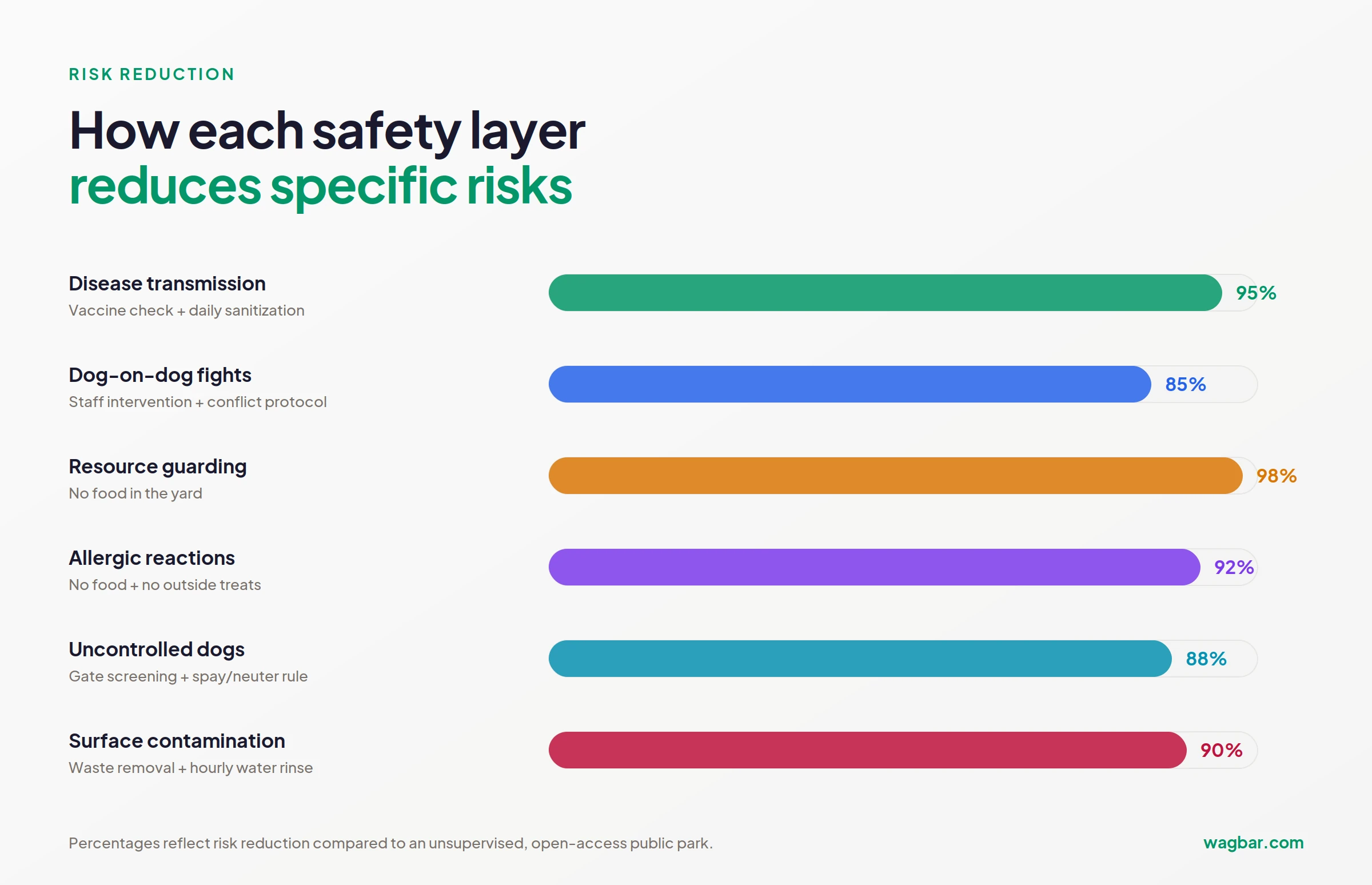
Every dog is checked at the gate before entering the yard. Rabies, DHPP (distemper, hepatitis, parvovirus, parainfluenza) and Bordetella (kennel cough) are required and verified from veterinary records, not self-reported. This single layer blocks the diseases that spread fastest in shared dog spaces. Parvovirus survives in soil for up to a year and is almost always fatal in unvaccinated puppies. Giardia spreads through contaminated water bowls. Kennel cough transmits through respiratory droplets in close quarters. A public park lets any dog walk in unchecked.
Layer 2. Trained staff supervision
Dog bartenders walk the yard continuously, reading canine body language and acting on what they see. They recognize play bows as safe signals, stiff posture as a warning, whale eye as stress and mounting as a cue to redirect. They spot these in two to three seconds and step between dogs before tension becomes contact. This is fundamentally different from a public park where the only supervision is owners checking their phones.
Layer 3. No food in the play yard
Wagbar prohibits all food, treats and edible items inside the play yard. This is a safety decision backed by four specific risks. Food triggers resource guarding, where a treat in one dog’s mouth becomes a target for every dog in smelling range and escalates from stiff posture to a fight in seconds. Food causes allergic reactions when dogs grab something not meant for them, because dairy, grain and chicken allergies are common and a stranger’s treat does not come with an ingredient list. Food creates choking hazards during active play, since a dog sprinting with a chew in its mouth is one stumble from an obstruction. And food leaves crumbs and residue on the turf that attract insects, generate odor and compound the cleaning load. Keeping food out keeps play calm, dogs healthy and surfaces clean. Dogs can eat before or after their visit.
Layer 4. Conflict de-escalation protocol
When two dogs clash, staff run a five-step protocol. They spot the tension signals, step between the dogs using body position without grabbing collars, separate both to cool-down zones, assess each dog individually for stress and injury, then decide whether to reintroduce or exit one dog for the day. The protocol runs in under 60 seconds. At a public park, the “protocol” is two owners yelling their dogs’ names from across the field.
Layer 5. Spay/neuter requirement
All dogs over six months must be spayed or neutered. Intact dogs can trigger hormonal responses in other dogs, including mounting, territorial marking and heightened arousal that elevates tension across the entire yard. Removing this variable from the group dynamic makes every other safety layer work better.
Layer 6. Clean, maintained surfaces
Waste is removed by staff within minutes instead of relying on the honor system that produces the predictable results you see at public parks. Water stations are rinsed and refilled hourly. Surfaces are sanitized daily with pet-safe disinfectant. The cleanliness standard blocks disease vectors like contaminated feces, standing water and unwashed surfaces that an unmaintained park cannot control.
Dog Bar vs. Public Park Safety
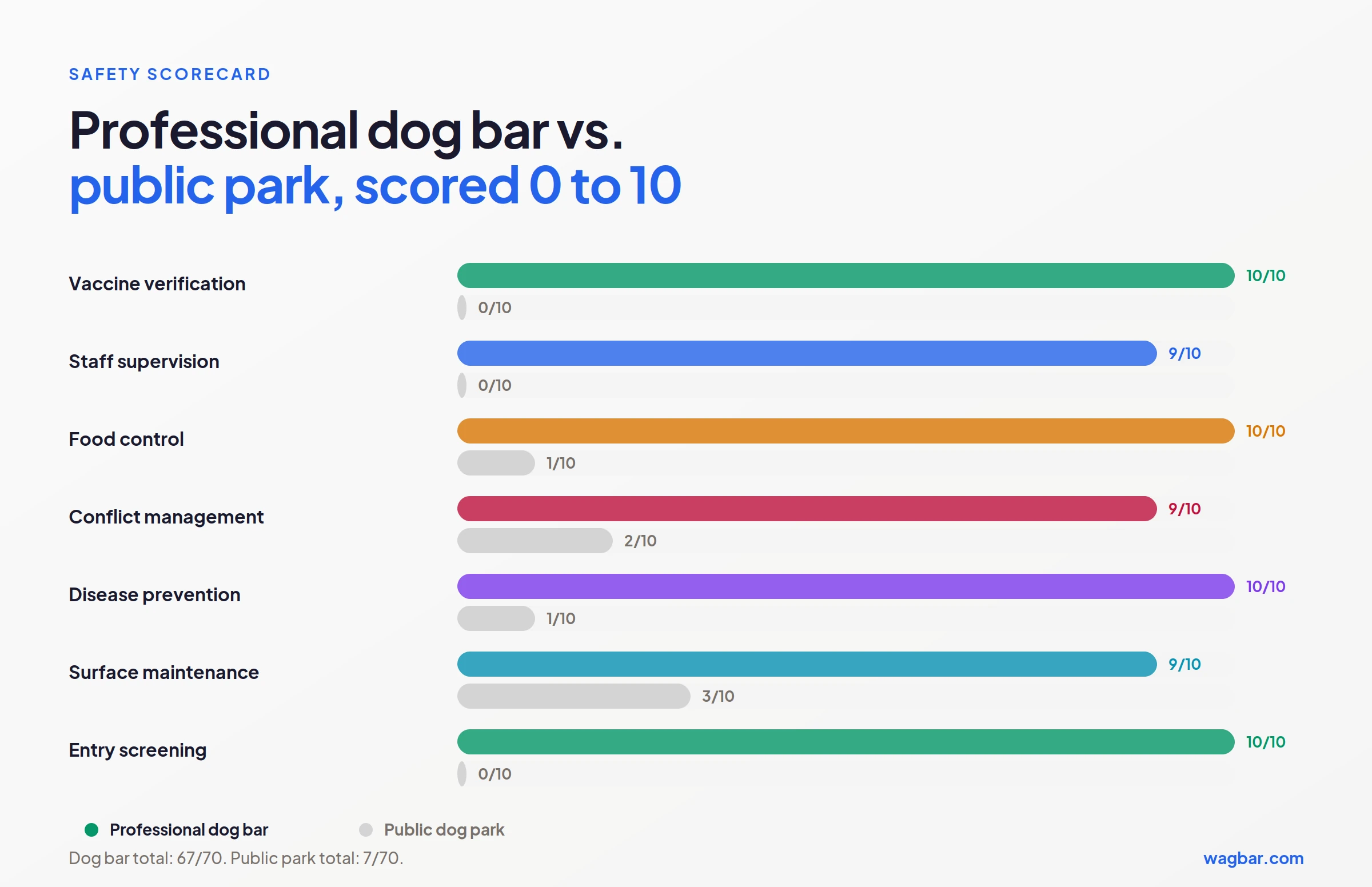
The comparison is not close. A public dog park has no vaccine checks, so unvaccinated and sick dogs enter freely. It has no staff, so conflict intervention depends entirely on owners. It has no food restrictions, so anyone brings anything. It has no conflict protocol, so fights play out until someone gets hurt. It has no waste system beyond the honor system. And it has no disease prevention, so parvo, giardia and kennel cough spread unchecked. A professional dog bar runs all six safety layers simultaneously, staffed by people trained to execute them.
The outcome gap follows directly. Professional venues see dramatically fewer bite incidents, near-zero disease transmission within the yard, higher customer retention and a calm atmosphere that keeps dogs focused on play instead of scanning for threats.
How to Evaluate Any Dog Bar
Not every venue that calls itself a dog bar runs all six layers. Before you bring your dog, check these five things.
- Are vaccines verified at the gate with actual records, not self-reported?
- Are there dedicated staff in the yard whose only job is watching the dogs?
- Is food prohibited in the play area?
- Can the staff describe their conflict protocol, or do they shrug when you ask?
- Is the yard clean right now while dogs are using it, not just “we cleaned it this morning”?
A venue that passes all five is doing it right. A venue that fails any one is cutting a corner that will eventually cost a dog.

Dog Bar Safety FAQs
Are dog bars safe for small dogs?
At well-run venues, yes. Wagbar’s staff supervision model includes redirecting size-mismatched play when it gets physical. Some venues offer separate small-dog areas. Ask about size management before your first visit.
What happens if my dog gets hurt at a dog bar?
Professional venues have trained staff who administer basic first aid and document every incident. Wagbar’s dog bartenders are trained in canine first aid including wound care, heatstroke response and choking protocol. Serious injuries are referred to a veterinarian immediately.
Are dog bars safer than dog daycare?
Both models use professional supervision, but the details differ. Dog bars are open-access where you stay with your dog, while daycare involves drop-off and pickup. The safety layers of vaccine checks, trained staff and conflict protocols should be present in both. Evaluate them the same way.
Why don’t dog bars allow food in the yard?
Four reasons. Resource guarding turns a treat into a fight trigger. Allergic reactions happen when dogs grab food not meant for them. Choking hazards increase when dogs run with food in their mouths. And surface contamination from crumbs attracts insects and creates odor. Removing food removes all four risks at once. Dogs can eat before or after their visit.
How do dog bars prevent disease?
Vaccine verification at the gate blocks the most transmissible diseases including parvo, kennel cough and distemper. Daily sanitization of surfaces with pet-safe disinfectant kills pathogens that survive between visits. Hourly water station cleaning prevents waterborne transmission. These three systems together bring disease transmission to near zero.
Safety Is Not a Feature. It Is the Foundation.
Every other thing a dog bar offers sits on top of safety. Without the six layers running, none of it works. See how Wagbar builds safety into every franchise location from day one.

Wagbar does not represent what a franchise owner will earn. Verified performance data is available only in Item 19 of the FDD, provided to qualified candidates during formal disclosure. Published cost figures are FTC-required regulatory estimates and are not profitability guarantees.
Six Layers. Zero Shortcuts.
Vaccine check at the gate, trained eyes on the yard, no food in the play area, a protocol for every conflict, altered dogs only, clean surfaces all day. That is what safe looks like. Bring your pup’s vaccine records and see it in action at the nearest Wagbar.
Dog bars are safe when they run six layers. Vaccine-verified entry, trained staff supervision, no food in the yard (prevents resource guarding, allergic reactions, choking and surface contamination), conflict de-escalation protocol, spay/neuter requirement, and clean maintained surfaces. Public parks run zero of these. Evaluate any dog bar on five checks. Vaccines verified with records, dedicated yard staff present, food prohibited, conflict protocol described clearly, yard visibly clean during use. A venue that passes all five is doing it right.