
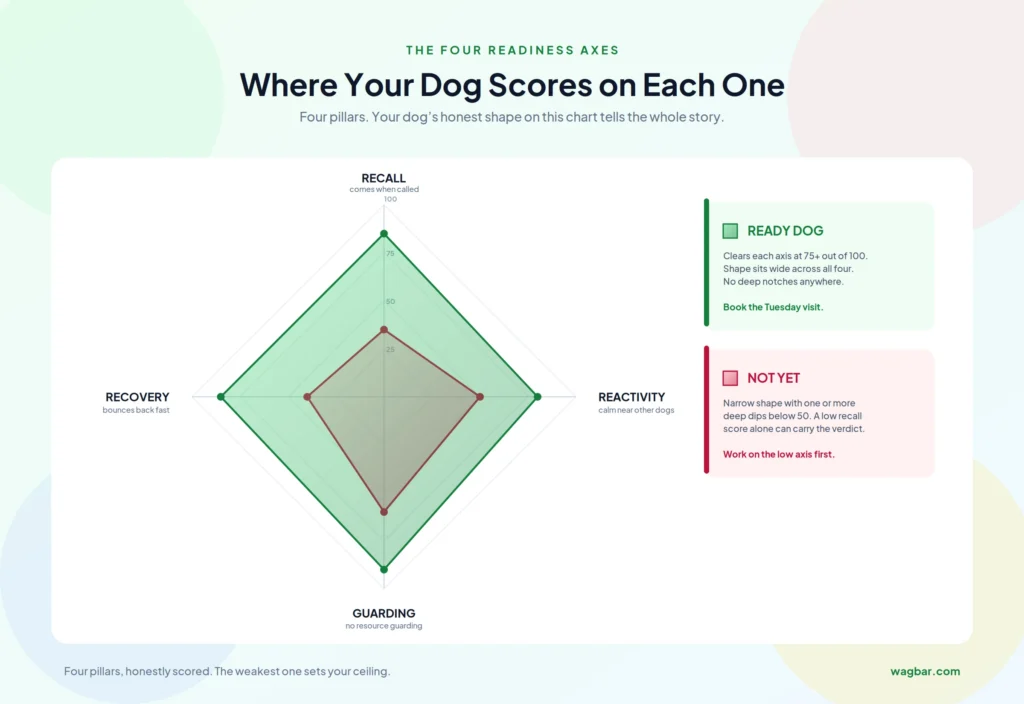
Top TL;DR: Your dog is ready for an off-leash dog bar when they have reliable recall under distraction, can be near other dogs without lunging or freezing, don’t guard food or toys aggressively, and recover from minor surprises within a minute or two. Run the eight-question self-assessment below before your first visit. If six or more answers are honest “yes,” you’re good to go. If several are “no,” put in a few weeks of focused work first. Readiness is not a moral grade on your dog, and it’s not fixed. It’s just a reading of where they are today and whether this specific venue is the right next step.
Behavioral readiness for an off-leash dog bar is different from general obedience. Your dog doesn’t need to know fifteen tricks. They don’t need a perfect heel. What they do need is the social and emotional baseline to handle a high-stimulation environment with twenty other dogs, music from the bar, food smells wafting over from the food truck, and a steady trickle of new arrivals at the gate. This page is the honest version of “should I bring them yet,” written down so you don’t have to guess.
What “Ready” Actually Means Here
Wagbar requires every dog to be at least six months old, spayed or neutered, and current on Rabies, Bordetella and DHPP. Those are the medical baseline and the whole gate picks them up. The full dog park rules page covers each requirement in detail, including why DHPP is the standard combination vaccine and what paper the gate accepts.
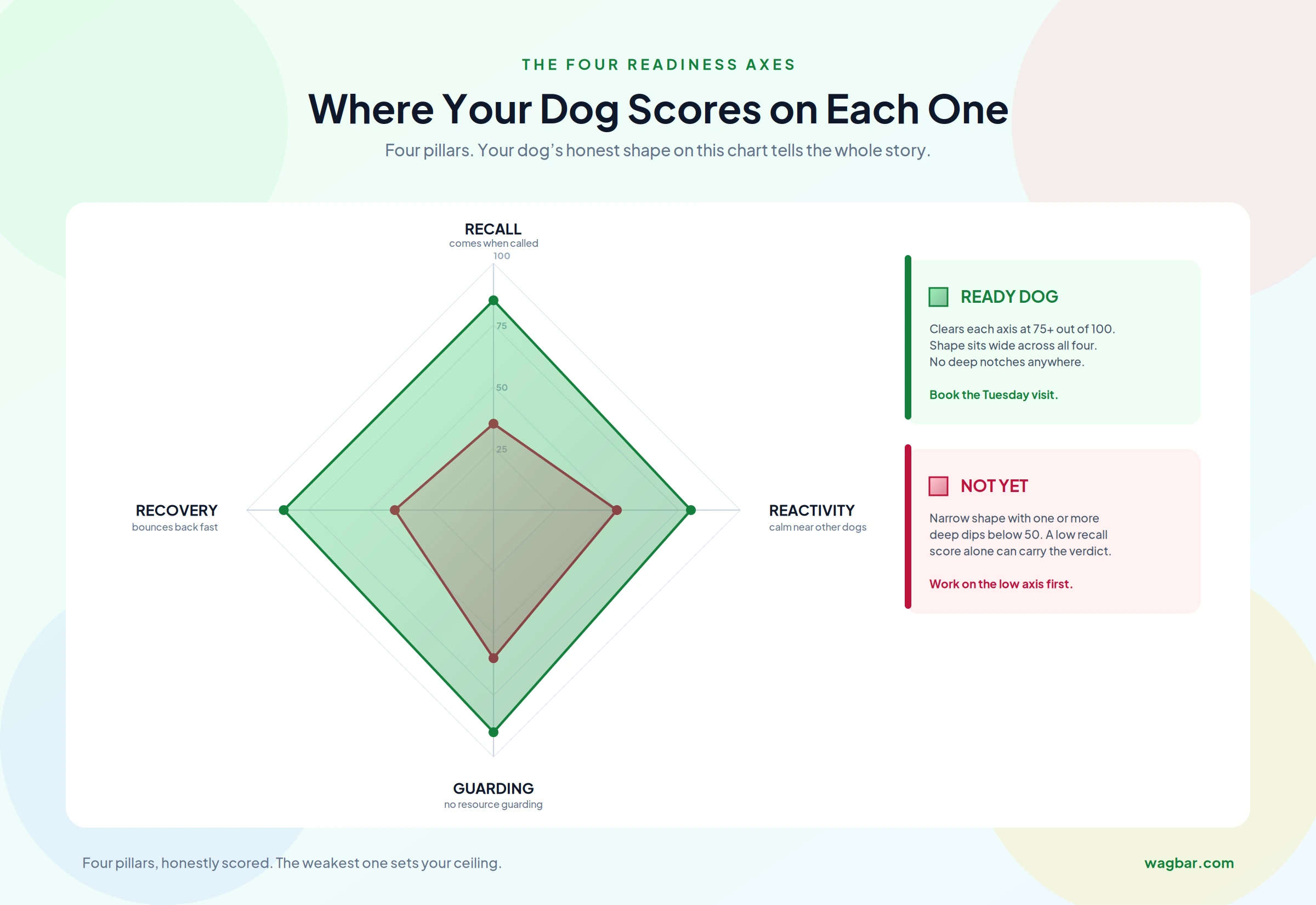
Beyond the medical gate, the dog bar model puts your dog in a setting where staff supervise but owners are still the first line of awareness. The yard team at Wagbar are the Bark Rangers, watching the group as a whole. You’re watching your individual dog. That split works when your dog is socially calibrated. It backfires when your dog is sent in before they’re ready. The four big readiness pillars are recall, reactivity around other dogs, no heavy resource guarding, and recovery after surprises. Everything else sits downstream of those four.
Recall: Can Your Dog Come Back to You?
Recall is the single biggest indicator of readiness. If your dog comes when called in your living room but ignores you in a park, they’re not ready for an off-leash bar. The version of recall that matters here is “comes back when called even when something more interesting is happening.” That’s a higher bar than most people realize. A dog who comes when nothing else is going on isn’t really tested. A dog who comes when another dog is running past them is.
Try this. Walk your dog to a quiet park or a friend’s yard. Drop the leash. Wait until they’re sniffing or watching something. Call them. If they turn and come within a few seconds, you’ve got real recall. If they glance at you and keep doing what they’re doing, you’ve got partial recall. If they don’t even acknowledge you, you’ve got recall problems that need work before any off-leash environment.
Recall doesn’t have to be perfect, but it has to be reliable enough to pull your dog out of an interaction if you see something going sideways. At Wagbar that might mean redirecting your dog away from a play partner who’s getting overwhelmed, or calling them off the gate when a new dog is entering. Without recall, you’re a passenger.
Reading Your Dog’s Reaction to Other Dogs
The next big readiness check is how your dog responds when other dogs are around. Watch them on a normal walk when another dog passes on the other side of the street. A ready dog notices the other dog, maybe pauses, and continues. They might wag, sniff the air, look interested. Their body stays loose. They keep moving with you when you cue them.
A not-ready dog reacts hard. They lunge, bark, freeze or pull. They might do this at every dog or only at certain ones. Even if they’re “friendly” reactive (excited to meet, not aggressive), the intensity is still a problem in a confined off-leash setting where they don’t get to launch at every new arrival. Reactivity isn’t a moral failure. Lots of dogs are reactive at some point in their lives, and many work through it with training. But it’s a real signal that the off-leash bar isn’t the right environment yet.
Resource Guarding: The Quiet Deal-Breaker
Resource guarding is the behavior where a dog gets tense, growls, snaps or fights when they think someone’s about to take something they value. It can be food, toys, a favorite person, even a spot on the couch. In a dog bar setting, this matters because the policy bans food and toys inside the yard specifically to remove the main triggers, and that policy exists because resource guarding incidents are the most common avoidable scuffle. Even so, dogs still come across things. A stick. A water bowl. A bench they’ve claimed.
A dog who resource guards heavily at home is at higher risk in this setting. Watch for early signs. Stiffening when another dog approaches their food. Lifting their lip when you reach for a chew. Low growls when someone walks past their bed. Mild guarding is workable. Strong guarding with snaps or bites is a real signal to address before any group setting, usually with a trainer who specializes in it rather than something to fix on your own.
Recovery After Surprises: The Bounce-Back Test
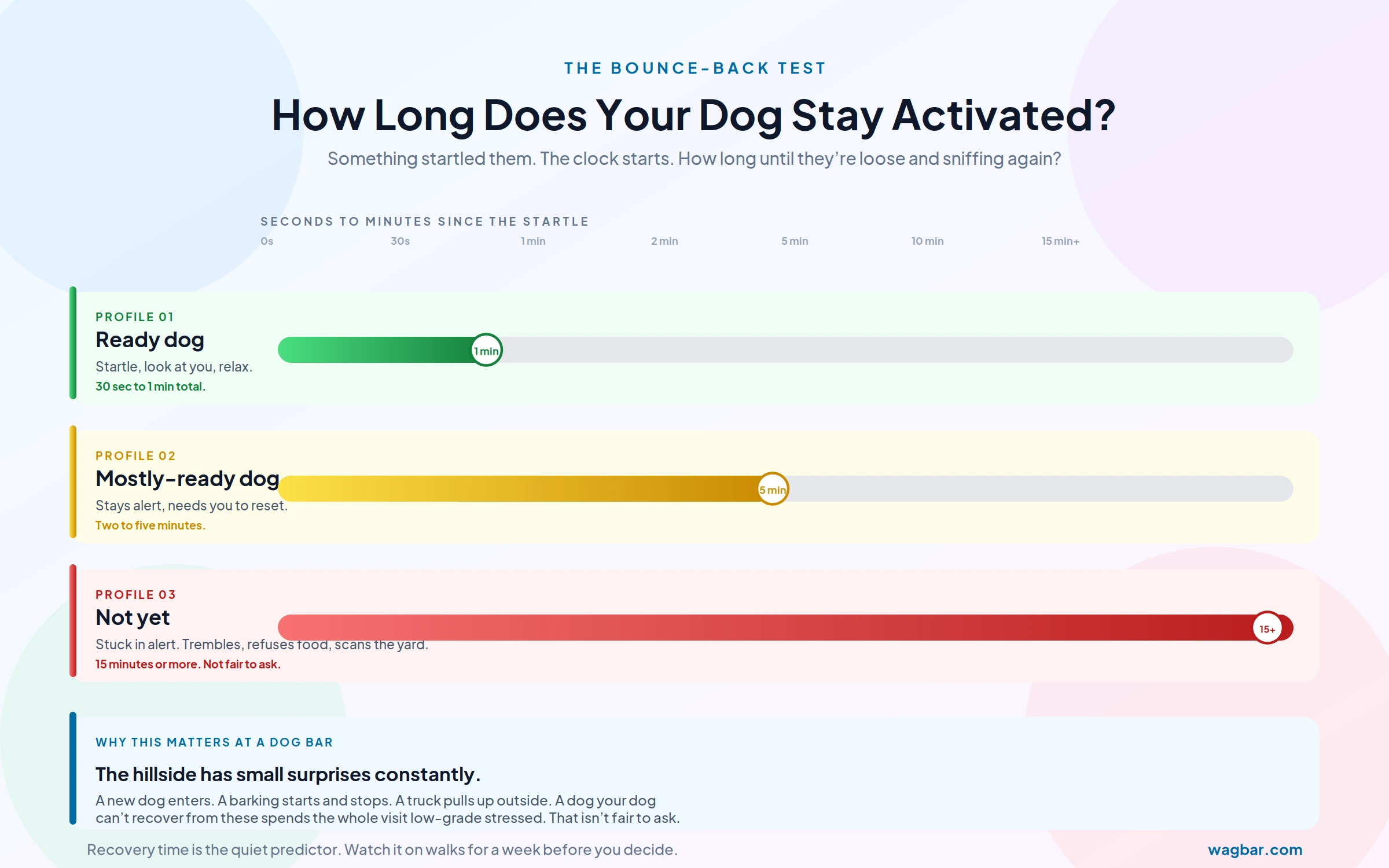
This one’s subtle but important. When something unexpected happens (a loud noise, a stranger walking up fast, another dog charging over), how long does it take your dog to recover? A ready dog might startle, look at you, get a little stiff, and then within thirty seconds to a minute they’re back to normal. They settle. Their body relaxes. They go back to sniffing or moving.
A not-yet-ready dog stays activated. The startle becomes a fixation. They stay on alert for ten or fifteen minutes. They might tremble, refuse food, plant their feet, or scan the area constantly. That difference is what the chart below is measuring.
Body Language You Should Read Before You Go
You don’t need to be an expert behaviorist, but reading basic dog body language is part of being a responsible owner in a group setting. The minimum vocabulary is roughly this. A loose body, soft eyes, relaxed mouth and play bows mean a dog who’s having a good time. A stiff body, hard stare, closed mouth and high tail mean a dog who’s not. Lip licks, yawns out of the blue, turning the head away, and slow movement mean a dog asking for space.
If you don’t already read these signals, take a few hours to learn them before your first visit. The dog park etiquette page walks through what counts as acceptable play on the hillside and what signals warrant stepping in. Knowing this changes how you watch your dog at the park, and it lets you intervene before something escalates. You also need to be able to read your own dog specifically. Every dog has personal tells. Some pant when stressed. Some shake. Some hide behind you. Some get hyper-clingy. Whatever your dog’s stress signals are, you should know them well enough to spot them across a busy yard.
The Eight-Question Self-Assessment
Run through these honestly. “Mostly” doesn’t count. Either yes or no.
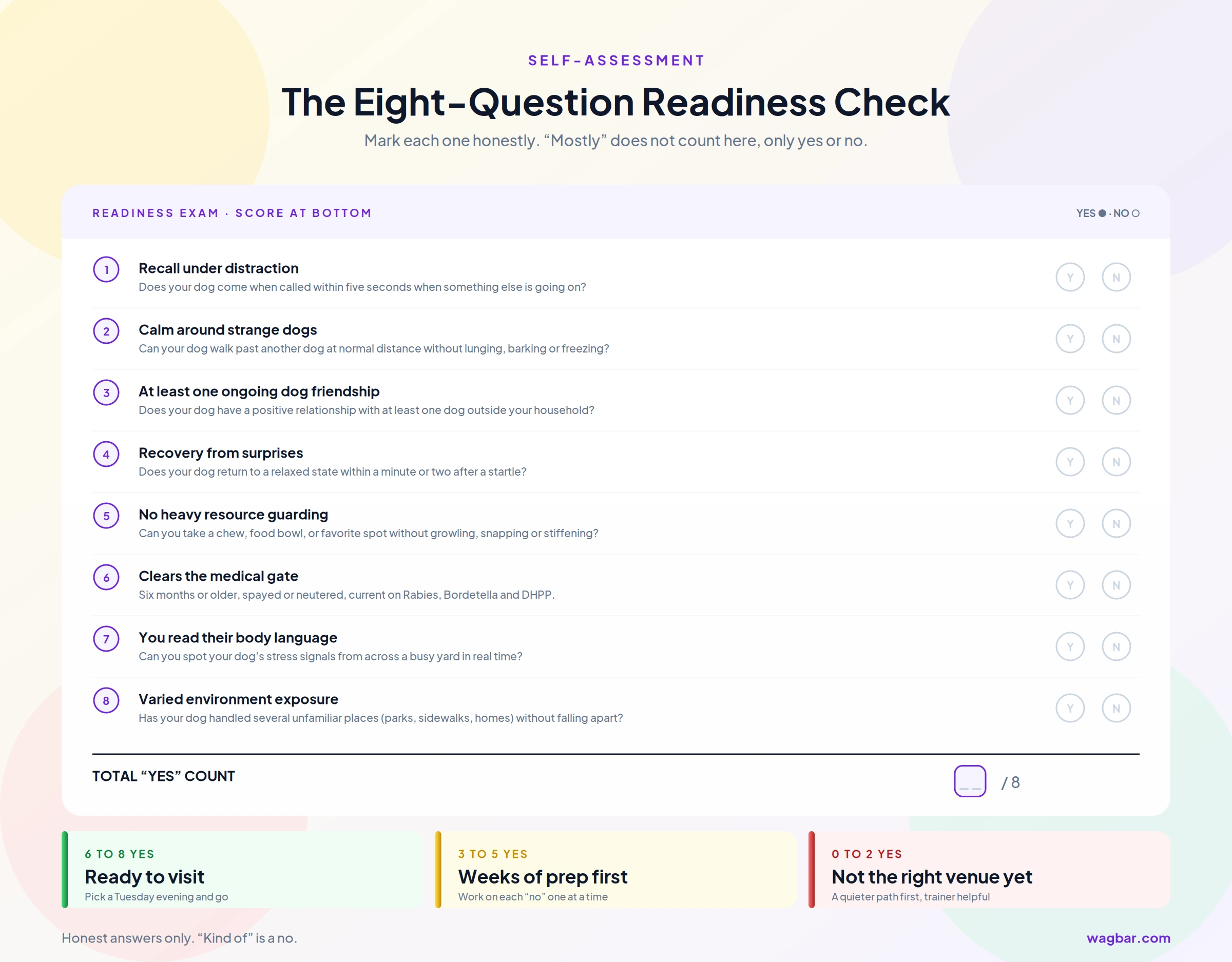
- Does your dog come when called within five seconds when they’re distracted by something interesting?
- Can your dog walk past another dog at a normal distance without lunging, barking or freezing?
- Does your dog have at least one positive ongoing experience with a dog outside your household (a friend’s dog, a cousin’s dog, a regular walking buddy)?
- Does your dog recover within a minute or two when something startles them?
- Can you take a chew, food bowl or favorite spot from your dog without growling, snapping or stiffening?
- Is your dog at least six months old, spayed or neutered, and current on Rabies, Bordetella and DHPP?
- Does your dog show clear, readable body language that you can interpret in real time?
- Has your dog had a few exposures to varied environments (different parks, sidewalks, friends’ homes) without falling apart?
Six or more “yes” answers usually means your dog is ready. Three to five means there’s prep work to do. Two or fewer means the off-leash bar isn’t the right next step yet. That’s a diagnosis, not a verdict.
Common False Positives
A few patterns make owners think their dog is more ready than they actually are. Watch for these.
“My dog is friendly with my other dog at home.”
Living with a sibling dog is different from meeting twenty unfamiliar dogs at once. Home siblings have a worked-out relationship over months or years. The bar setting is a flood of new dogs, new smells and new social negotiations every minute.
“My dog plays great at daycare.”
Daycare and an off-leash bar overlap but aren’t the same. Daycare typically has smaller groups, structured time, and trained handlers running the floor all day. The bar adds music, food trucks, dropped objects, and a much wider variety of dogs and energy levels showing up at random hours.
“My dog has been to dog parks before.”
Most dog parks are smaller and quieter than an off-leash bar. Some are also poorly supervised, which means your dog may have learned to cope rather than thrive. Coping isn’t readiness.
“My dog used to be social as a puppy.”
Puppy social skills don’t always carry into adulthood, especially if the dog had a sparse socialization period or a single bad experience between months six and eighteen. Re-evaluate your adult dog as the dog they are now, not the dog they used to be.
“My dog is a friendly breed.”
Breed tendencies matter, but individuals vary widely. A “friendly” Golden Retriever can still be reactive. A “tough” Pit Bull can still be a social butterfly. Read the dog in front of you, not the stereotype.
If the Answer Is “Not Yet,” Here’s the Path Forward
A “not yet” answer isn’t a verdict. It’s a starting point. Most dogs who aren’t ready can get there with a few weeks to a few months of focused work. Start with the gaps that showed up in your assessment. If recall was the issue, work on recall in low-distraction settings and build up to higher-distraction ones. If reactivity was the issue, that’s its own training arc. If resource guarding was the issue, talk to a trainer who specializes in it before trying to fix it on your own.
Build social exposure gradually. Calm parallel walks with one other dog. Quiet meetups in a friend’s yard. A short visit to a low-traffic dog park during off-hours. Each layer adds confidence. If your dog is a newly adopted dog still inside the 3-3-3 adjustment window, the readiness clock hasn’t really started yet, and the kindest move is to wait it out before running this assessment at all.
When you do get to the readiness threshold, start with a short first visit during a quiet hour. Mid-week mornings are usually calmest. Treat the first visit as a test rather than a commitment to a full afternoon. If it goes well, you’ve confirmed the work paid off. If it doesn’t, you’ve learned something useful without blowing a whole Saturday.
What a Good First Visit Actually Looks Like
Two new dogs meeting on the hillside, the circle of sniffs, a play bow or two, a short burst of chase, and then the whole thing settling. The clip below is roughly what you’re working toward when the assessment above comes back green.
Where This Fits in the Bigger Picture
This readiness check is the gate before the gate. If your dog clears it, the first visit to a dog bar pillar is the right next read, with a full walkthrough of what to expect from the parking lot to the goodbye at Wagbar Asheville on 320 Merrimon Avenue in Weaverville. If your dog doesn’t clear it, this page is a path forward rather than a closed door.
Frequently Asked Questions
How old does my dog have to be to come to Wagbar?
At least six months old, spayed or neutered, and up to date on Rabies, Bordetella and DHPP. The reasoning behind the spay and neuter rules is covered in its own page, including the welfare and conflict-reduction case. The age cutoff lets your dog’s immune system, body and behavior mature before being introduced to a busy group setting.
What if my dog is friendly but very high-energy?
High energy isn’t a problem on its own. It becomes one if your dog can’t moderate themselves around lower-energy dogs. Watch for overarousal like fixated chasing, mounting, or inability to stop. If your dog can play hard but also pause, drink water and read other dogs’ signals, energy alone won’t keep them from being ready.
Can a shy dog handle an off-leash dog bar?
Often yes, with a slow introduction. A shy dog who watches from a distance, stays close to their owner, and gradually engages over multiple visits is doing fine. A shy dog who shuts down completely, refuses to move, or shows persistent stress signals is telling you they need more time and a different environment first.
My dog had one bad experience years ago. Are they still ready?
Maybe. Bad experiences leave imprints, but they don’t always become permanent. Test your dog’s current reactions in controlled settings first. If they’ve moved past it, they may be fine. If you see lingering fear or reactivity tied to the original event, address that with a trainer before adding a high-stimulation environment.
Is the readiness check different for older dogs?
Mostly the same, with a few add-ons. Older dogs benefit from shorter visits, especially if they have arthritis or low stamina. They may also do better at less crowded times. The same recall, reactivity and recovery checks apply, but consider physical comfort alongside behavior.
Should I bring my dog if they’ve never been around other dogs?
A first off-leash bar visit isn’t the right place for true first-ever dog exposure. Build up with smaller, controlled meetings first. Once your dog can handle one or two unfamiliar dogs without spiraling, the off-leash bar becomes a reasonable next step. Wagbar staff screen vaccinations and supervise the floor, but that screening isn’t a substitute for a dog being socially prepared.
Where exactly is Wagbar?
Wagbar Asheville sits on a 25,000 square-foot grassy hillside at 320 Merrimon Avenue, Weaverville, North Carolina. It’s the only Wagbar currently open.
What’s the best time for a first visit?
Mid-week mornings or Tuesday evenings. Both run calmer than weekend afternoons, which makes the first visit easier to read and easier to recover from if your dog isn’t quite as ready as you thought.
Bottom TL;DR: Behavioral readiness for an off-leash dog bar comes down to four pillars. Solid recall under distraction. Calm reactions to other dogs. No heavy resource guarding. Quick recovery from surprises. Walk through the eight-question self-assessment and answer honestly. Six or more “yes” answers means you’re ready to plan a first visit at Wagbar Asheville, 320 Merrimon Avenue, Weaverville. Anything less means a few weeks of focused work first. “Not yet” is a diagnosis, not a verdict. Most dogs who aren’t ready today can be ready in a month or two with the right prep.