
Top TLDR: When two dogs don’t click at Wagbar, our Bark Rangers run a five-step protocol in under 60 seconds: spot the tension signals, step between the dogs using calm body blocking, cue a redirect or separation, check both dogs and both owners, then decide whether play resumes. Owners stay with their own dog throughout. No raised voices, no grabbing collars, no dragging. The goal is to defuse before anything escalates.
Dogs aren’t people. They don’t always click. At a well-run dog bar, that’s okay — because the staff on the yard are trained to catch the early signs before the first lifted lip. At Wagbar those staff are Bark Rangers, and when two dogs don’t get along, the protocol runs quietly, calmly, and fast. Here’s exactly what happens.
- Five-step protocol: spot → step in → separate → assess → decide. Under 60 seconds.
- Prevention is the standard. The protocol exists for when prevention fails. Good supervision means it rarely fires.
- No food in the yard eliminates the most preventable trigger — resource guarding over food.
- Incompatible dogs aren’t banned. They come back on a quieter day with a different mix.
Conflict between dogs in a shared off-leash space isn’t a question of if — it’s a question of how well the staff handle it when it happens. At an unsupervised public park, two dogs who don’t get along means a fight that owners try to break up (often making it worse) or one that plays out until someone gets hurt. At a professionally managed dog bar, it means a trained Bark Ranger reads the tension before it peaks and runs a protocol designed to resolve the situation safely for both animals.
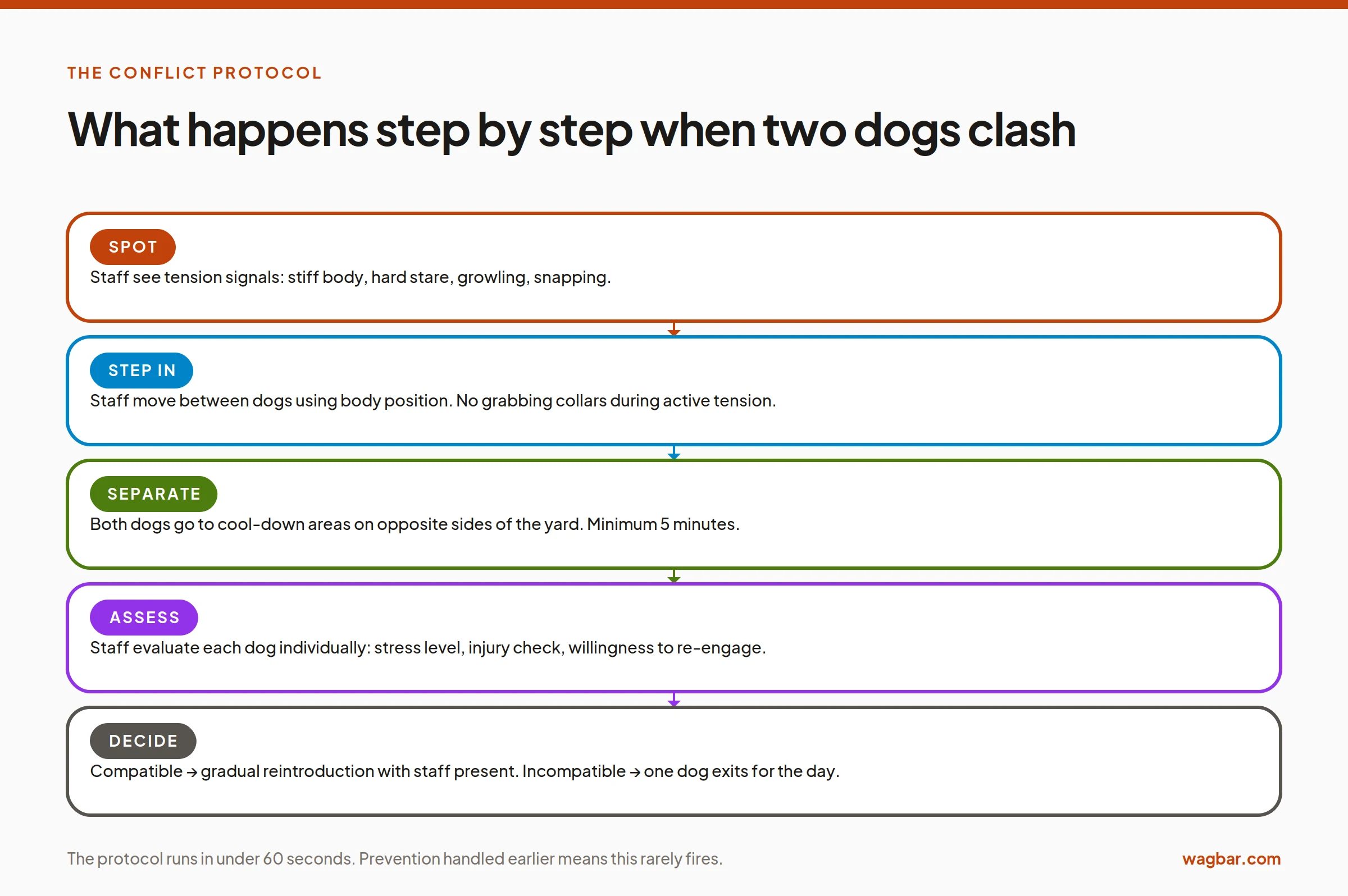
The Five-Step Conflict Protocol
Step 1: Spot the signals
Conflict doesn’t start with a bite. It starts with body language that most owners miss and trained staff catch instantly. A stiff body with locked joints. A hard stare fixed on another dog without breaking. A rigid tail — not wagging, not tucked, just held in position. Lip curling that exposes teeth. A low growl that the other dog’s owner can’t hear from 30 feet away. The Bark Ranger sees these signals and begins moving toward the dogs within two to three seconds.
Step 2: Step in with body position
The staff member moves into the space between the two dogs. Not running. Not yelling. Walking with calm, deliberate energy that interrupts the fixation without adding more arousal to the situation. The staff member’s body breaks the eye contact between the two dogs, which is often enough to defuse the tension on its own. The critical rule: never grab a dog’s collar during active tension. A grabbed collar often triggers a redirected bite — the dog turns and snaps at the nearest hand because it’s already in fight mode.
Step 3: Separate both dogs
Both dogs go to cool-down areas on opposite sides of the yard. Not just the “aggressor” — both. In most conflicts, both dogs contributed to the escalation even if one was more overtly aggressive. Separating both prevents the remaining dog from redirecting its arousal onto a third dog in the yard. Each dog is leashed if necessary and walked calmly to its cool-down zone.
Step 4: Assess individually
With the dogs separated, staff check each one individually. Injury check first — mouth, ears, legs, belly. Then stress level: is the dog panting, shaking, whale-eying, or has it already calmed down? Finally, willingness to re-engage: is the dog looking back toward the yard with relaxed body language, or is it still stiff and fixated? This assessment takes five to ten minutes and determines what happens next.
Step 5: Decide — reintroduce or exit
If both dogs show relaxed posture and no lingering fixation, staff run a parallel walk: both dogs walked side by side at a comfortable distance, with staff between them, before sharing open space again. If either dog is still tense or the conflict was severe (breaking skin, sustained aggression), one dog exits the yard for the day. Not as punishment — as a safety decision. That dog is welcome back on a different day with a different yard mix.
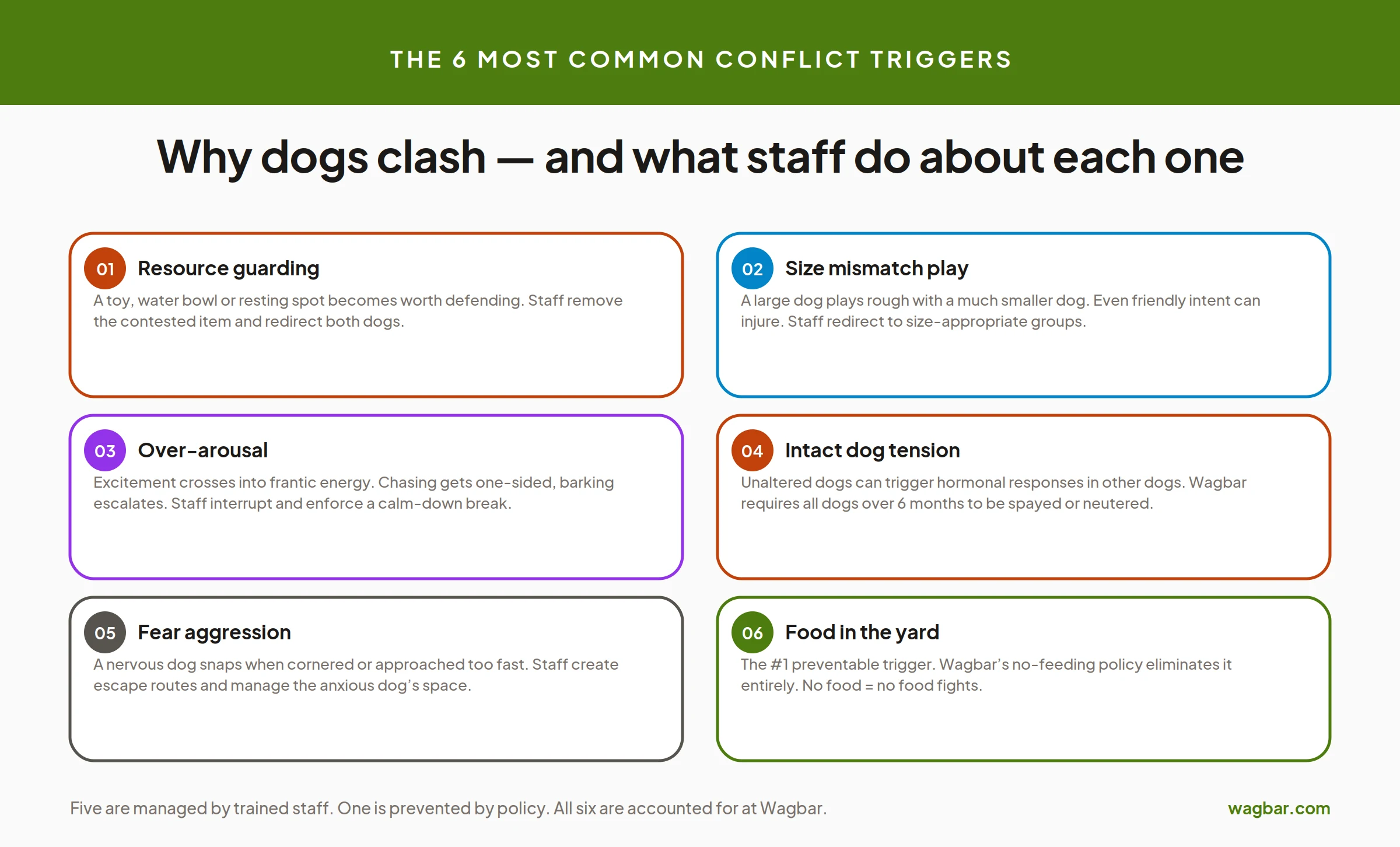
The Six Most Common Conflict Triggers
Resource guarding
A toy, a water bowl, a shaded resting spot, an owner’s lap — any valued resource can trigger possessive behavior. The fix is twofold: staff remove the contested item immediately, and high-value items (toys that individual dogs fixate on) are rotated out of the yard. Water stations are spaced far enough apart that no single dog can “own” one.
Size mismatch play
A 90-pound lab playing with a 15-pound dachshund isn’t inherently dangerous, but the margin for accidental injury is thin. Even friendly roughhousing from a large dog can knock a small dog into a fence post or roll it hard enough to cause a joint injury. Staff redirect size-mismatched pairs when the play gets physical.
Over-arousal
Some dogs escalate from playful to frantic without a clear trigger. Chasing becomes one-sided, barking turns sharp, and the dog can’t self-regulate back to calm. Staff interrupt with a calm-down break — leash the over-aroused dog, walk it slowly around the perimeter for a few minutes and reintroduce only when the energy drops.
Fear aggression
A nervous or under-socialized dog that feels cornered will snap. The aggression looks sudden to owners but follows a clear sequence of displacement signals (yawning, lip licking, turning away) that trained staff recognize. The fix isn’t correcting the fearful dog — it’s managing the space around it so it always has an escape route and isn’t crowded by confident dogs.
Intact dog tension
Unaltered dogs can provoke hormonal responses in other dogs, increasing tension across the entire yard. Wagbar requires all dogs over six months to be spayed or neutered — a policy that removes this trigger before the dog enters the gate.
Food in the yard
The single most preventable trigger. A treat, a pup cup, a dropped piece of a food truck meal — any food item in the yard creates an instant resource guarding event. Wagbar’s no-feeding policy eliminates this trigger entirely. No food enters the play yard. No treats from owners, no handouts from staff, no exceptions. The result: zero food-related conflicts.
The Cool-Down and Reintroduction Process
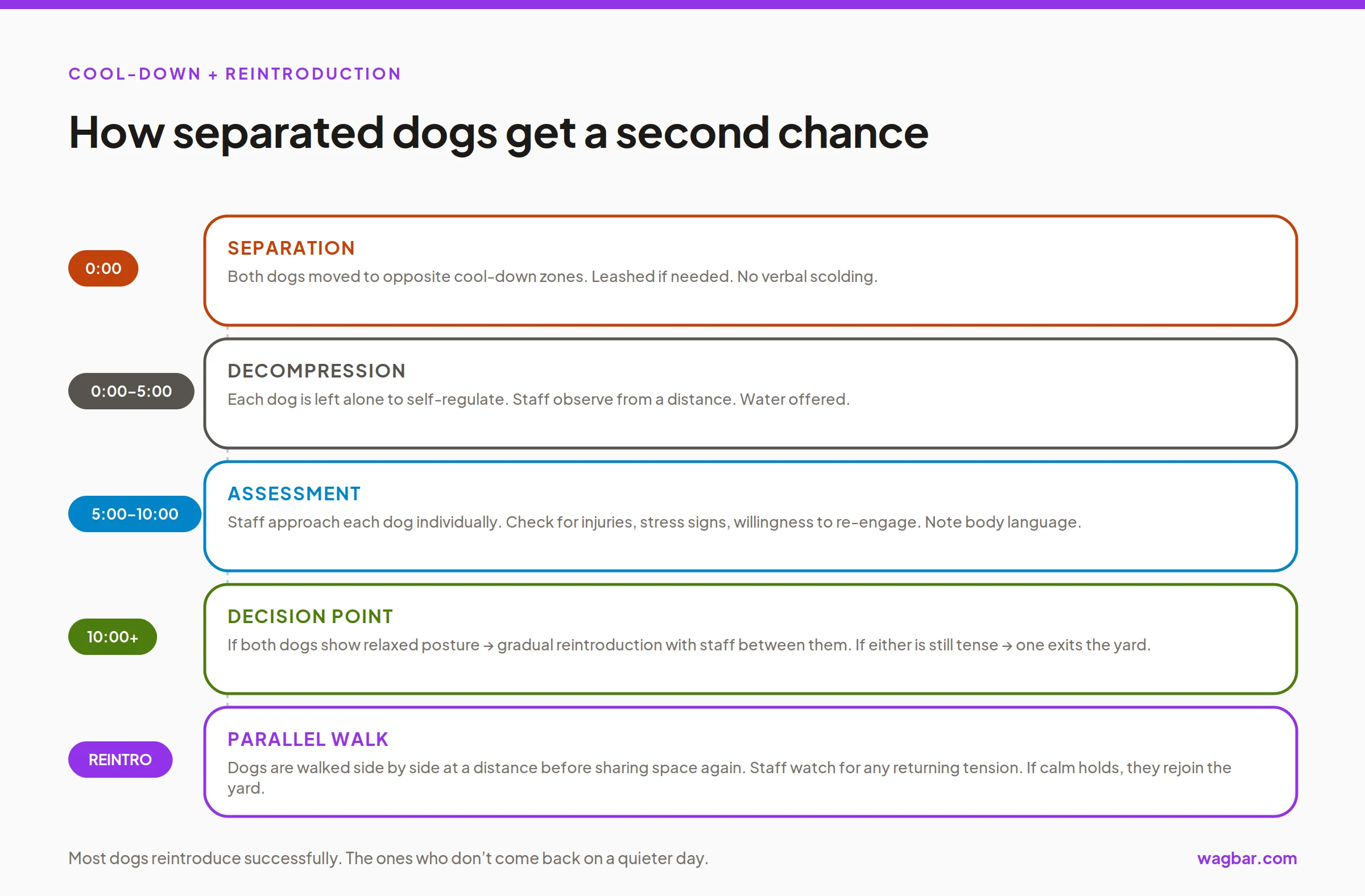
Separation isn’t the end of the story for most dogs. The cool-down process has four phases: decompression (five minutes of quiet, no human interaction), assessment (staff approach individually and check body language), the decision point (relaxed posture means reintroduction is possible, ongoing tension means exit), and the parallel walk (both dogs walked side by side at a distance before sharing the yard again). Most dogs reintroduce successfully. The ones who don’t come back on a quieter day with a smaller group.

Dog Conflict FAQs
What happens if my dog gets in a fight at Wagbar?
Staff separate both dogs immediately, check for injuries, and run the cool-down protocol. You’ll be briefed on what happened and what both dogs’ body language showed before the incident. If the conflict was minor, your dog can rejoin the yard after a supervised reintroduction.
Will my dog be banned after a conflict?
No. A single conflict doesn’t result in a ban. Dogs that are fundamentally incompatible with group play after repeated incidents may be recommended for smaller play groups or off-peak visits. Bans are reserved for dogs with a pattern of severe, unprovoked aggression.
Should I intervene if my dog is in a conflict?
Let the staff handle it. Owners who rush in during a conflict often escalate the situation — yelling adds arousal, grabbing collars risks redirected bites. The Bark Rangers are trained for exactly this moment. Step back and let them work.
How does the no-feeding rule prevent conflicts?
Food is the number one trigger for resource guarding in shared dog spaces. A treat in one dog’s mouth triggers competition from every dog in range. Removing all food from the yard eliminates the trigger entirely, letting staff focus on managing play dynamics instead of policing food fights.
Do Bark Rangers physically restrain dogs?
They use body positioning and calm redirection, not physical restraint. Grabbing a tense dog’s collar often triggers a redirected bite. Staff step between dogs to break eye contact and walk them away using leash guidance when needed.
Build a Venue That Handles Conflict Professionally
The five-step protocol, the trigger awareness, the cool-down process — these are operational systems built into every Wagbar franchise. Learn how Wagbar trains its team to manage the yard.

Wagbar does not represent what a franchise owner will earn. Verified performance data is available only in Item 19 of the FDD, provided to qualified candidates during formal disclosure. Published cost figures are FTC-required regulatory estimates and are not profitability guarantees.
Conflict Handled. Play Continues.
Two dogs that don’t get along aren’t a crisis — they’re a protocol. Trained staff, clear steps, calm execution. Bring your pup’s vaccine records and see how a managed yard keeps every dog safe at the nearest Wagbar.
Bottom TLDR: Dog conflicts at Wagbar follow a five-step protocol: spot signals, step in with body position, separate both dogs to cool-down zones, assess individually for injury and stress, decide on reintroduction or exit. The six common triggers are resource guarding, size mismatch, over-arousal, fear aggression, intact dog tension and food in the yard — the last one eliminated by the no-feeding policy. Cool-down takes 5 to 10 minutes. Most dogs reintroduce successfully. Incompatible dogs return on a quieter day.