

Top TLDR: A covered dog patio turns a seasonal off-leash park into a year-round destination. Shade sails or solid roofs handle summer sun and rain. Industrial fans and misting systems cool the air on hot days. Propane or electric heaters push the outdoor season through fall and even mild winters. The best covered patios also give dog owners a comfortable place to sit, eat and drink while keeping a clear view of the play yard.
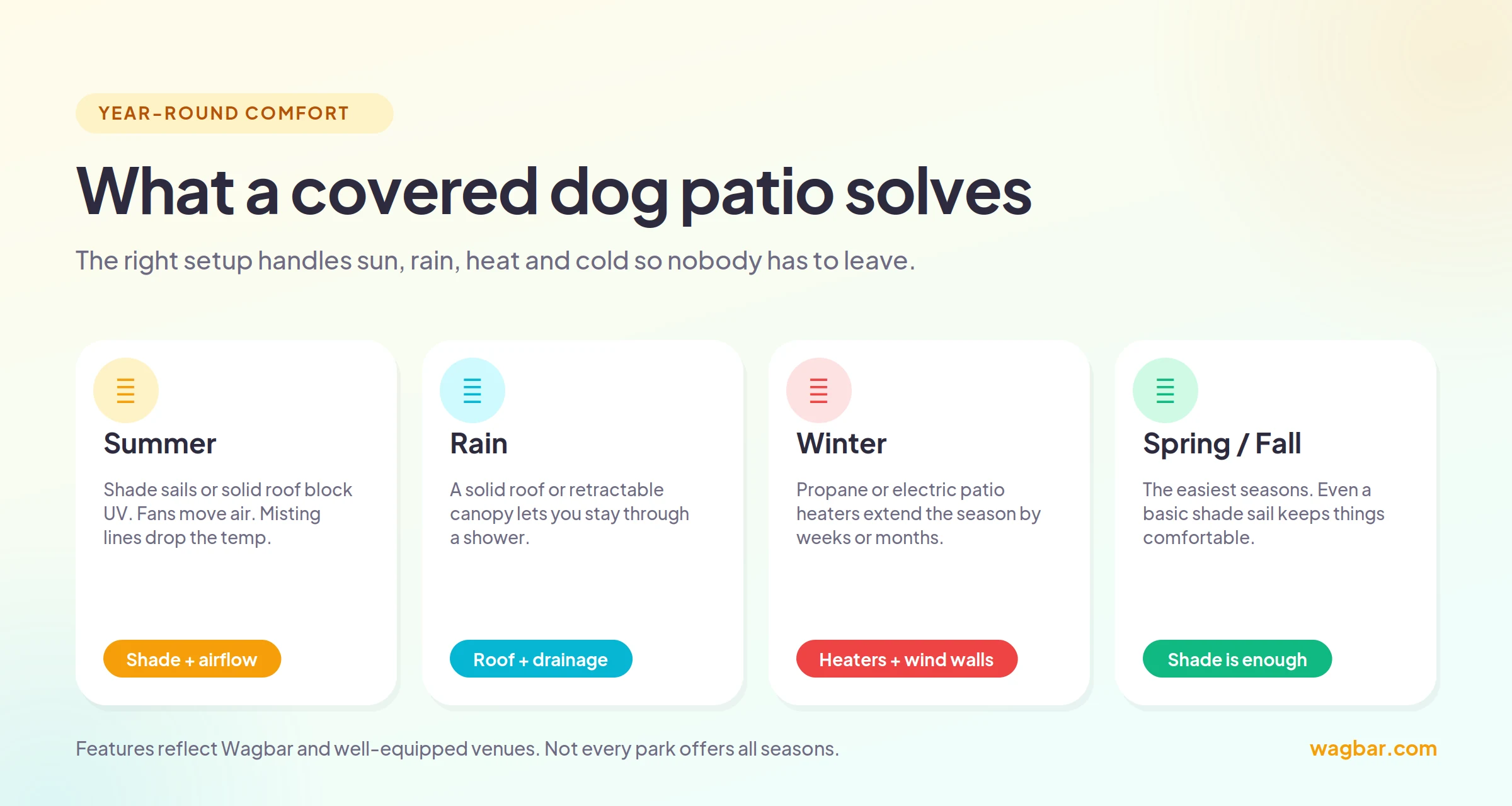
- Shade is the foundation. Dogs overheat fast, and owners without shade leave early.
- Fans and misters handle summer. Ceiling fans drop perceived temp by 8–10°F; misting lines drop it by 15–25°F in dry heat.
- Heaters extend the season. Propane and electric radiant heaters keep covered patios usable well past the first frost.
- The patio keeps humans present. When owners are comfortable, they stay longer and watch their dogs more closely.
Nobody wants to stand in the sun at 95°F holding a leash and squinting at the yard. And nobody wants to go home the minute a cloud opens up. Covered dog patios solve both problems at once: they protect dogs and humans from sun, rain, heat and cold so the visit doesn’t depend on perfect weather. Here’s what goes into a great one, how each component works, and why a dog bar treats the patio as seriously as the play yard.
Why Covered Patios Matter at Dog Parks
An uncovered dog park has one season: nice weather. The moment the sun gets punishing, the rain starts or the temperature drops, visits get shorter or stop entirely. That’s a problem for the dogs (less exercise, less socialization) and for the business or municipality (lower use, lower revenue, harder to justify maintenance budgets).
Covered dog patios fix the calendar. They’re especially important for the humans, because the biggest safety gap at most parks is distracted owners. Give owners shade, a seat and a drink, and they stay, pay attention and catch problems early. That’s the thinking behind every covered section at Wagbar’s locations.
Shade Structures: The Options
Shade is the starting point. The right structure depends on the climate, the budget and how permanent you want the installation to be.
Shade sails
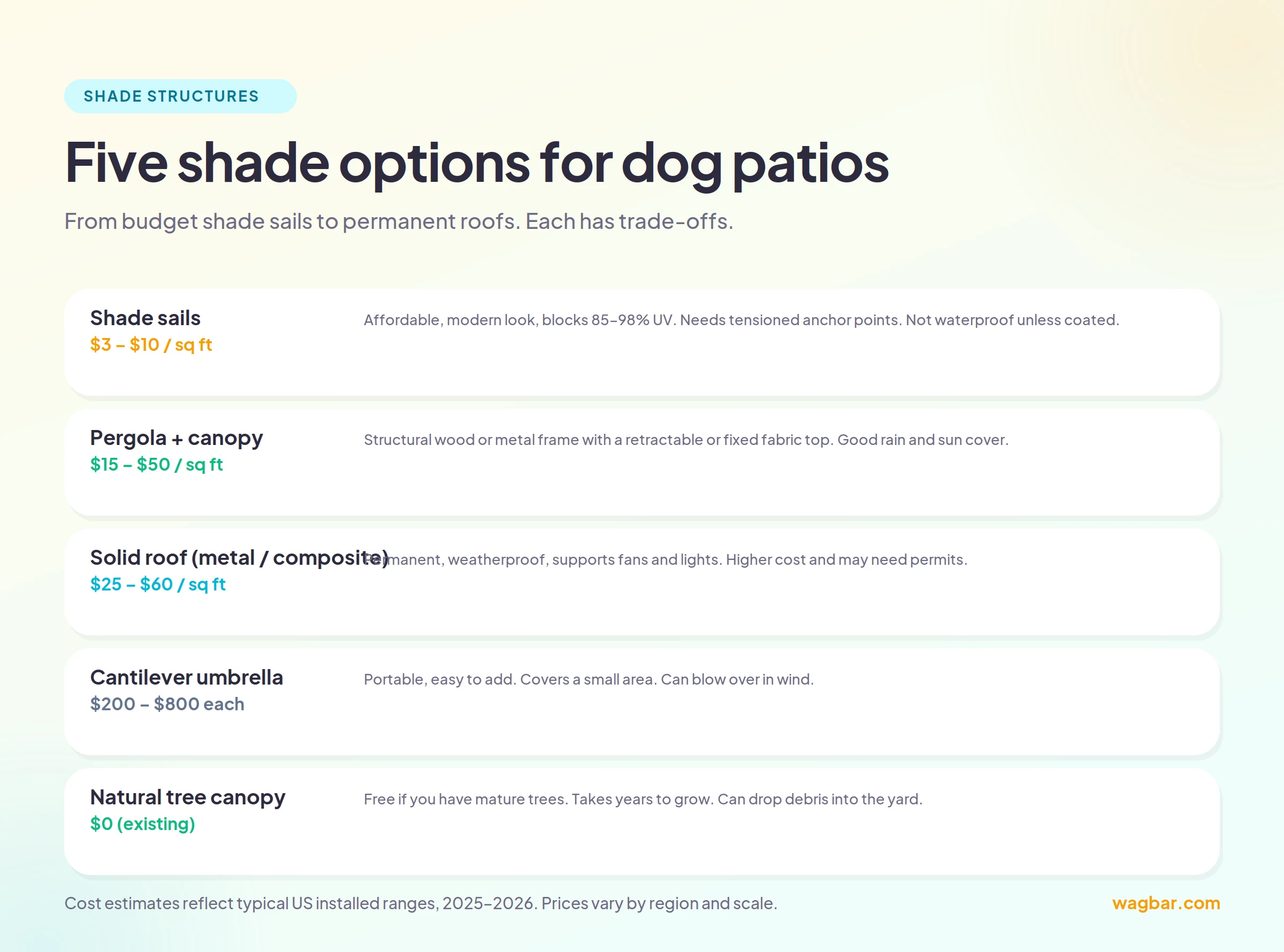
Triangular or rectangular fabric panels stretched between posts. They block 85% to 98% of UV depending on the fabric density, and they give a park a clean, modern look. Standard shade sails are not waterproof, though some coated versions handle light rain. Installed cost runs roughly $3 to $10 per square foot, making them the most affordable shade option for large areas. Wagbar’s original Weaverville yard uses shade sails over sections of the play area.
Pergolas with retractable or fixed canopies
A structural frame (wood or metal) topped with fabric. Retractable canopies let you open the roof on mild days and close it when the sun or rain hits. More expensive than sails ($15 to $50 per square foot installed) but more versatile and rain-ready.
Solid roofs (metal or composite panels)
Permanent, weatherproof, able to support ceiling fans, lights and heater mounts. A solid roof is the gold standard for a covered dog patio because it handles every season. The cost is the highest ($25 to $60 per square foot) and permits are usually required.
Cantilever umbrellas
Large freestanding umbrellas on an offset base. They’re portable, easy to add after construction and cover enough area for a table and a few chairs. They blow over in strong wind and don’t scale well for large patios, but they’re useful as supplemental shade in specific spots.
Natural tree canopy
Free if the trees already exist. Mature hardwoods provide excellent, cool shade and look better than any manufactured structure. The trade-off: they take years to grow, they drop leaves, seeds and branches into the yard, and they can’t be easily relocated.
Fans: Moving Air Where It Matters
Shade lowers direct solar heat, but air temperature stays high underneath a still canopy. Fans fix that by moving air across skin and fur, which accelerates evaporative cooling.
- Industrial ceiling fans (60 to 96 inches) mount to a solid roof or pergola beam. They move thousands of cubic feet of air per minute and drop the perceived temperature by 8 to 10°F. Look for UL-rated damp or wet models designed for outdoor use.
- High-volume, low-speed (HVLS) fans cover even larger areas with a single unit. A 10- to 24-foot HVLS fan can cool 5,000 to 10,000 square feet, making them common at commercial dog facilities and covered arenas.
- Pedestal and wall-mount fans are cheaper and easier to add, but they cover a smaller radius and can be knocked over by large dogs near the base.
Misting Systems: Evaporative Cooling for Hot Days
Misting lines spray a fine fog of water droplets that evaporate in the air and lower the ambient temperature by 15 to 25°F in dry climates. They’re mounted along the edge of a shade structure or pergola beam and run off a standard water line with a pump.
- Best in dry heat. In arid climates (the Southwest, inland California, the Mountain West), misting systems are game-changers. In humid climates (the Southeast, Gulf Coast), they add moisture to air that’s already saturated, which makes the cooling effect smaller and the “damp dog” effect bigger.
- Position matters. Aim nozzles outward or over open areas, not directly above seating or dog resting spots. Fine-mist systems produce less drip than coarse-spray setups.
- Maintenance: flush the lines regularly, replace clogged nozzles and winterize in freeze-prone climates.
Heaters: Extending the Outdoor Season
Covered dog patios don’t have to shut down when the temperature drops. Heaters push the comfortable outdoor season by weeks or months, depending on the climate.
Propane patio heaters
The classic mushroom-top tower. Freestanding, no electrical hookup needed, heats a radius of 10 to 20 feet. They run on a standard propane tank and produce enough radiant heat to keep a seating area comfortable down to the mid-30s°F. Keep them clear of low ceilings, fabric and dog traffic paths, and always use them in ventilated (open-air) settings.
Electric infrared heaters
Wall- or ceiling-mounted panels that radiate heat downward. No open flame, no propane tank to swap, instant on and off. They need a solid mounting surface and an electrical circuit, so they work best under a permanent roof. More expensive up front than propane but cheaper to operate over a full season.
What Wagbar Gets Right About Covered Patios
Every Wagbar location is designed so the bar and main seating area have a clear sightline to the play yard. The covered area is where owners spend most of their visit, and the layout reflects that:
- Shade sails over the yard protect dogs from direct sun during peak hours.
- Covered bar and seating let owners stay comfortable during rain, heat or cold.
- Seating faces the yard, not the parking lot. Owners can watch their dogs without standing at the fence.
- Food and drink service keeps people anchored. When you’re sipping a cold draft instead of standing in the sun, you’re a better dog supervisor.
For the full breakdown of how shade fits alongside fencing, surfaces, water features and staffing. The off-leash dog park features breakdown connects all of those elements into a single design philosophy.
Climate Control: Fans, Heaters and Misting at a Glance

Design Tips for Covered Dog Patios
- Cover at least 30% to 50% of the human seating area. Full coverage is ideal but expensive. Partial coverage with well-placed sails goes a long way.
- Use light-colored fabric and roofing. Darker materials absorb more heat and re-radiate it downward.
- Plan drainage before you build. A solid roof that dumps rain onto the seating area defeats the purpose. Gutters, downspouts and grading matter.
- Wire for fans and lights during construction. Retrofitting electrical to a shade structure costs two to three times more than running it during the build.
- Leave the play area partially uncovered. Dogs need sun exposure in moderation, and many prefer running in open sky. Covered zones are rest stops, not ceilings over the whole yard.

Covered Dog Patio FAQs
Do dogs need shade at a dog park?
Yes. Dogs overheat faster than most people realize, especially brachycephalic (flat-faced) breeds and dark-coated dogs. Shade over at least part of the yard and all resting areas is essential in warm climates.
Are shade sails waterproof?
Standard shade sails are not. They block UV but let rain through. Waterproof or water-resistant versions exist, usually with a coated or laminated fabric, but they cost more and need steeper angles to shed water properly.
How much does a covered patio add to a dog park build?
It depends on the structure. Shade sails over 500 square feet might add $1,500 to $5,000. A solid-roof patio with fans and heaters over the same area could run $15,000 to $30,000 or more. The ROI is in longer visits and year-round use.
Can I use a patio heater near dogs?
Yes, with precautions. Keep heaters out of dog traffic paths, secure freestanding units so they can’t tip, and position them where dogs rest or owners sit, not in the middle of a play zone.
What’s better for a dog patio, fans or misting?
Fans work everywhere. Misting works best in dry heat and adds moisture that humid climates don’t need. Many parks in hot regions use both: fans for air movement, misting for an extra temperature drop on the worst days.
Build a Patio People and Dogs Actually Use
A great covered dog patio keeps visitors comfortable from April to November, or all year in mild climates. If you’re planning a venue where the human side matters as much as the yard, Wagbar has been designing that balance since 2019. See what goes into a Wagbar franchise.

Wagbar does not represent what a franchise owner will earn. Verified performance data is available only in Item 19 of the FDD, provided to qualified candidates during formal disclosure. Published cost figures are FTC-required regulatory estimates and are not profitability guarantees.
Sit Down. Stay Awhile.
The right covered patio means your dog gets a longer play session and you get a better afternoon. No standing in the sun, no running to the car in the rain, no cutting the visit short because winter showed up. Experience what a thoughtfully covered yard feels like at the nearest Wagbar.
Bottom TLDR: Covered dog patios turn a weather-dependent park into a year-round spot. Shade sails and solid roofs handle sun and rain. Industrial fans and misting lines cool the air in summer. Propane and electric heaters carry the season through fall and winter. The covered patio is also where owners sit, eat and drink, so it directly affects how long they stay and how well they watch their dogs. Done right, it’s the feature that ties the whole venue together.